








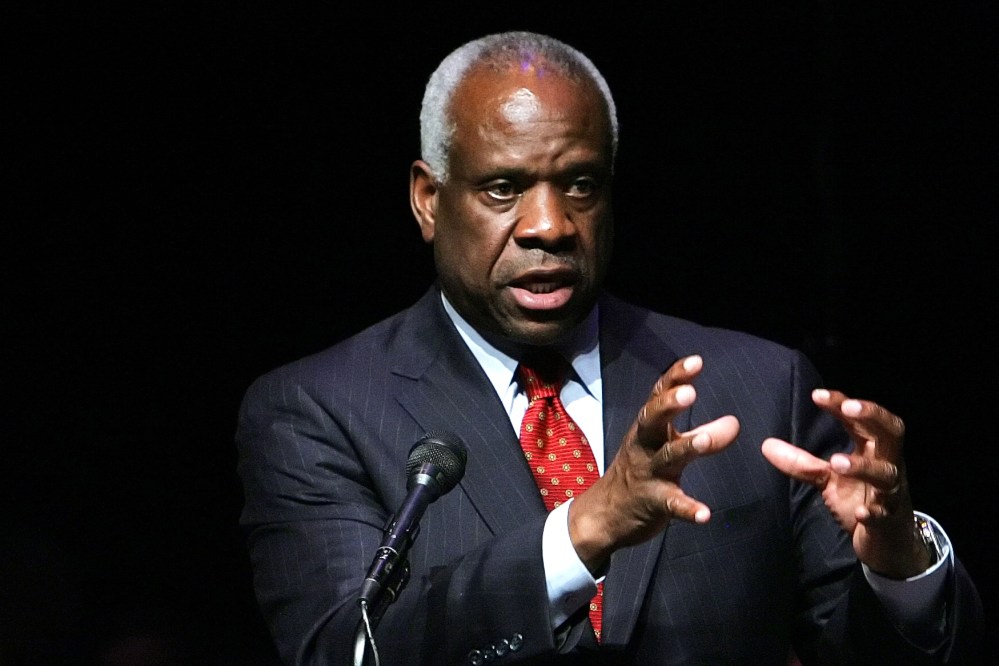
Ten years ago Monday, Supreme Court Justice Clarence Thomas asked a question from the bench.
He hasn’t done it since.
The streak is a record — no other justice in modern history has gone more than a term without asking a question during oral arguments. It’s also a source of curiosity and angst in the legal community.
It will also likely continue for some time. Thomas has shown no sign of changing his ways, issuing his opinions in written form and making little more than small talk with other justices when the court is hearing arguments — and, once, three years ago, cracking an apparent joke.
The last time Thomas asked a question was Feb. 22, 2006, during arguments on a death penalty case.
No one knows quite why Thomas chooses to abstain as he does. Some have pointed to his prior remarks about growing up self-conscious about his rural Georgia accent. But the more likely explanation is that Thomas believes he learns more if he keeps quiet.
“I just think that it’s more in my nature to listen rather than to ask a bunch of questions,” he told high school students in 2000. “And they get asked anyway.”
Thomas has also said he is uncomfortable competing with the court’s louder voices — which, until his death this month, included Justice Antonin Scalia.
Taking part in oral arguments is just one piece of the high court’s deliberative process. Lawyers on both sides make most of their arguments in briefs submitted beforehand. Justices use oral arguments to analyze those positions and to debate indirectly with their colleagues.
Preferring silence is not unprecedented, scholars say: Justice William Brennan, for example, was famously reticent during his late career.
Stephen Wasby, political science professor emeritus at the University of Albany, said Thomas’ approach hurts the process.
“He’s not giving the lawyers an opportunity to address his concerns. And I think he should,” Wasby said. “The others do. He should. That’s a legitimate concern.” But scholars point out that the court’s increased volubility is more a recent development. Historically, they say, the court didn’t ask many questions during oral arguments. That makes Thomas somewhat of a throwback. He’s better known for the power of his written opinions, which reflect his conservative beliefs and originalist interpretation of the Constitution and which scholars say are proving to have lasting impact on American law. His ideas about individual gun rights under the Second Amendment, for instance, have been influential. Ralph Rossum, a law professor at Claremont University who wrote a book about Thomas’ impact on constitutional law, said it wouldn’t necessarily make Thomas more effective if he suddenly started to speak up. “Obviously, Thomas knows he doesn’t ask questions and there’s a lot of criticism that he doesn’t,” Rossum said. “But he’s confident enough in his own skin not to care. He’s going to do it his way.”
Jon Schuppe Recommended


