








As most of the 2016 polls predicted, insurgent candidates Sen. Bernie Sanders and Donald Trump emerged triumphant in their respective primaries in New Hampshire on Tuesday, but their first place finishes were among the only presidential campaign developments that weren’t surprising.
By any standard, the results in New Hampshire have shaken up the 2016 race and raised serious questions about the direction in which both major parties are going. And the burning question remains: If Sanders and Trump emerge as their party’s nominees, will former New York City mayor Michael Bloomberg make good on the buzz that he will mount a third-party challenge for the White House?
As the race pivots to Nevada for the Democrats and South Carolina for the Republicans — where the demographics represent a much more diverse swath of the the American electorate than seen in Iowa or New Hampshire — here are five takeaways political watchers are focusing on today:
Rubio’s fifth place followup
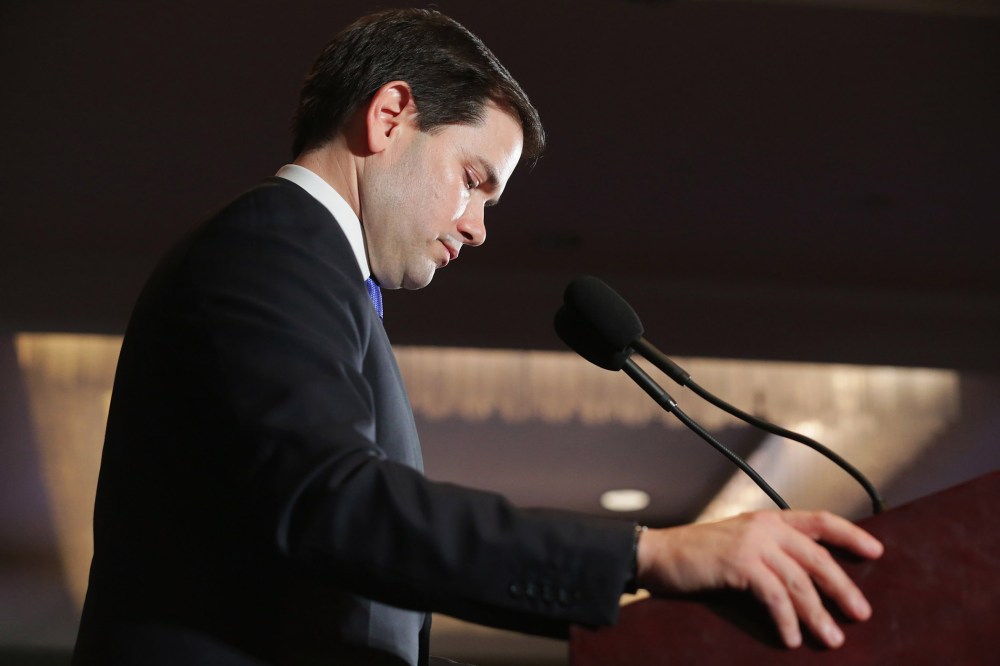
After his surprisingly strong third place finish in Iowa, Florida Sen. Marco Rubio became the focal point for a lot of good press but also attacks from his rivals. At least as far as New Hampshire voters were concerned, Rubio did not hold up well under pressure. Despite polls suggesting that Rubio was poised to finish a strong second in the Granite State, an infamously poor debate performance on Saturday and mocking “robot Rubio” protesters appear to have seriously undercut his campaign narrative. Rubio finished fifth in New Hampshire, a result so disappointing that even in the candidate himself acknowledged that his candidacy had stumbled during his concession speech. “I did not do well on Saturday night … That will never happen again,” he vowed.
RELATED: New Hampshire primary results plunge GOP race into chaos
Kasich’s second place finish
Although it may be little more than a footnote in this election cycle, the perpetually cellar-dwelling (poll-wise) Ohio governor’s unexpected second place finish in New Hampshire was a tribute to old fashioned on-the-ground retail campaigning. Kasich was ubiquitous in New Hampshire for a month, trying make a connection with the state’s more mainstream Republican voters. His efforts paid off and he was able to distance himself from the other so-called establishment candidates in the race — Jeb Bush, Marco Rubio and Chris Christie — who all finished behind him. Kasich has a tough uphill battle ahead in South Carolina, where he is polling in the low single digits, but his New Hampshire performance was just the jump-start his campaign needed.
Will Christie call it quits?
The New Jersey governor’s strong debate performance on Saturday, where he was credited with eviscerating the talking points of Rubio, didn’t help give his candidacy a boost on Tuesday. He finished with less than 10 percent of the vote in what was expected to be one of his strongest states. After Tuesday’s results. he planned to return to the Garden State to reassess his campaign and “take a deep breath.” The lack of upcoming appearances scheduled in South Carolina suggests that his 2016 candidacy is coming to a close. If so, it will be a stunning blow the national political profile of a governor who was once a party favorite. Many have argued that Christie’s candidacy came four years too late, and his departure would dwindle the representation of current or former governors in the race to just three (Kasich, Bush and, yes, Jim Gilmore).
How big Sanders beat out Clinton with women and youth The Vermont senator won big with younger voters — winning voters under 29 by a 79-to-20 margin — and he won 75 percent of all voters under 45. This was unexpected, even Clinton herself has conceded she has a lot of ground to make up with the youth vote. What may be more alarming for Clinton and her supporters is that she lost to Sanders in New Hampshire among women by a wide margin. Sanders won women 55 to 44 percent, despite a direct appeal to female voters from Clinton and prominent surrogates like Gloria Steinem and Madeleine Albright, who highlighted the historical breakthrough her election as the first woman president would be. The only group Clinton wound up winning over were voters aged 65 or older. RELATED: For Clinton, more than a problem of geography Muslim ban has a lot of fans According to NBC News’ exit polls, more than 60 percent of GOP primary voters in New Hampshire support Trump’s controversial call for a ban on Muslims entering the U.S. until we can “figure out” what is going on with the terrorist organization ISIS. Although Trump has neglected to explain how he would enforce this proposal (of if he even legally can impose a religious test on emigration), it has proven to be wildly popular with his supporters, although it has been condemned both in the U.S. and abroad as racist, xenophobic and anti-American. Although there was some pushback from Trump’s GOP rivals when he first promoted the concept last December, their resistance has dampened as the real estate mogul’s standing has remained steady at the top of the polls.
Adam Howard Recommended


