








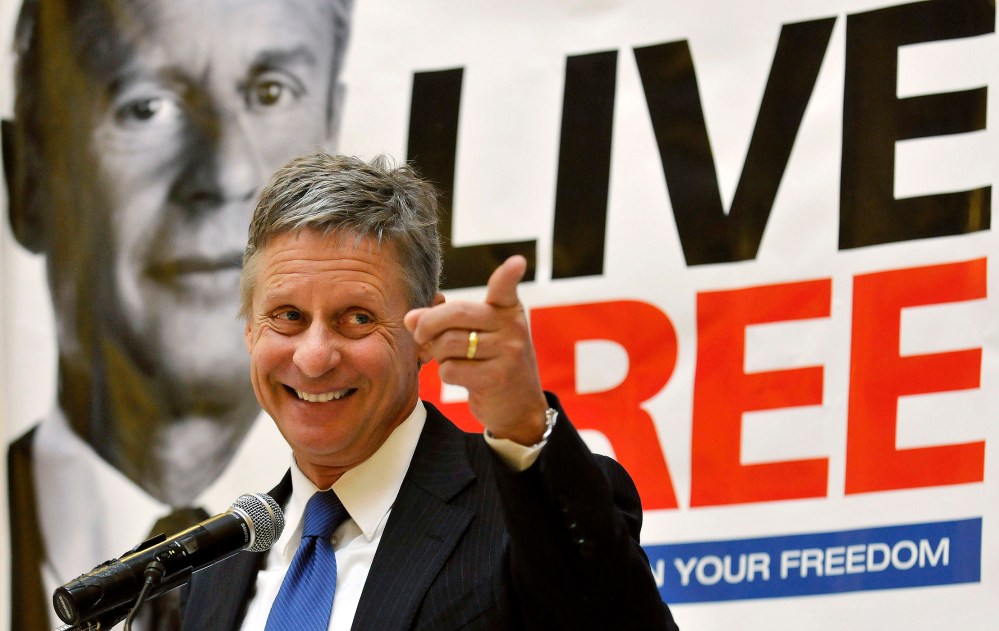
Libertarian presidential candidate Gary Johnson has been down this road before.
After all, as a member of the GOP he served for two terms as New Mexico’s governor through much of the 1990s and early 2000s. He even made an ultimately unsuccessful bid in 2012 to become the Republican Party’s presidential nominee.
But his sensibilities leaned Libertarian and he ultimately ran in that election cycle as the party’s presidential nominee. His hope: win 5 percent of the vote with an eye toward boosting the party’s national profile.

While he fell far short of that goal — some polls had him netting roughly 1 percent of the vote — he’s sized up the competition on the Republican and Democratic sides of the field and figures he has another shot this time around.
“I’m not gonna’ have to devote any resources at all to either side,” he told NBC News.
Maybe not. But running as a third party candidate in the United States isn’t easy.
Candidates have to work to get on the ballot in every state and they aren’t included in the debates if they don’t poll high enough. The Libertarian Party is working with the Green Party to sue the Commission of Presidential Debates to change their rules.
Currently, candidates need to poll above 15 percent nationally to be included in the debates.
“Outside of having that happen, no chance of getting elected,” Johnson said.
Still, the latest NBC News/SurveyMonkey Weekly Election Tracking poll found that 19 percent of voters would choose a third party candidate if given a choice between Democratic presidential front-runner Hillary Clinton and Republican presidential candidate Sen. Ted Cruz. And 16 percent would vote for a third party candidate if given a choice between Clinton and Republican presidential front-runner Donald Trump.
Third party candidacies have become a part of the conversation surrounding the 2016 election cycle as a group of conservative leaders weigh a third party alternative if Trump becomes the Republican presidential nominee. Trump has vowed to run as an independent candidate if he thinks the Republican Party has treated him unfairly in allocating delegates.
According to Ballot Access News editor Richard Winger, a Libertarian who once ran for Secretary of State for California, it’s very difficult for third party candidates to be successful due to the effort it takes to get on the ballot and voters’ preconceptions that third party candidates just can’t win.
But he thinks this election could be a unique case due to the polarizing presidential players.

“I honestly can’t think of another presidential election since 1964 where there would be so many unhappy voters in either major party,” he told NBC News.
Third party candidates have had a pivotal role in the election in the past.
Ross Perot won 18.91 percent of the vote in 1992 when he as an independent, and Ralph Nader, as a Green Party candidate, won 2.74 percent of the vote in 2000 in an election so close that some attribute Bush’s win to him.
“The conditions are ripe for one or more third-party or independent candidates to flourish. The GOP could be headed for a crackup in Cleveland, whoever is nominated,” said Larry Sabato, director of the Center for Politics at the University of Virginia.
“While dissension on the Democratic side is far less intense, it’s quite possible that up to a quarter of Bernie Sanders’ backers won’t support Hillary Clinton come fall.” The problem, Sabato said, is that third parties often struggle to in getting candidates that are seen as more broadly acceptable. There are also often internal organizational issues and problems raising the large sums needed to mount successful bids. Ballot deadlines in states are another barrier. Johnson plans on presenting himself as a fiscally conservative, pro-immigrant, socially liberal alternative to Trump. He said he plans on contrasting himself to Clinton by focusing on “crony capitalism,” military intervention, and legalizing marijuana. Green Party presidential candidate Jill Stein also feels the timing is right for a third party candidate. RELATED: Meet Jill Stein, the Green Party candidate for president Stein also pointed out that her 2012 campaign focused on many of the ideas that are at the center of 2016, such as free public education and universal healthcare, and that America may be more ready today to pay attention to her platform. She netted .36 percent of the vote in that year’s election. Green Party presidential candidate Jill Stein announces the formation of an exploratory committee to seek the Green Party’s presidential nomination again in 2016. during an event at the National Press Club Feb. 6, 2015 in Washington. Olivier Douliery / Sipa USA via AP Stein says that while she expects Clinton to be the Democratic nominee, she hopes to take advantage of Sanders’s momentum. “We hope that Bernie Sanders and his campaign will join us in continuing to fight for the true American revolution which so many of Bernie’s supporters truly put their hope and faith in,” Stein said. “And we think it would be a terrible mistake to throw in the towel, we’ve come much too far.” “This is kind of a perfect storm for independent principled politics,” she said. This article originally appeared on NBCNews.com.
Rachel Witkin
Halimah Abdullah Recommended


