








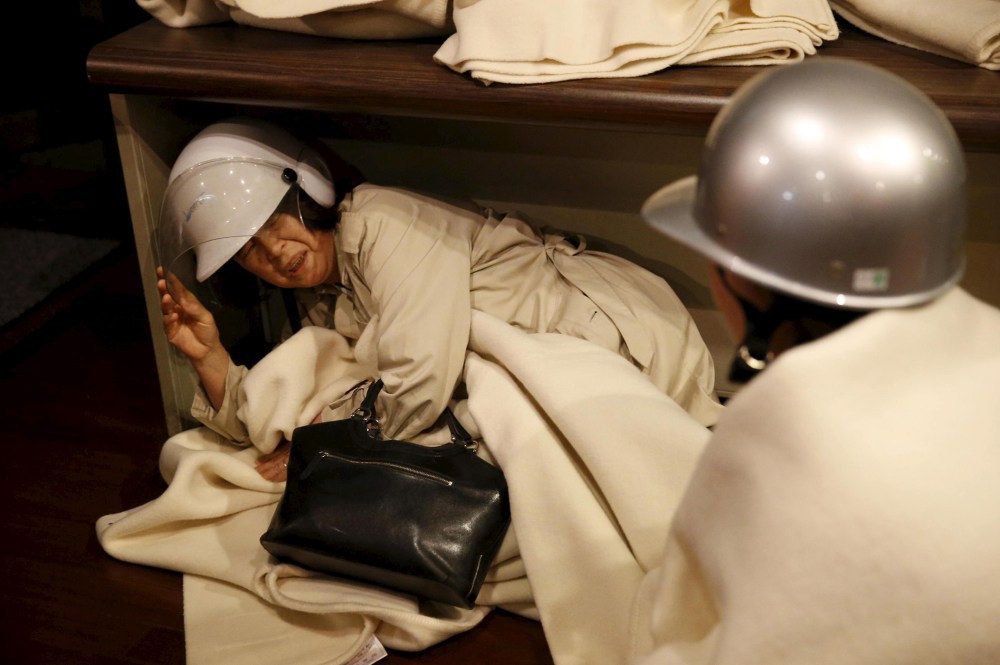
A flurry of aftershocks hit southwestern Japan on Saturday as rescuers scrambled to reach trapped survivors of two big quakes that killed at least 35 people. About 190 suffered serious injuries, according to the government.
Evacuation orders were issued for areas vulnerable to landslides amid powerful thunderstorms in the area, the government’s main spokesman Yoshihide Suga said in an evening press briefing.
“There are still sporadic aftershocks from this morning’s earthquake, and so there is still a need to be vigilant,” Suga warned.
Saturday’s massive quake killed 26 people on top of the nine who died in a temblor two days earlier, he said.

The United States Geological Survey reported the magnitude-7.0 earthquake struck at 1:25 a.m. Saturday in the city of Kumamoto on the island of Kyushu, at a depth of 25 miles.
Thursday night, a magnitude-6.5 quake shook the same area. There were more than 130 aftershocks.
On Saturday afternoon, 2,000 soldiers were active in the rescue and relief efforts following the two quakes, but Suga said that number will increase to 15,000.
There have been no irregularities reported at any of the nuclear power plants in the region, according to Suga.
Saturday’s earthquake briefly triggered a tsunami advisory that the Japan Meteorological Agency later lifted. At least five aftershocks rattled the region, the strongest of which was a magnitude-5.8, the USGS said.
Since Saturday’s quake was bigger, Thursday’s was technically a foreshock, a Meteorological Agency official, Gen Aoki, told a news conference.
The greatest seismic activity was from Kumamoto Prefecture to Oita Prefecture, Gen Aoki, director of Japan Meteorological Agency earthquake and monitoring division, told reporters Saturday.
“In those areas where the tremors were strong, there is a higher risk of homes collapsing and landslides so we urge everyone to pay particular attention to tremors and rain,” Aoki said.
The Fire and Disaster Management Agency said 66 people were trapped inside a nursing home in Mashiki, the hardest-hit town, and rescue efforts were underway, the AP reported. No other details were immediately available. “The shaking was so violent I couldn’t stand still,” said Hironobu Kosaki, a Kumamoto police official, after Thursday night’s quake. There was a glimmer of good news after Friday’s devastation: A baby who was buried under rubble for hours was rescued unscathed. U.S. State Department spokesman John Kirby said the U.S. has been in touch with authorities in Japan and isn’t aware of any Americans who have been affected by the quakes. “Our thoughts and prayers go out to everyone affected by the earthquake, this second one as well, and we are monitoring it as best we can,” he said at the State Department briefing Friday. The Associated Press and Elizabeth Chuck also contributed to this report. This article originally appeared on NBCNews.com.
Jillian Sederholm
Arata Yamamoto Recommended


