








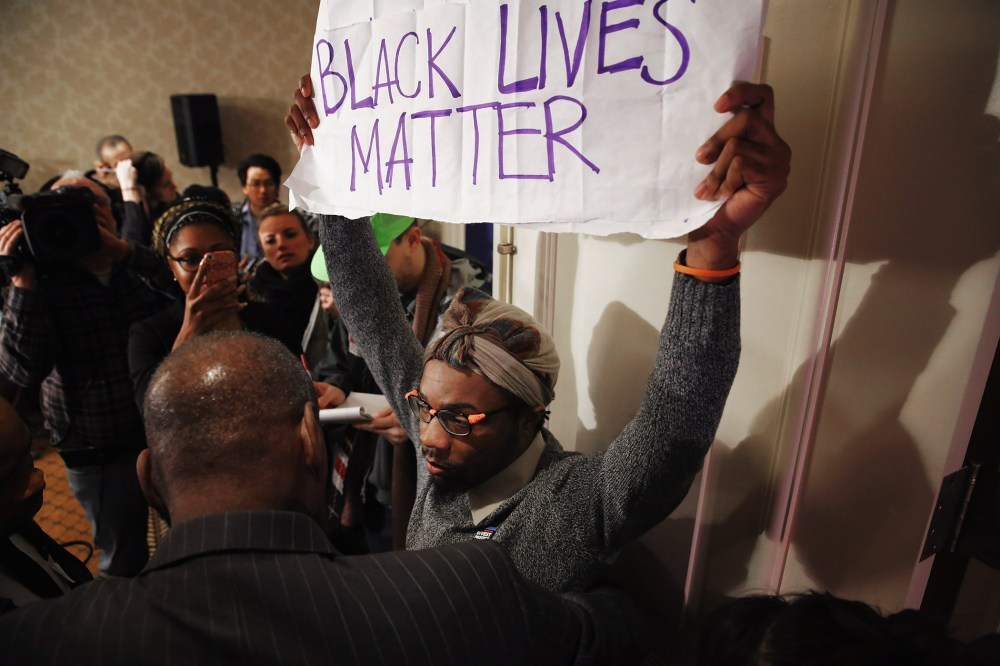
I woke last Friday to pundits talking about whether former President Bill Clinton’s nearly 15 minute response to Black Lives Matter (BLM) protesters at his event in Philadelphia was 2016’s “Sister Souljah moment.” You will recall that in 1992, the calling out of the former rap artist for her remarks about racist LA cops by then-nominee Governor Bill Clinton was seen as a signal to white independent voters that he was a different kind of Democrat. This new Democrat wasn’t going to kowtow to elements of the black community for political convenience — a necessary, if not unfortunate, bow to the so-called Reagan Democrats of the time.
In this case, I think the pundits are on to something, but they are missing the larger current context of the moment. It was a Sister Souljah moment, but not for Bill Clinton. It was a Sister Souljah moment in reverse. BLM, an intentionally decentralized cohort of young, vocal black leaders, announced that they are indeed a different type of movement, one that doesn’t kowtow to the establishment or abide by the conventional tactics defined in the post-Civil Rights era.
Putting leaders on the spot as the issues of the prison industrial complex and police brutality gain prominence in this year’s political contest is a testimony to BLM’s success regardless of whether or not you agree with their tactics. I don’t agree with the tactics of the Tea Party, but no student of politics can deny their impact on the country’s political discourse. Meanwhile, the movement’s influence continues to grow. BLM has in very short period of time evolved into a valid representational voice of the African-American community, particularly among millennials.

While there is, in general, a considerable amount of displeasure with the African-American community’s current leadership, our polling shows a community closely split: a slight 39 percent plurality of African-Americans agree that movements like BLM speak for and better represent their community, while 34 percent agree that the more traditional, iconic Civil Rights organizations, like the NAACP, represent the community. Unsurprisingly, this shift is being driven by millennials, with 47 percent of that age group identifying with BLM. BLM is now as legitimate a movement in the African-American community as the Tea Party is in the white electorate, if not more so.
As public discourse in this presidential election year continues to unfold, at least in discussions involving the Democratic side of the aisle, the primary focus will be garnering a majority stake in the black electorate. Unfortunately for those wishing for the return of paradigms lost, there is no longer a means of escaping the necessity of a black agenda. Not even a former president, even one as historically popular and beloved as Bill Clinton, is immune from the strident demands of this new body.
By now, it should be clear that the failure to address issues of importance to the black community will no longer be tolerated by a growing group of younger leaders who are now taking up the mantle of progress for the community, just as their forefathers before them did with just as much skepticism at the time. While campaigns set loose an army of surrogates charged with engaging and mobilizing voters, each would be wise to take note of the sea change underway in the black community. The rise of BLM will influence the political discourse of the community as the first black president exits the stage. Suddenly, the once-dependable cadre of Civil Rights-era leaders, icons and institutions that has for decades been acting as the community’s chief negotiators with our political leaders, has been rendered an uncertainty that must now compete with the rising tide of leaders who are just coming into their own with a new set of demands and different tactics. And frankly, a free market of competing ideas is ultimately good for the African-American community. Phrases like Black Lives Matter connote more than a protest movement. For me, BLM is more like shorthand for a transformation in the black community’s desires and demands, which will now include a black community-specific agenda that can be used both to gauge a candidate’s commitment and to provide the community with a basis of measurement it can use to hold elected officials accountable. The effectiveness of this growing new movement to mobilize its ranks given its emphasis on decentralization is a fair question, but BLM is increasingly giving voice to an anxious group of young black Americans, and the political powers that be would be wise to take the kids seriously. Cornell Belcher is president of Brilliant Corners Research & Strategies, based in Washington. He is a former pollster for the Democratic National Committee and for President Obama’s campaign team.
Cornell Belcher Recommended


