








Congress ended the first government shutdown in 17 years and narrowly avoided a catastrophic default by going small — striking a deal that keeps the government funded through January 15th.
But as Congress returns to Washington this week to dive back into formal talks on the budget, don’t expect them to go big.
“There is not going to be a grand bargain,” Majority Leader Harry Reid said in an interview with Nevada’s KNPR radio station. “You keep talking about Medicare and Social Security. Get something else in your brain,” he said. “Stop talking about that. That is not going to happen this time.”
Republicans and Democrats are dug in as much as ever over their top priorities, making a big deal as elusive as it was in President Obama’s first term.
Case in point: In just six weeks, a fresh round of across-the-board cuts will slash domestic and military spending — and there’s no clear path to soften them, even though neither side intended the cuts to take effect when they were dreamed up in a debt ceiling deal back in 2011.
Most Democrats want to offset the cuts with new revenues. Republicans say no way. That leaves little room to negotiate any kind of larger deal.
“We’ve got automatic spending cuts coming. There are smarter ways of cutting spending — whether you’re a Republican or a Democrat,” Paul Ryan said in an interview with The Washington Post.
Ryan is in the drivers seat for Republicans on negotations. But his offers have already turned off Reid, who isn’t interested in Ryan’s pitch for reimagining Medicare as a voucher program.
“If we focus on some big, grand bargain then we’re going to focus on our differences, and both sides are going to require that the other side compromises some core principle and then we’ll get nothing done, Ryan said in an interview last week. “So we aren’t focusing on a grand bargain because I don’t think in this divided government you’ll get one.”
Meanwhile, many Senate Democrats want to see new revenues as any potential deal — a nonstarter with House Republicans.
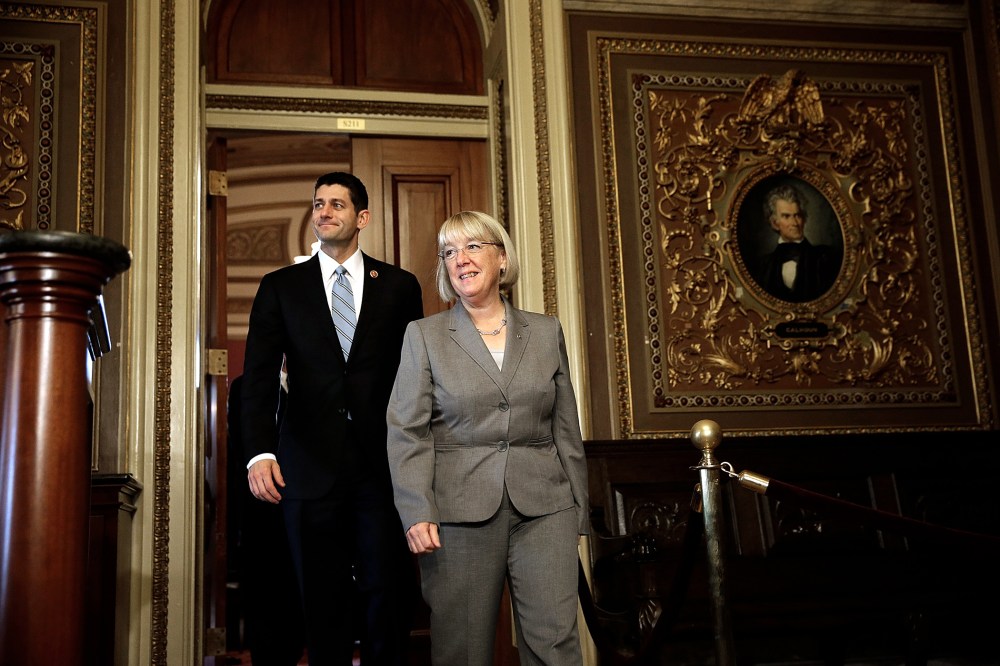
Ryan and Republicans originally passed a budget that would revamp entitlement programs without raising taxes, while Democrats are pushing for a budget that leaves entitlement programs alone, but insists on closing certain tax loopholes in order to generate additional revenue. The budget conference committee will hold its first public meeting on Wednesday, Oct. 30. Future meetings could be held behind closed doors. On the Democratic side, Sen. Patty Murray of Washington will take the lead at the negotiating table. She has been in step with Reid. While she’s signaled optimism over reaching a deal, she’s not convinced her counterpart is willing to come to the table in good faith. In a radio interview with the University of Washington’s NPR station, she said the jury is out on whether Ryan will be open to making a deal with Democrats. “There is, in my mind, a curiosity about whether Paul Ryan can come to the table and be a negotiator, or whether Paul Ryan is going to be the guy who can go to his caucus and say, ‘I can be as conservative as anybody else here,’” she said. “He is going to have to decide.”
Traci Lee Recommended


