








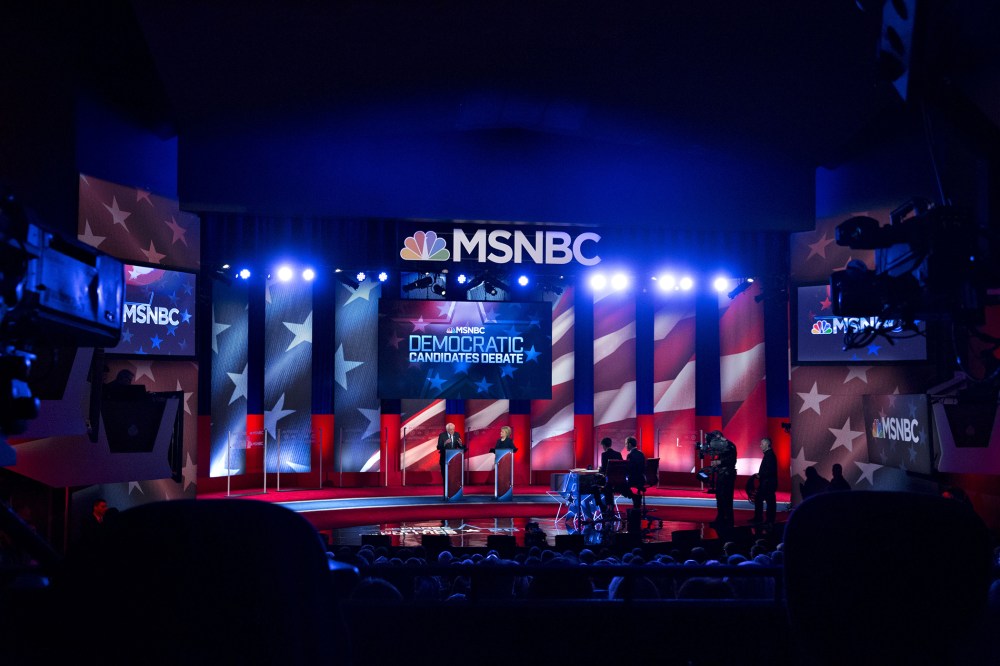
DURHAM, New Hampshire – Thursday’s Democratic presidential debate on MSNBC offered the clearest, rawest, and most specific examination of two fundamentally different philosophies about the character and future of the Democratic Party voters have seen yet.
Not only was it the first one-on-one debate between front-runner Hillary Clinton and insurgent Bernie Sanders, but it came at time when the candidates are finally ready to hash out the core questions of what it means to be a Democrat.
RELATED: Catch up on all the highlights from the Democratic debate
Seven years of control of the White House has built up fundamental divisions within about who the party should represent and what it should do.
Clinton represents one view, calling for continuity and pragmatism, while Sanders represents the polar opposite, with his outspoken calls for “revolution.”
Guided by moderators Chuck Todd and Rachel Maddow, the candidates articulated the most cogent representations of both arguments so far this campaign.
What’s a fair campaign?
Clinton’s aides and allies have complained about Sanders being unfair to their candidate. But Clinton herself walked into the debate hall Thursday night wanting to get something off her chest.
“Sen. Sanders has said he wants to run a positive campaign. I’ve tried to keep my disagreements over issues, as it should be. But time and time again, by innuendo, by insinuation, there is this attack that he is putting forth, which really comes down to — you know, anybody who ever took donations or speaking fees from any interest group has to be bought,” she said.
“And I just absolutely reject that, Senator. And I really don’t think these kinds of attacks by insinuation are worthy of you. And enough is enough. If you’ve got something to say, say it directly,” she said.
It was all windup for her final punch: “So I think it’s time to end the very artful smear that you and your campaign have been carrying out,” she added.
It was one of strongest moments of the night and her sharpest rebuke of Sanders’ message thus far.
Clinton was essentially demanding Sanders a pick a side: Be the above-the-fray politician you claim to be or get down in the mud of politics with me. If you claim to be the guy who always says what he means, then come out and say it, she seemed to taunt. “I know this game,” Clinton said.
Sanders, not surprisingly, suggested he has no interest in backing off his not-so-subtle contrasts. “One of the things we should do is not only talk the talk, but walk the walk,” he said. “I am very proud to be the only candidate up here who does not have a super PAC, who’s not raising huge sums of money from Wall Street and special interests.”
Who is a Democrat?
Clinton has touted her years of work for the Democratic Party and promised fellow Democrats she would unite the party and build its infrastructure from top to bottom to get more Democrats elected to office.
Sanders was not a Democrat until he decided to run for president last year, and Maddow challenged him his connection to the party.
“It is true, it’s not to be denied, I am the longest-serving independent in the history of the United States Congress. People of Vermont sent me to Washington as an independent. That is true,” Sanders replied said. “I am running for president as a Democrat. And if elected, not only do I hope to bring forth a major change in national priorities, but let me be frank, I do want to see major changes in the Democratic Party.”
Anti-establishmentarianism Clinton challenged Sanders’ attacks on her by saying that his criticism would extend to all Democrats. “It’s really caused me to wonder who’s left in the progressive wing of the Democratic Party. Under his definition, President Obama is not progressive because he took donations from Wall Street; Vice President Biden is not progressive because he supported Keystone; Sen. Shaheen is not progressive because she supports the trade pact,” Clinton said. “Even the late, great Sen. Paul Wellstone would not fit this definition because he voted for DOMA” (the Defense of Marriage Act). But, Sanders responded, that is exactly the entire point of his campaign. He’s not just taking on Clinton, he’s challenging the entire political establishment of which she is a key part. “Yes, Sec. Clinton does represent the establishment. I represent, I hope, ordinary Americans, and by the way, who are not all that enamored with the establishment,” Sanders said. Sanders grudgingly acknowledged that Obama is a “progressive,” but it came after a long windup, full of caveats and exceptions — suggesting his hand may have been forced by the president’s 90 percent approval rating among Democratic primary voters. Sanders has defined the policy terrain As with the last Democratic debate, hosted by NBC News in Charleston, South Carolina, this debate — and the Democratic primary as a whole — has been largely fought on issues that Sanders brought to the fore. Remarkably, gun control, Clinton’s tip of the spear against Sanders, was almost entirely absent from the two hour debate. The issue has been one of Clinton’s most effective weapons against Sanders, combatting both his progressivism and his purported imperviousness to special interests. But Sanders’ issues so dominated the debate that she never had a chance to use it. The debate did feature a lengthy exchange on foreign policy, which clearly favors the former secretary of state, and Sanders faced tough questions from the moderators. “Nobody knows who your foreign policy advisers are. You haven’t given a major foreign policy speech. And it doesn’t sound like all the time that foreign policy is a priority,” said Todd, accurately summarizing the matter. But almost all of the passion and intensity of the night was reserved for issues like Wall Street and campaign finance reform. On that terrain, Clinton starts from behind, as Vice President Joe Biden has said, and seems to be constantly playing catch-up.
Alex Seitz-Wald Recommended


