








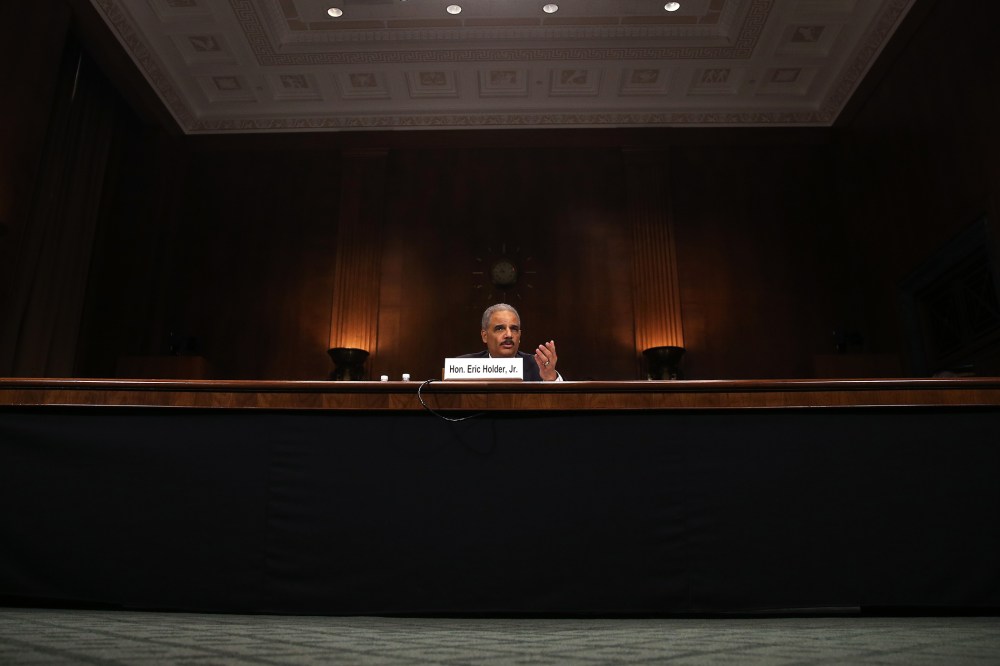
As Attorney General Eric Holder prepares to depart government service after six years, supporters point to his defense of marriage equality and the Voting Rights Act as issues that will define his legacy. But as others have pointed out since the attorney general announced Thursday that he would resign, Holder’s work on civil liberties has been far less inspiring. Holder will leave his successor with the task of explaining and justifying many controversial policies. Here are four of the most significant civil liberties failures of Eric Holder’s time as America’s top attorney.
Prosecuting leakers and whistleblowers: It’s not just Edward Snowden and Chelsea Manning — the Obama administration has prosecuted more people under the 1917 Espionage Act than all other previous administrations combined. Recent attempts at reform have still left would-be whistleblowers afraid of retaliation, and some agencies have revised official policies to restrict conversations with journalists about even the most basic things.
Whoever takes the reins from Holder also will have to decide what to do about New York Times reporter James Risen, who the Justice Department is still trying to compel to testify about a confidential source. Holder said in early September that Risen would not face jail time, but the DOJ has not indicated that it plans to change course about forcing him to testify.
Spying on journalists: Holder’s DOJ hasn’t just tried to force journalists to hand over information about sources. In May 2013, the Associated Press revealed that the Justice Department had spied on some of its reporters by collecting phone records, ostensibly because it was needed for an investigation into leaks. And in addition to the AP spying, the DOJ also took the phone records of a Fox News reporter. Only weeks later, former NSA contractor Edward Snowden would reveal much more widespread government spying, some of which is conducted by agencies like the FBI, which function under the authority of the Justice Department.
Guantanamo Bay is still open, and dozens of prisoners remain untried: Holder did try to get the Justice Department involved in Guantanamo cases, but congressional fear-mongering and opposition sank his plan to bring some detainees to the United States for trial back in 2010. The U.S. has successfully prosecuted nearly 500 people in federal courts since 9/11, but only six military commission convictions have been upheld. Meanwhile, military commissions for those accused of plotting 9/11 and the bombing of the USS Cole continue to drag on. Holder’s hands been effectively tied against prosecution in American courts, but that is not the only avenue for reducing Guantanamo’s population. Last year, the DOJ released a document with recommendations from an Obama administration task force for the men still held at the island prison. The White House has released 17 detainees in the past year, and another 79 are approved to leave Guantanamo Bay and await transfer. Dodging requests for transparency about targeted killings: Holder has staunchly defended the administration’s claim that the U.S. has the legal right to kill American citizens overseas, as in the killing of Anwar al-Awlaki. A confidential memo released in February 2013 showed the DOJ says it is justifiable if the U.S. believes the citizen is a member of al Qaida or an associated force, but that there need not be an actual threat to national security to strike them with a drone or missile. More detailed standards for proving that a person is a threat have not been revealed, and Holder has not clarified if those standards exist. Beyond the fact that the criteria for killing an American citizen without any legal due process remains extremely hazy, four Americans, including al-Awlaki’s innocent teenage son Abdulrahman, have been killed by targeted strikes during Holder’s tenure.
Meredith Clark
Meredith Clark is a freelance writer and editor. She was previously a senior news producer for "Patriot Act with Hasan Minhaj," a reporter with MSNBC.com, the digital politics and culture editor at Glamour and a senior news and politics editor at Refinery29. She has written for Vulture, Rolling Stone, Self, Marie Claire, Cosmopolitan, The Daily Beast and Bustle. Recommended


