








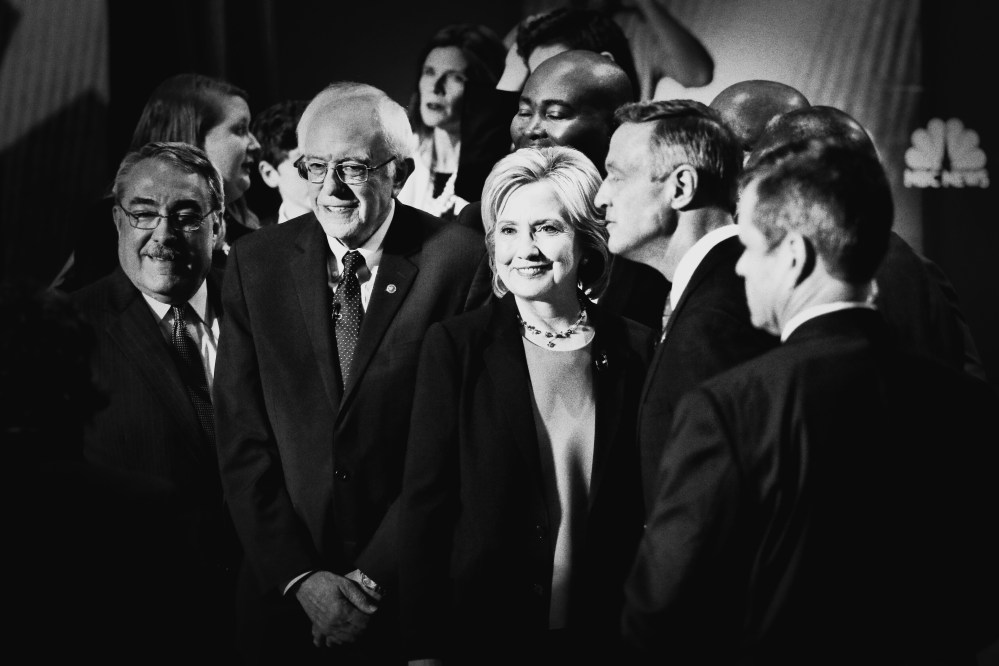
DES MOINES, Iowa — Politics is always a mix between emotion and logic. But with two presidential candidates in the Democratic race neatly representing each, Iowa’s Caucuses a week from Monday will test whether head beats heart in the idiosyncratic and critically important process of picking a presidential nominee in the first state to have its say.
If Bernie Sanders’ hot-blooded appeals win out, he’ll be able to continue battling front-runner Hillary Clinton and making his mark on the Democratic Party and the nation into the spring. If Hillary Clinton’s cooler pragmatism carries the day, she will deal a dramatic and potentially mortal blow to Sanders’ momentum, backed up by a firewall of support in later contests that will bookend a possible win for Sanders in New Hampshire next month.
Martin O’Malley, the struggling third candidate in the race, will hope to salvage what was once a promising presidential bid so he can exit the race with his head held high.
Iowa was the site of the stunning upset in 2008 that derailed Clinton’s presidential ambitions, when she finished third behind Barack Obama and John Edwards. Perhaps that painful loss was on her mind Sunday as she walked into the Mt. Zion Missionary Baptist Church in Cedar Rapids with Sen. Corey Booker, who came to stump for her. “Oh my goodness. Walking in and hearing this choir sing and hearing that prayer about we are people of second chances,” she said.
RELATED: Bernie Sanders: ‘We would beat Donald Trump badly’
Sanders is explicitly trying to claim Obama’s uplifting “change” message, as well as his support base. The Vermont senator encourages his supporters to let their hearts run wild and imagine the world as they wish it were, without getting too hung up on the way it is now or what “establishment” naysayers say.
“I have been attacked time and time and time again, but I think for many Iowans, it kind of sounds familiar. ‘Bernie Sanders doesn’t have experience. Bernie Sanders is naive. Bernie Sanders’ ideals are pie in the sky,’” Sanders said Sunday in Fayette. “We heard that back in 2008. Iowans did not fall for it then. I don’t think they’re going to fall for it this campaign.”
Sean Sommers, a 23-year-old first-time-caucus from Mequoketa, said he used to think his vote didn’t matter. “But Sanders changed that,” Sommers said. “There’s not one thing that Bernie says that I do not agree with.”
Clinton, on the other hand, has been doing a whole lot of party hopping across Iowa lately, popping up in various towns and media outlets to remind caucusgoers to be realistic and set their sights a bit lower than what Sanders is promising. Change is hard, she reminds them, invoking this weekend the legacy of former New York Gov. Dewitt Clinton, whom she said shared her name and tenacity.
It’s a message even some of her supporters acknowledge is not the most inspiring, but it’s one that fans of both Sanders and Clinton agree would make her a good president.
“I know some of you are still shopping. I like to shop too,” Clinton said in North Liberty Sunday, before turning more serious to remind the audience they are picking a commander in chief. “We need to chart a steady course.”
“I like his idea of sweeping change, but I don’t think it would be feasible,” said Katherine Goodwin, a college senior from Cedar Rapids who came to support Clinton in a “Friends don’t let friends vote Republican” t-shirt.
During the 2008 contest, 29% of caucusgoers said they made up their minds in the final week, according to exit polls. And unlike on the divisive Republican side, Sanders and Clinton are both widely popular among Democrats in the state. That’s giving some a hard time deciding between two candidates, whom they like for different reasons.
“I love his passion. I love his dedication,” said Bruce Lehnertz, after he saw Clinton in West Des Moines Sunday night. He planned to see Sanders in Ames on Monday. “But what we just heard [from Clinton] is really pretty compelling. She’s got a breadth of experience that’s hard to find.”
Ryan Jones, the owner of the Irish Democrat restaurant in Cedar Rapids said he was 50-50 between the two. He came out to a Clinton event Sunday afternoon in Marion, hoping to feel something similar to what he felt eight years ago. “Seeing Obama just made my mind up. How he could move crowds, move people. I like to see leaders do that,” Jones recalled. “I’d like to get inspired.”
Despite the incredible attention paid to the Iowa Caucuses, participation is very limited. Unlike a traditional primary, caucusing is a kinetic process that requires attendees to arrive by 7 p.m. sharp (late arrivals may be barred) on Monday night and physically arrange themselves in a room depending on which candidate they support.
RELATED: What to watch on the GOP side with Iowa caucus a week away
Given the effort, it’s a highly self-selective process. In a state of 3 million people, only somewhere between 125,000 and 240,000 people are expected to participate Monday — between just about 4 and 8 of the state’s population.
Sanders is counting on Iowans’ hearts, not heads, to push them to make the effort. “What this campaign is about, and I’m seeing it every day, is an excitement and energy that does not exist and will not exist in the Clinton campaign,” he told the Washington Post this weekend. The higher the overall turnout, the more likely it is that Sanders wins, according to his coordinator for the state, Pete D’Alessandro, whose job it is turn Sanders rally-goers into caucus goers. “The enthusiasm is there,” he told MSNBC. “Now we need to get our people out there.” The biggest challenge on that front may be young people, who back Sanders 2-to-1, but historically turn out in low numbers. D’Alessandro was confident, dismissing as “ridiculous” the idea that Sanders’ young supporters won’t show up. Seth Archer, who teaches writing at Clinton Community College and backs Sanders, said he was not at all concerned about youth turnout. To prove his point, he walked a reporter over to two of his students who came out to see Sanders speak on a Saturday night in Maquoketa. One of the students, Meghan Mclaughlin, brought her mother, whom she had been trying to convert to team Sanders for weeks, with only modest success. “Hearing him talk is so powerful,” Mclaughlin said. Still, Bethany Maxwell, who came to see Sanders in the town of Clinton Saturday acknowledged that she didn’t know “anyone else that’s going to caucus our age.” But as important as turnout is, Sanders also has a geographical problem. His supporters are overly concentrated in smaller number of precincts and counties than Clinton, and peculiar rules of the caucus system favor candidates with more geographically diffuse support. Meanwhile, as the two leading candidates duke it out for first and second place, O’Malley soldiers on. Iowa’s caucus system requires candidates to meet a certain viability threshold of support in each precinct — usually 15% — and O’Malley is polling at around just 5%. But he’s likely to meet the threshold and pick up at least some delegates in smaller precincts. And in others, team Sanders and Clinton may give O’Malley some of their supporters to keep hep him viable as part of the complex delegate gaming that goes into the caucuses. In the final days before the caucuses, the Clinton and Sanders campaigns will be flooding the state with celebrity surrogates as they barnstorm down the final minute. Adding a bit of glamour to Sanders’ rumpled campaign will be rapper Killer Mike, actors Susan Sarandon, Justin Long and Gaby Hoffman, along with indie bands Vampire Weekend and Foster The People. Clinton has focused on progressive validators, like Sen. Booker and Planned Parenthood head Cecile Richards, but also bringing along singer Demi Lovato, actress Jamie Lee Curtis and more. O’Malley, meanwhile, has been barnstorming and door-knocking himself, along wit an assist from his son and others.
Alex Seitz-Wald Recommended


