









Before there was Jack Bauer, there was John Wayne.
There is arguably no more enduring conservative pop cultural icon than the star of numerous Hollywood Westerns, affectionately known as “The Duke,” so naturally swaggering GOP presidential nominee Donald Trump is crowing about his endorsement from the late film star’s family on Tuesday.
Besides being an Iowa native, Wayne’s on-screen persona (and to some degree, his off-screen persona) has come to represent so many facets of the American aesthetic that conservative voters find appealing. He is fondly remembered by fans as a “man’s man,” a hyper-masculine figure whose characters often had a contempt for due process, a kind of grim embrace of isolationism, a staunch preference for established gender roles and some profound cultural insensitivity (to put it kindly) when it came to issues of race.
RELATED: Bachmann flubs her John Wayne nod
While Wayne has managed to rank among the most beloved American actors decades after his death, his appeal is largely generational. After all, Wayne allegedly considered Clint Eastwood, now 85, a young buck who was trying to usurp his place as the premiere conservative cowboy in Hollywood. Demographically, Wayne is the ranking favorite movie star of white men aged 69 or older with a high school diploma or less — a slice of electorate that has shown a considerable affinity for Trump.
Wayne built up his tough guy bonafides by beating up countless (and usually nameless) natives on-screen, and by supporting reactionary bodies like the House Committee on Un-American Activities and the John Birch Society (albeit temporarily) off-screen. Like many modern conservatives, who are riled by social upheavals brought about by the gay rights and Black Lives Matter movements, Wayne was a stubborn bulwark against the more progressive filmmakers and stars that began to take over Hollywood in the late 1960s and early ’70s. In fact, in 1968, segregationist George Wallace even considered him as a potential running mate for his third party presidential bid, but Wayne demurred.
That same year he made an unabashedly pro-Vietnam film just as opposition to that war was about to go mainstream. That film, “The Green Berets,” now serves as a surreal time capsule of ineptitude, but it did little to detract from the Wayne mystique. Nor did his infamously slurred address to a gathering of young Republicans in the late ’70s, during which he trashed student activists. Conservative fans of Wayne never quote his controversial 1971 interview with Playboy in which he declared, “I believe in white supremacy, until the blacks are educated to a point of responsibility.” In that same interview, he said, “I’d like to know why well-educated idiots keep apologizing for lazy and complaining people who think the world owes them a living. I’d like to know why they make excuses for cowards who spit in the faces of the police and then run behind the judicial sob sisters. I can’t understand these people who carry placards to save the life of some criminal, yet have no thought for the innocent victim.”
Wayne also displayed little sympathy for the Native Americans he was routinely portrayed slaughtering in the movies. “I don’t feel we did wrong in taking this great country away from them. There were great numbers of people who needed new land … and the Indians were selfishly trying to keep it for themselves,” he once argued.
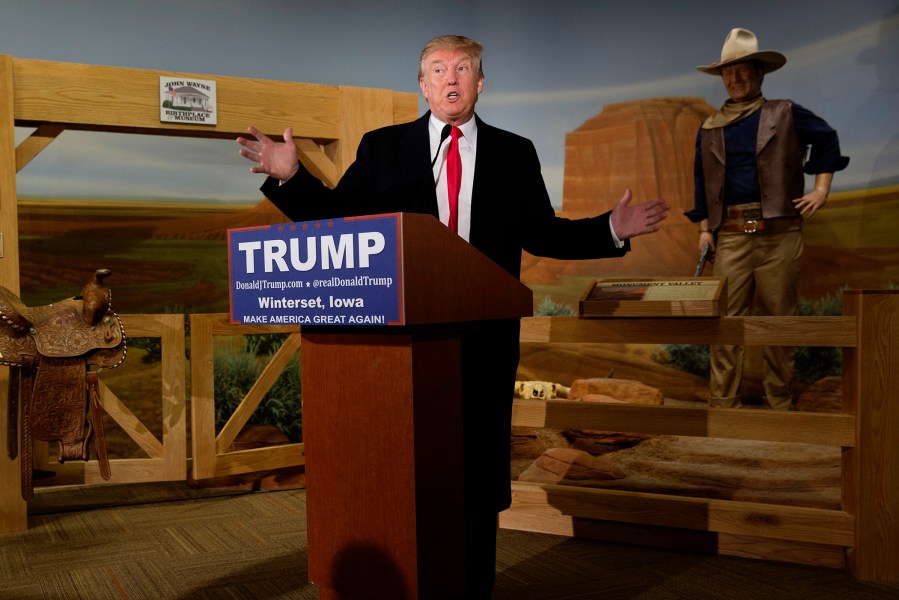
And yet, Wayne has an undeniable cinematic cool — the same kind of simple, inelegant appeal that Trump has employed to woo voters since last summer. As Buzzfeed’s Anne Helen Petersen aptly described Wayne last fall: “He’s like the racist grandpa that millions of Americans nevertheless acknowledge as their own; he’s the embarrassing tear in your eye when you root for America in the Olympics or watch a good Chevy commercial.”
Wayne stood tall, literally, in every film he was in and showed real range as an actor and has genuine charisma in several classic films like “Red River,” “Rio Bravo,” “Stagecoach,” “The Searchers” and “The Shootist.” He did represent, and continues to represent, a certain kind of American infallibility. Wayne’s characters were so certain they were right that audiences believed them, too. And he didn’t waste time yapping in his trademark laconic drawl about his enemies’ motivation, he just shot them dead with ruthless efficiency. His apparent contempt for so-called elites only endeared him to audiences who found his lack of pretension both comforting and inspiring. Wayne was able to maintain his unassailable image of immovability for an unprecedented career as a star and political activist: He campaigned tirelessly for Republicans and even appeared at one of their national conventions in 1968, and his speech, by all accounts, fared better than Eastwood’s conversation with a chair some 44 years later. Wayne’s rugged sensibility is something every modern Republican strives for. You can see it in Ronald Reagan’s outdoorsy attire, George W. Bush’s brush-clearing photo ops, or Sen. Ted Cruz’s impromptu hunting trips. His portrayal of dominant white manhood is so precious that when a character suggests he was actually gay in a memorable scene in the 1984 cult classic “Repo Man,” the implication leads to a near fist fight. The thought being that Wayne represented something “pure” — that if corrupted, could call so much of America’s romantic self-image into question. Trump put it best while accepting the Wayne family’s endorsement Tuesday: “John Wayne represented strength. He represented power. He represented what the people are looking [for] today, cause we have exactly the opposite from John Wayne right now in this country. And he represented real strength and an inner strength that you don’t see very often.” What Trump neglected to explain was how Wayne’s “strength,” both real or imagined, would translate into an approach to governing. Some have speculated that the dual electoral triumphs of Barack Obama in 2008 and 2012 represented the greatest blows to the Wayne model of manhood and leadership. “Wayne’s America was hard and unyielding. This emerging America is softer and more sensitive,” wrote Neal Gabler for Reuters in 2012. Trump, it appears, is vying to restore the frontier-style justice version of America which Wayne’s films often portrayed, the only trouble it is was always make-believe.
Adam Howard Recommended


