








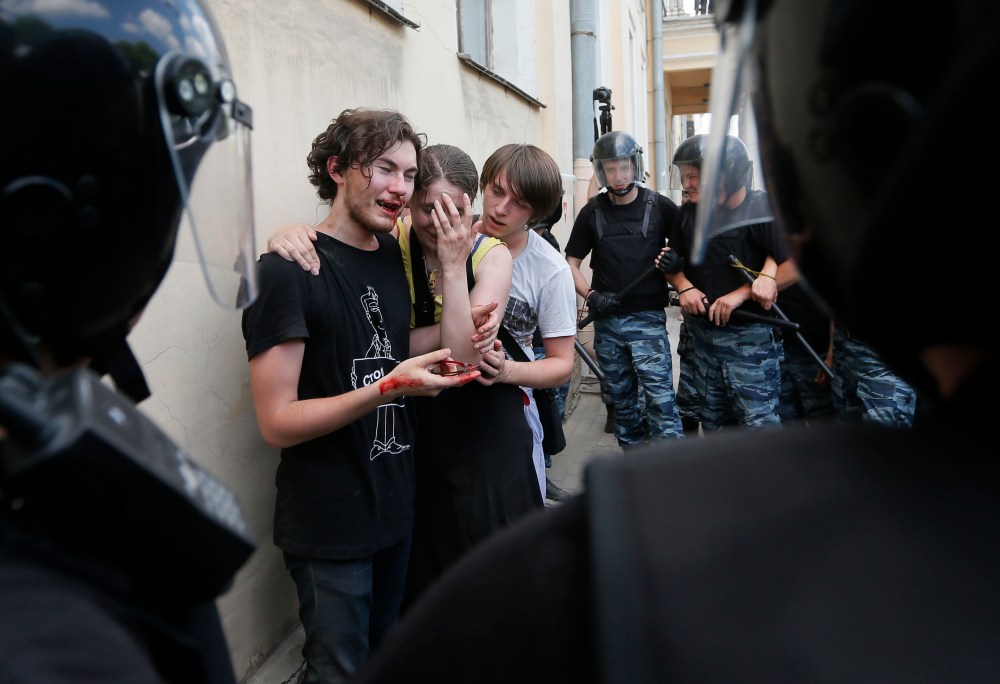
Despite growing pressure from the U.S. government and concerns from American athletes, the International Olympic Committee has provided little guidance or guarantees for the safety of lesbian and gay competitors and their families headed to the Winter Games in Sochi, Russia. Two statements, one seemingly aimed at curtailing protests of Russia’s anti-gay laws, and another suggesting that Russia will not enforce its laws during two weeks of Olympic events, provided little assurance and seemed to contradict public statements from Russian officials. The environment, meanwhile, has grown increasingly hostile toward LGBT individuals living in Russia–as evidenced, if nothing else, by their treatment in the mainstream media. Months after one Russian TV personality was fired shortly after publicly coming out as gay, another declared that gays and lesbians were unfit to be organ donors. One week after President Obama spoke forcefully of Russia’s responsibility to protect the human rights of all people, especially as hosts of the games, the Russian rhetoric intensified, while few world leaders have followed the president. But U.S. lawmakers were reportedly preparing a unified response along with demands that Secretary of State John Kerry protect LGBT rights at the games. Six weeks have passed since Russian President Vladimir Putin signed into law one of the harshest restrictions on LGBT expression in recent memory, sparking an international outcry and a corresponding spike in anti-gay violence. Six months remain before more than 40,000 athletes, volunteers, and members of the press are expected to flock to Sochi for the 2014 Winter Olympics. Nearly 750 Americans will join the Team USA delegation, according to the U.S. Olympic Committee, but thousands more are expected to attend, including families, journalists and sponsors.
Related: Russia’s anti-gay posture violates ‘basic morality,’ says Obama
“The crackdown on freedom of expression since Putin re-emerged as leader is extremely troubling and disturbing,” said Samir Goswami, managing director for Amnesty International’s Individuals and Communities at Risk program. “There has to be a larger conversation at the IOC level, but also among the global community. At what cost are we producing these Olympics?” Since Putin’s re-election in 2012, over 5,000 people have been arrested in more than 200 protests over anti-gay laws, according to figures from Amnesty International. In addition to the law banning “propaganda of nontraditional sexual relations among minors,” Putin has also signed a law banning the adoption of Russian-born children to gay couples and to individuals living in countries that allow gay couples to marry. He also signed a law in June that classifies “homosexual propaganda” as pornography. Those moves, ahead of the Olympics, sparked demonstrations around the world with protesters’ demanding boycotts of Russian vodka and even the Olympic Games. Last week, the LGBT advocacy organization All Out delivered a petition signed by over 300,000 to the IOC, calling for a large-scale response to the anti-gay legislation. “People can dump out as many gallons of vodka in the streets as they want, but when it comes to achieving realistic change in Russia, we are at a time of strategizing right now,” said Gregory T. Angelo, executive director of the Log Cabin Republicans, a GOP-focused LGBT advocacy group. “Right now this is up to the State Department and the IOC. The State Department needs to present to the American public its plan to protect LGBT athletes, but the onus really needs to be on the IOC.” So far, both IOC’s president and the U.S. Olympic Committee’s executive officer have issued statements that champion equality, but reserve action until further clarification from the Russian government is given. A more troubling statement from the IOC was recently reported by Gay Star News, suggesting that the committee would join Russia in punishing gay athletes, rather than ensuring their protection.
Related: Lady Gaga calls out Russia’s anti-gay laws on Twitter
“The IOC has a clear rule laid out in the Olympic Charter (Rule 50) which states that the venues of the Olympic Games are not a place for proactive political or religious demonstration,” said the IOC spokesperson to Gay Star News, implying that athletes or other members of the U.S. delegation could be dismissed from the games for sporting rainbow paraphernalia in protest. As far as the State Department is concerned, spokesperson Laura Seal declined to discuss specific security measures with msnbc, but did provide a statement explaining who bears the responsibility for Americans’ safety:
“The host nation – in this case, Russia – is in charge of security and contingency planning for the Olympic Games. The State Department’s Bureau of Diplomatic Security chairs the International Security Events Group that comprises ten U.S. federal agencies. This group liaises with host nation security for large events including the Olympic Games where thousands of U.S. citizens, Team USA athletes, and corporate sponsors are present for an extended period of time. We do not release the details of our security procedures. We will continue to monitor the security situation as the Olympics draw near.” Meanwhile, anti-gay sentiment in Russia has shown no signs of slowing. Over the weekend, Americablog reported that one of Russia’s most popular news anchors appeared on a government-controlled show to argue that the newly-enacted laws didn’t go far enough. His prescriptions, met with roaring applause from the audience, were far more extreme. “I think that just imposing fines on gays for homosexual propaganda among teenagers is not enough,” said Dmitri Kisilev, host of the show Vesti, according to a translation posted on YouTube. “They should be banned from donating blood, sperm. And their hearts, in case of the automobile accident, should be buried in the ground or burned as unsuitable for the continuation of life.” While the IOC has made assurances that gay athletes and spectators would be protected from discrimination, Russia’s sports minister has said just the opposite–that anti-gay laws would be enforced during the games. More concrete confirmation came Monday in a statement from Russia’s Interior Ministry that the anti-gay propaganda law would be in effect for next year’s Olympics. The statement added that the law does not promote discrimination against gay people, calling such claims “totally unfounded and contrived.” Related column: Don’t boycott the Olympics, ban Russia from competing instead Before he signed the legislation, Putin echoed that sentiment during a press conference, saying that gays and lesbians–referred to as “these people”–enjoyed “the same rights and freedoms as everyone else.” Human rights advocates strongly disagree, and argue that the laws could have an even greater impact on visitors during the Olympics. “For Russian citizens who violate this [propaganda] law, they face fines of several hundred dollars,” said Jane Buchanan, associate director for Europe and Central Asia at Human Rights Watch. “If you’re a foreigner, it’s even more dangerous. You can be fined, but you can also be arrested or deported. So yeah, I would say the stakes are pretty high.” Foreigners are also undoubtedly in danger of falling victim to anti-gay violence, to which Russian authorities have turned a blind eye. Olympic figure skater Johnny Weir and his husband, Victor Weir-Voronov, whose parents immigrated to the U.S. from the former Soviet Union, are not concerned about facing brutality, but both willingly accept the possibility of arrest. “I don’t think that there is a crazy squad of homophobic KGB officers running around Russia,” said Weir to msnbc Tuesday. “Being gay in Russia has always been a little bit difficult,” he said. “Putin signed a law, and the law for actual Russians doesn’t change the way they’ve always had to live.” However, said Weir, “for people who hate gays, [the laws] are definitely a license for them to attack.” Nevertheless, both Weir and his husband said they felt safe travelling to Russia for the games, thanks in large part to their high profiles. “People who are in a position of power or influence or celebrity aren’t going to get picked on,” said Weir-Voronov. “Instead of worrying about me, I’m worrying about how I can help the Russian community,” said Weir. “If someone gets the wrong idea and arrests me because they can, because technically I am ‘gay propaganda’ to my core, that’s one thing. But if I get arrested, or if I get beaten up, I hope that it will serve as making a point to the world that this is something that needs to change.” While Weir believes the IOC lacks the authority to demand change from the Russian government, human rights advocates called for a stronger response from both the IOC and the games’ corporate sponsors. “They pay for the Olympics,” said Buchanan. “They can certainly make it very clear that they don’t want their business and their brand so prominently displayed for an Olympics that could go down as the ‘Anti-gay Games,’” she said. “I don’t think there could be a better time for the IOC, and corporate sponsors, and governments to say, ‘We don’t accept this, and these aren’t the games that we want to be participating in.’” NBC Universal, which owns the U.S. broadcast rights for the Winter Games said in a statement: “NBCUniversal strongly supports equal rights and the fair treatment of all people. The spirit of the Olympic Games is about unifying people and countries through the celebration of sport and it is our hope that spirit will prevail.”
Emma Margolin
Emma Margolin is a reporter at MSNBC.com. Recommended


