








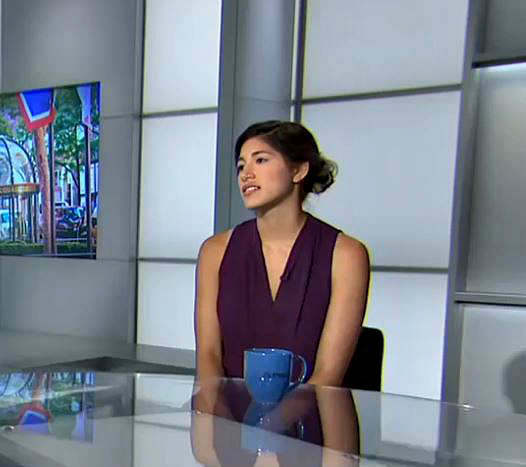
Emma Sulkowicz told us that on the first day of her sophomore year at Columbia University, she was raped. Although she was initially hesitant to talk about it, once she heard from two other women who said they were assaulted by the same man, she reported it to Columbia’s administration. But after an investigation that took over 7 months, the board ruled that there was insufficient evidence to take disciplinary action against her alleged perpetrator.
Emma is now starting her senior year and the man she said raped her is still on campus. Only back at school a few days, she has already seen him.
She and 22 other Barnard and Columbia students filed a complaint last year with the U.S. Office of Civil Rights accusing the school of mishandling of sexual assault cases. Columbia University is now one of a long list of schools under federal scrutiny for its handling of sexual assault complaints on campus.
After Krystal Ball’s live interview with Emma on RFD, I sat down with her to chat about how her college experience was altered by what happened to her.
I started by asking how difficult it was to balance it all — the investigation, the media appearances, her emotional recovery, on top of all the regular academic demands:
WF: Was your whole summer consumed by this?
ES: It was mostly my last semester of junior year. I couldn’t really finish a lot of my classes. My teachers had to give me a lot of leeway because I wouldn’t be able to write an essay if I had four interviews…
WF: Did you feel like you had support coming from your professors?
ES: Some of my professors were really, really supportive and others just didn’t understand. One class had a lot of reading and to make up for the missed reading assignments one professor would say “you have to write two extra essays.” I never ended up doing it and he didn’t end up lowering my grade, but it’s strange that he would tell me I had to do more when I was working on this stuff which was obviously so much more pressing and important to me.
WF: How do things feel coming back for senior year?
ES: I mean, I’ve already seen him back on campus. It was so nice last semester because he decided to study abroad, which I’m sure was related to the fact that this whole thing was starting to blow up. I was talking about it a lot so it was obviously on my mind but I didn’t have to actually see him. Now he’s back, so I have to see him all the time. And I’m going to be doing this crazy art piece…
WF: What do you anticipate the reaction to be?
ES: I’ve been working on it with my professors and artists I trust. I’ve written up 5 pages for the rules of engagement for the piece. I’ve tried to make it as thorough and well-researched as I can – as long as I’m on Columbia campus or any Columbia-owned property, I have to have this mattress with me. It’s an extra-long twin and made of foam so it’s not heavy and impossible, but it’s floppy and unruly. I have a feeling that the administration’s first reaction is going to be to try and shut me down. In our occupancy agreement for Columbia housing we’re not allowed to take furniture out of the Columbia rooms, but I’ve already made sure to purchase my own mattress that’s exactly the same. I don’t know what other ways they might try and shut me down but I know they don’t want that kind of publicity on their campus. I hope that when my attacker sees me doing this piece he will want to leave on his own. I just want my campus back.
WF: Do you feel like you now harbor a lot of negative sentiments towards Columbia?
ES: Most people go to college to have a college experience. For me, college will always be the place where I was raped by a serial rapist, and then the administration ignored me and all the women who were raped by him. It will always be the place where I was allowed to be the victim of a serial rapist.
WF: When we talk about rape on college campuses specifically, people often float around terms like “rape culture” and “hookup culture.” Do you see a difference between the two?
ES: The man who raped me and all of these other women is a serial rapist. It’s not a hookup culture that’s causing it. He has systematically attacked women. And there are a bunch of other men on my campus who systematically target and attack women. That’s not the result of some sort of hookup culture. On the other hand, I do think a hookup culture (influenced by alcohol) makes it harder for survivors to come out and report their cases because as a society we place so much blame on survivors when really, they’re the victim of a calculated crime. WF: When I was an undergrad, my alma mater dealt with a somewhat similar issue – 16 students filed a complaint alleging that the sexual climate on campus violated the Title IX act. Since then a variety of investigations have taken place and a variety of committees have been created to monitor and foster a more fluid dialogue about sexual life on campus. Does this sound like the type of route you would want Columbia to take in an ideal world? ES: The Coalition Against Sexual Violence and No Red Tape worked on a set of policy proposals that we submitted to the administration. The administration actually recently released a new set of policies on sexual assault on campus that were good in some way – I’m glad they brought up alcohol’s role in defining rape – but they really screwed up in other areas because they made it harder for serial rapists to be caught. Past behavior can only be used to show a pattern of behavior and potentially give a harsher sentence to a serial rapist if the case is closed. My case took seven and a half months to come to a close…if a serial rapist rapes three victims within two months none of those victims will see justice. And especially if a rapist rapes two victims in the same night, those two victims won’t even be able to be witnesses. WF: It bothers me in some way to ask this question because it assumes that women need to gear up and arm themselves… but given the circumstances, what are ways in which women can protect themselves on college campuses? ES: First of all, it’s so important to know your rights. I reported my case to the school not knowing what my rights were and they continued to just violate my rights. I thought “maybe they’re supposed to postpone my case for seven and a half months so one of the victims graduates.” So it’s important to be educated so that when the administration violates your rights you can call them out on it. In terms of avoiding being assaulted, it’s really difficult. And the best we can do is to increase education. Beginning of the year education for the entire student body is really important. WF: Have you found that Columbia’s educational seminars on assault and consent have changed at all? ES: I’m not a freshman anymore, but I’m going to get the scoop on this year’s workshop. WF: Is there anything else you feel people can be doing to encourage victims to speak up and to galvanize their rights? ES: One of the biggest things I’ve learned is that survivors are chronically plagued by feeling like they’re wrong in some way. With those sorts of feelings, it’s extremely hard to feel confident enough to report about your case and even to speak about it in general. Part of why I feel so strongly about making my case public is that I want to help survivors to start believing that they weren’t in the wrong and it’s not their fault. Check back in with us as we follow up with Emma next week. She is launching her art project on the first day of classes – and we’ll be there!
Willa Frej Recommended


