








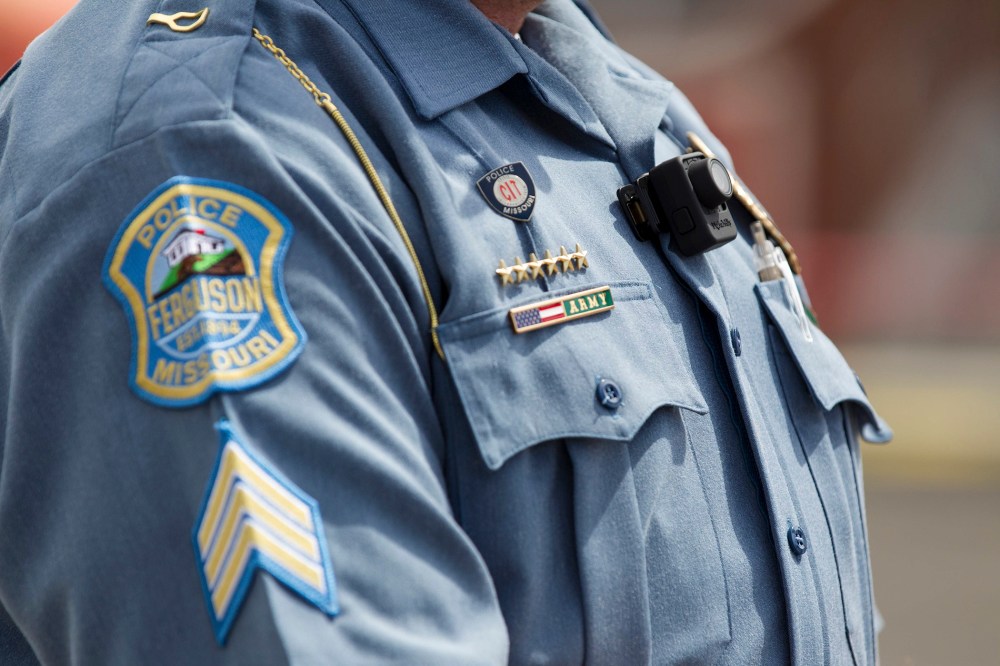
In its most concrete move yet toward reforming law enforcement tactics and repairing its frayed relationship with the community, the Ferguson Police Department is now equipping officers with body cameras, a major step for a local police force that the whole country is watching.
The Justice Department will announce Thursday that it will open a civil rights investigation of the entire Ferguson, Missouri Police Department, according to administration officials. The Washington Post was first to report the impending investigation late Wednesday.
The return to normalcy to the streets of Ferguson does not come without complications for a police department anxious to make amends with residents and outrun its reputation as having been ill-prepared to handle the national spotlight after officer Darren Wilson shot and killed Michael Brown last month.
Critics who have called for greater checks on the embattled police department were pleased to see officers wearing portable video recording devices on their uniforms during protests Saturday that drew thousands of people to rally outside both the police headquarters and across town at the site where the 18-year-old was shot. Supporters say evidence from the cameras protects both citizens and police – cops are less likely to act aggressively while the cameras are rolling, and the footage can also potentially exonerate police when there are conflicting accounts of their behavior.
However, the ad hoc strategy used by the Ferguson police in responding to Brown’s case and the ensuing unrest continues to raise serious questions of accountability for a department desperate for relief.
Michael White, a professor of criminology and criminal justice at Arizona State University who wrote the book on police body camera surveillance policy for the Department of Justice, said the circumstances in Ferguson put the department in a unique position. Other departments across the country have taken months to test out methods and different products, and develop policies in pilot programs before the cameras were deployed in the field.
In Ferguson, it took a matter of days.
Two tech companies, Safety Vision and Digital Ally, were the first to offer help to Ferguson, together donating roughly 50 body cameras to outfit the entire department. Not even a week had gone by before officers were testing them out in real time.
The officers were “still playing with them,” Chief Tom Jackson told the St. Louis Post-Dispatch on Saturday, as crowds of protesters swelled, flanked by Brown’s parents. “The quality is good.”
“This is moving at lightning speed,” White said. And while the technology in the field is still relatively new, White said Ferguson had the opportunity to adopt wholesale policies from other departments that had already been through the pilot stage of body-cam programs, although it is unclear whether Ferguson police ever looked into that possibility. The Ferguson Police Department did not respond to multiple requests for comment.
“I think it’s very possible that they could have done this, and done it very well by reaching out to experts,” White said. “The concern would be if they didn’t do that.”
Supporters of body cameras for police caution that clear guidelines mandating when officers are able to turn on or off their device are crucial when implementing the policy. Recording interviews with victims of sexual assault or domestic violence are particularly sensitive. Privacy concerns also arise when children are being filmed, or when citizens request that officers turn off the cameras, or the footage is in any way tampered with. Additional privacy concerns over how video footage is stored, how long it is archived and what security precautions will be taken to protect the data have yet to be ironed out.
“Most of the footage should never see the light of day,” said Jay Stanley, senior police analyst at the ACLU’s Speech, Privacy and Technology Project. “There must be very clear enforcement expectations for when police should have the cameras turned on and good policies around when the video is or is not made public.” Concerns about the cameras also extend to officers’ privacy, with policies needed to ensure the cameras aren’t rolling during break periods. “That raises concerns with officers,” White said. “That could be troubling because in many places, everything that gets video coverage is discoverable [in court].” Other policy issues quickly emerged on the first day of the cameras’ use in Ferguson when their batteries became drained, Chief Jackson told the Post-Dispatch, a supposedly rare occurrence since battery life is designed to last an entire shift. With the Ferguson police still in the spotlight, it is likely that many more departments will also make the move toward equipping police with body cameras, a movement that could become a game-changer for community-police interactions. “The time is really right for this type of policy,” Stanley said. “I imagine they want to take steps to urge the public that they can be trusted.” One test case out of Rialto, Calif., shows some promise. The city of just over 100,000 residents saw police brutality complaints plummet by 88% during the year-long pilot program that mandated all officers wear the devices. During that same time period, police use of force dropped another 60%. “It is very important if there are tools that give a clear view of the interactions between someone in law enforcement and the people who are involved,” said Patricia Bynes, Democratic committeewoman for the township of Ferguson. “That’s a fantastic thing.”
Amanda Sakuma Recommended


