








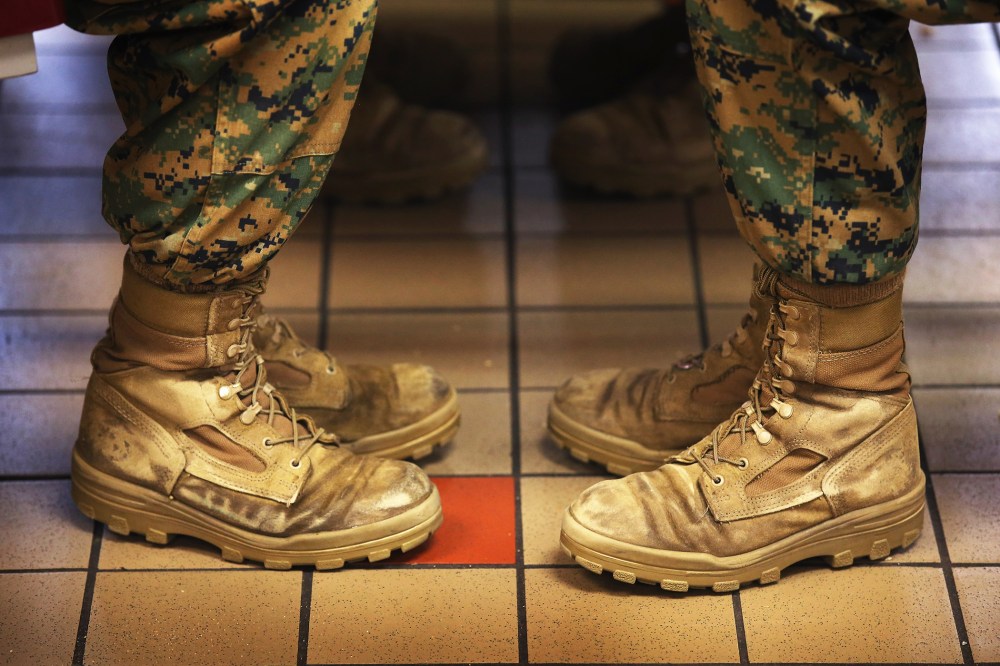
Amanda didn’t know the U.S. military banned transgender service members until after she joined. She didn’t even know the term “transgender” until she graduated high school, and didn’t know for sure that it applied to her until early adulthood. A simple Google search — “Can I be transgender in the military” — revealed the truth. She would have to hide it.
“It’s really difficult because every day I go to work, and I train and fight with these guys. I consider them family,” said Amanda, who cannot disclose her legal name because she is currently on active duty. “We can go to war and die right next to each other, but I can’t be honest about who I am.”
There are approximately 15,500 troops serving in the military who, like Amanda, have to lie about having gender dysphoria — a condition in which there is a marked difference between a person’s expressed or experienced gender and the gender others would assign him or her. As a result, these transgender service members cannot access medically-necessary health care, like hormone therapy and gender reassignment surgery. Addressing their needs, however, may be easier than anyone imagined.
According to a new study released this week by the Palm Center, a San Francisco think tank, lifting the military’s ban on transgender personnel would be “administratively feasible and neither excessively complex nor burdensome.” Based on research into the 18 foreign militaries that currently allow transgender service, including Canada’s and Britain’s, an expert commission identified 14 administrative changes that should be made in order to adopt a fully inclusive policy.
Some are simple, like adhering to gender-correct dress and grooming standards upon the beginning of transition. Others are more complicated, like amending the military health care system to cover transition-related surgery “in the same manner as other medically necessary procedures.” But above all, the report recommends strong leadership from the top — “key to creating such a culture of respect” — and flexibility within military regulations, “[b]ecause no two transgender individuals transition in exactly the same way.”
“It just comes down to being fit for duty, and that’s the bottom line,” said Maj. Jeff Mueller, co-chair of the Board of Directors at OutServe-SLDN, a network of actively-serving LGBT military personnel. “The reports lays out pretty easily how we can do it. I’m hopeful this will continue to push the ball forward in ending this unnecessary ban.”
Unlike “Don’t Ask, Don’t Tell,” the military’s former ban on openly gay service members, which was repealed three years ago this September, the ban on transgender personnel isn’t a statutory bar; it’s simply Department of Defense policy. That means that ending the ban requires only the direction of the president and secretary of defense, not the approval of Congress.
President Obama is already on his way to being remembered as the most-LGBT friendly commander-in-chief in history. And in May, Secretary of Defense of Chuck Hagel said he was open to reviewing the transgender ban. Yet despite these encouraging signs, time is undeniably running out for this administration to take action. Who knows if the next one will be as likely to revisit the policy?
“There are two ways it could happen,” said Mueller. “Either the ban will end before [President Obama] is out of office, or it will take another 15 years.”
Given the momentum the LGBT movement has generated over the last few years, however, Mueller said he’s “becoming more hopeful it’ll happen before [Obama’s] term is up.”
Amanda senses the shift as well, though she acknowledges changing the policy on transgender troops is “something that would take a little more getting used to” in her combat MOS, or military occupational specialty. “There’s a certain closed-mindedness in my job,” she said. “Some people are still having a hard time accepting the fact that lesbian, gay and bisexual troops can serve openly.” However, as she pointed out, history offers some encouragement. The military used to have a problem with African-Americans and women serving alongside white, male troops. But when those barriers disappeared, so too, in large part, did the bigotry. “Every time there’s a change in policy to allow people to serve openly, it’s really only gotten better for the military,” said Amanda. “Once they change the policy on transgender service members, I think it’ll be just like that. They’d realize it’s the same people; they can do the same job.” Though finding out she would have to lie about being transgender was a shock, Amanda said she doesn’t regret joining the military or serving in Afghanistan. If the ban ends, she plans on taking advantage of the newly available medical benefits. If not, she’ll transition once her service is up. “It’s something that I take a lot of pride in, something that’s very fulfilling,” said Amanda of being in the military. “I really enjoy helping soldiers and playing an active role in America. I love America, and I love serving.”
Emma Margolin
Emma Margolin is a reporter at MSNBC.com. Recommended


