








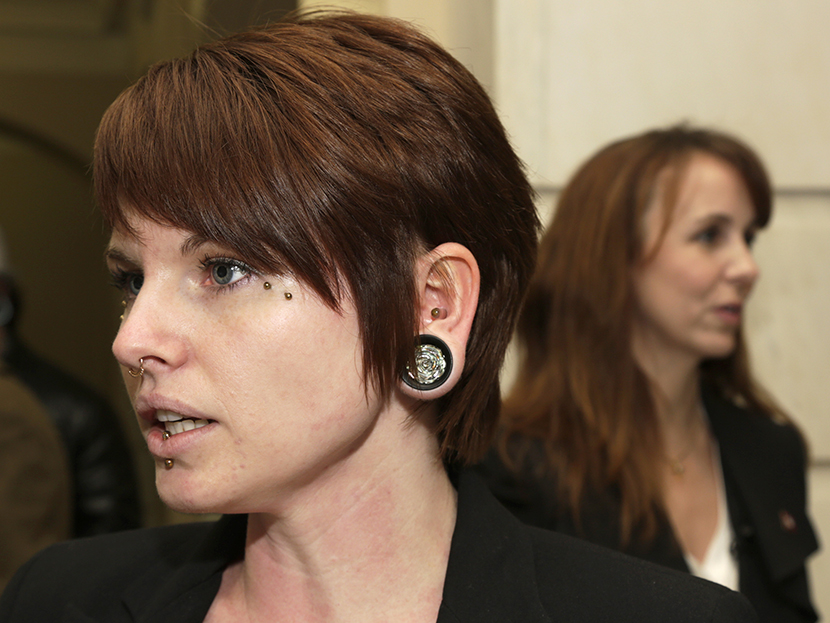
At a time when gridlock defines Washington, national lawmakers could learn a lot from the cooperation between state officials and the body art industry in Arkansas.
Working together, the two sides updated the rules and regulations governing tattooing, piercing, and other types of body art in the state.
The relatively new law is getting renewed attention in social media circles. It’s been widely misunderstood and misrepresented, causing headaches for Arkansas’s body art industry and one state senator after people starting sharing articles online. Despite what you may have read on Facebook, Twitter, Reddit, on blogs, or in the alternative press, the Arkansas state Senate did not vote to ban any types of tattoos or body piercings.
“You can’t believe the things I’ve been called on Twitter,” said Republican state senator Missy Irvin, who sponsored the legislation. She told MSNBC: “The b-word, the c-word. It’s been pretty bad.”
At issue is Arkansas Senate Bill 387 which both chambers of the Arkansas state legislature actually passed in late March of this year. The bill was then signed by the governor. Rather than banning tattoos or cracking down on the body art industry–as many headlines have suggested–the bipartisan legislation actually legally redefines the term body art in Arkansas to add the practice of scarification–the scratching, etching or cutting of the skin to produce a design.
Rather than a seeing the bill as a crackdown, most body artists in the state are pleased with the legislation.
“We came away really happy,” piercing and scarification artist Misty Forsberg told MSNBC. Forsberg, who works for Southtown Tattoo & Body Piercing in Fort Smith, Arkansas, was one of several in her industry working with state legislators to update the state’s laws. The effort was “a little bit of a bumpy ride at first,” she said.
An earlier version of Irvin’s bill banned Arkansas’s licensed body artists from performing scarification, but state legislators and the industry reached a compromise with the Arkansas Department of Health and that language was removed from the bill.
In fact, Forsberg said she and other artists spoke in favor of the legislation in the Arkansas House, once the language banning scarification was taken out.
“The state’s aware that I do scarification,” said Forsberg. “I’ve shown them my portfolio. We’ve been really professional on our end to make sure they know what we do.” In working to reach a compromise on this bill, she said legislators showed an interest in learning about scarification and moving to properly regulate it instead of ban it. “Arkansas could become the first state to license it,” she added.
Irvin said it took some coaxing to convince legislators and Health Department officials that it was actually a bad idea to ban scarification.
“They were worried. Scarification is really kind of new, so how do you make it safe?” Irvin said. But communication between the body art community and Health Department officials led to progress. “You can always find a path forward,” she said, “and we did on this.” There is one prohibition in the bill that passed. Body artists licensed by the state are not legally allowed to insert subdermal implants. Subdermal implants are molded pieces of body jewelry, generally made out of silicone, that are inserted below the skin to alter the body’s shape. Subdermal implants were first used by a body artist in Phoenix back in 1994. It is a more extreme and more rare form of body art that often creates very dramatic results. Under the new law, subdermal implants can still be implanted by medical professionals, but critics argue that is, in effect, a ban on cosmetic subdermal implants in Arkansas. However, Joe Phillips of the Arkansas Body Modification Association told MSNBC that as far as he knows, no one in Arkansas is performing that type of implant. Forsberg also suggested that, should subdermal implants become popular in Arkansas in the future, state officials and the body art industry now know they can work together to take on another potential change to the state’s body art laws. “This was a great experience, working alongside a group of small business owners who really care about their industry and their clients,” Irvin said. “So often we make these assumptions based on the way people look–we discriminate.” Irvin said. As for the headlines claiming she’s tried to limit artistic freedom, Irvin said, “I can take it. I’ve been put into a box because I’m a Republican, a woman, a Christian–but I’m a former modern dancer. I’ve danced in New York. These are artists. These are my people.”
Nick Ramsey
Nick Ramsey is a senior producer with MSNBC’s “The Last Word with Lawrence O’Donnell.” Recommended


