








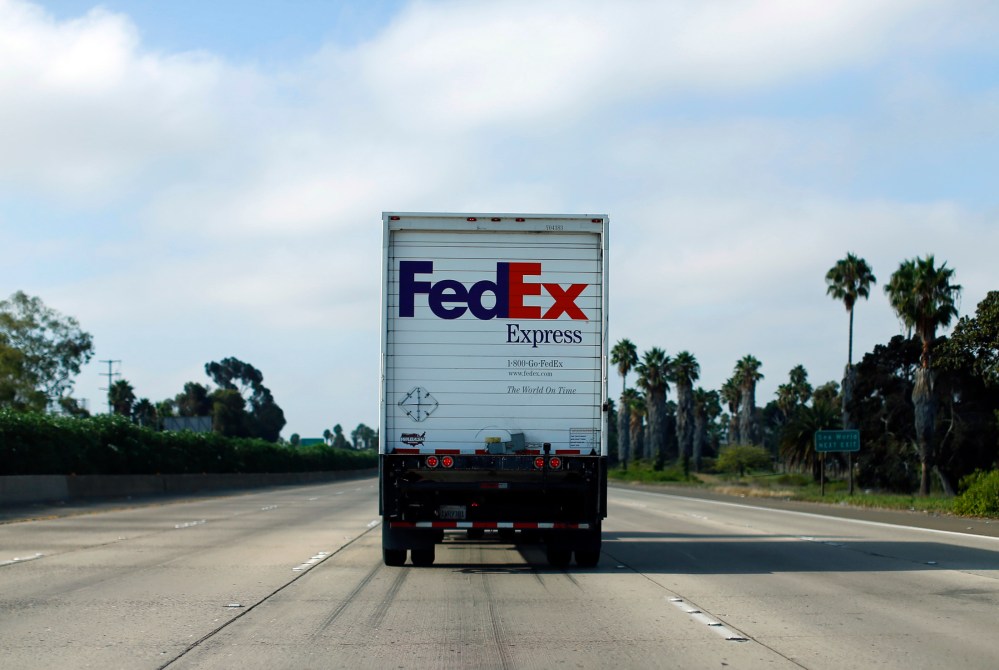
The “fissured workplace” took another hit on Aug. 27 with the unsealing of two federal appellate decisions disputing FedEx’s contention that its drivers in California and Oregon are properly classified as independent contractors.
By claiming its drivers aren’t employees, FedEx has long been able to avoid paying overtime, providing leave to care for ailing family members, or contributing to Social Security, Medicare, or unemployment insurance — all that tiresome stuff bosses are required by law to provide anyone on the payroll. During the past decade, this arms-length arrangement was challenged repeatedly by drivers in about 40 state courts, and eventually many of these cases were consolidated into three federal class actions. The two new decisions — one covering the California class, the other covering two Oregon classes — were handed down by San Francisco’s 9th Circuit, and they constitute the first-ever victories for FedEx drivers at the federal appellate level.
Coming on the heels of a decision by the National Labor Relations Board’s general counsel to treat McDonald’s Corp. as a joint employer of its franchisees’ fast-food workers, the 9th Circuit decisions further undermine the “devolution of the proletariat” — corporate America’s ongoing effort to shed front-line, often low-wage employees through independent contracting, subcontracting, and franchising arrangements, as documented in David Weil’s recent book, “The Fissured Workplace.” Weil is currently on leave from Boston University’s School of Management to serve as administrator of the Department of Labor’s wage and hour division.
“We fundamentally disagree with these rulings, which run counter to more than 100 state and federal findings … upholding our contractual relationships with thousands of independent businesses,” a spokesperson for FedEx Ground, the FedEx subsidiary named in the suit, said in a prepared statement.
The 9th Circuit decisions were blistering. Judge William Fletcher wrote the California opinion (Alexander v. FedEx) as well as the Oregon opinion (Slayman v. FedEx). In both, he observed (echoing the old Smothers Brothers song “My Old Man,” perhaps deliberately): “The drivers must wear FedEx uniforms, drive FedEx-approved vehicles, and groom themselves according to FedEx’s appearance standards. FedEx tells its drivers what packages to deliver, on what days, and at what times. Although drivers may operate multiple delivery routes and hire third parties to help perform their work, they may do so only with FedEx’s consent.” In a concurring opinion for the California case, Judges Stephen Trott and Alfred Goodwin quoted Abraham Lincoln’s observation that if you call a dog’s tail a leg, it still has only four, because “calling a dog’s tail a leg does not make it a leg.”
The two class actions were filed on behalf of FedEx drivers during the periods of 2000 to 2007 (California) and 1999 to 2009 (Oregon). FedEx Ground, in its prepared statement, said the particular contracting arrangement for these drivers “is no longer in use. Since 2011, FedEx Ground has only contracted with incorporated businesses, which treat their drivers as their employees.” In other words, the company has shifted from an independent contractor model to a subcontractor model. “This is FedEx’s m.o.,” said Catherine Ruckelshaus, general counsel of the National Employment Law Project. Whenever a given arrangement with drivers comes under legal attack, Ruckelshaus explained, FedEx “makes minor adjustments … and says, ‘We’re fine now.’” Drivers must then decide whether to re-litigate the matter. Philip Monrad, an attorney for the drivers, said the newly-unsealed decisions should invalidate even FedEx’s post-2011 arrangement. “Labels don’t count,” he wrote in an e-mail. It seems likely FedEx will want to appeal the 9th Circuit decisions to the Supreme Court. But it may face some difficulty in doing so, because — even though made at the federal level — the two decisions concern matters of state law rather than federal. Their reach is similarly limited; they apply only to FedEx drivers in California and Oregon. But there’s a decent chance the 9th Circuit’s decisions will influence future decisions in other jurisdictions. At the very least, they are shining more light on corporations’ maddening reluctance to take responsibility for the folks who represent them most directly to the public.
Timothy Noah Recommended


