








Last Monday, U.S. District Court Judge Myron H. Thompson issued the second ruling in a week striking down laws that required abortion providers to obtain admitting privileges at local hospitals. He joined judges from an appeals court panel who ruled that a similar law in Mississippi was unconstitutional because the restrictions, if enacted, would have the net result of driving doctors out of business, shuttering clinics, and effectively rendering the right to access abortion moot for women in the two states. Only Texas has seen this law upheld in a federal court after it was reviewed by a panel of conservative judges.
%22Their%20intent%20is%20not%20to%20keep%20women%20safe%2C%20but%20to%20drive%20doctors%20away%20from%20serving%20patients%20and%20to%20close%20clinics.%22′
In his ruling, Judge Thompson took the opportunity to focus the conversation where it squarely belongs — on the need for laws that protect the safety of doctors, clinic staff, and the women they treat, not ones that foster an environment of hate. Thompson outlined a detailed history of clinic violence, saying “this court cannot overlook the backdrop to this case: a history of severe violence against abortion providers in Alabama and the surrounding region.”
The anti-choice movement has tried to whitewash this history over time by portraying clinic protesters as kindly “counselors,” typified by the plaintiff in the recent McCullen v. Coakley case where the Supreme Court struck down Massachusetts’ buffer zone law. Of course many of them are peaceful, but the sum of their actions tell a different story.
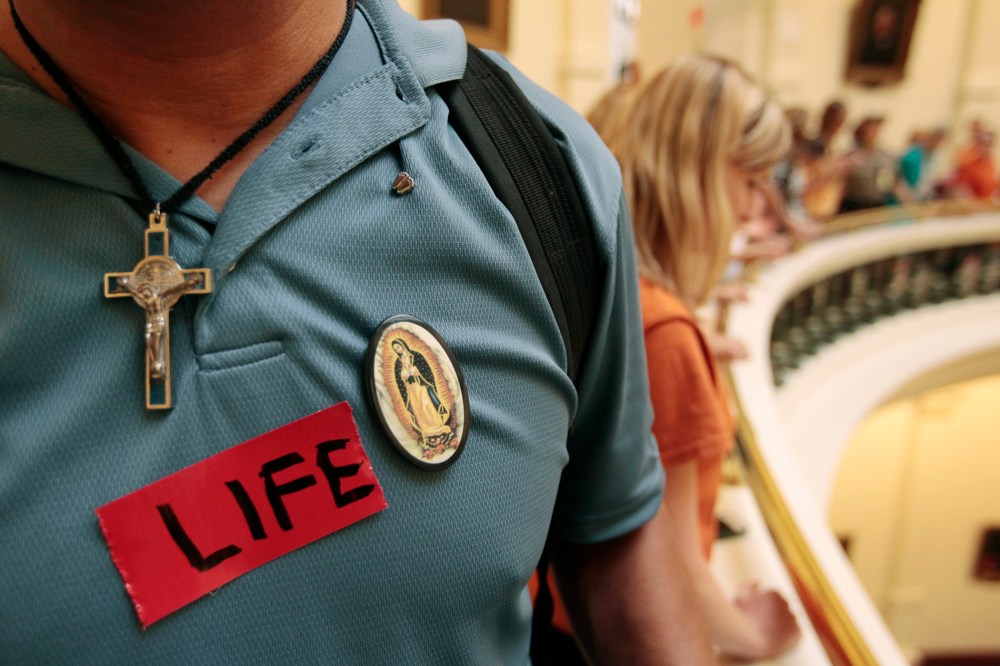
Groups of screaming protesters terrorize women outside of clinics while their allies in legislatures pass laws that put abortion and even birth control out of reach. This is a well-coordinated, well-funded effort to take women’s personal decisions out of our hands and squarely into politicians’. And try as they might, they cannot erase the memories of doctors who have fallen serving their patients. That history of violence — doctors stalked and shot, clinics bombed and burned — is the history of the anti-choice movement.
Advocates and doctors who support reproductive freedom have one thing constantly on our minds: how to create the political and cultural landscape that allows women to safely make decisions that are best for us about if, when, and with whom to have children. Research consistently shows that when safe abortion services disappear, the number of abortions don’t drop. Instead, women seek alternative avenues for abortion care, often with devastating results.
In one study in Texas, 7% of women who needed abortion care had first attempted to self-abort because it was too difficult to get to a clinic. Who knows how many never made it to a facility? As clinics disappear, that number can only rise. And in the meantime, women are losing the other services those clinics provide: contraception and other family planning services, prenatal care, cancer screenings, even regular check-ups.
%22Groups%20of%20screaming%20protesters%20terrorize%20women%20outside%20of%20clinics%20while%20their%20allies%20in%20legislatures%20pass%20laws%20that%20put%20abortion%20and%20even%20birth%20control%20out%20of%20reach.%22′ Those who take away these services only drive this dangerous dynamic. Experts debunk these laws from a medical perspective — abortion is an extremely safe procedure, and emergency rooms are required by law to accept patients in the rare chance that a woman needs to be transferred to a hospital. Their intent is not to keep women safe, but to drive doctors away from serving patients and to close clinics. The stakes are high. If the law had gone into effect in Alabama, three out of the five clinics where doctors provide abortion care would have closed. In Mississippi, the last remaining clinic in the state would now be shuttered. And in Texas, when the law takes fully effect on September 1, the number of abortion providers could go down to six — leaving tens of thousands of women without legal abortion care. Esquire recently profiled Dr. Willie Parker, who flies regularly from his home in Chicago to serve women in the South who would otherwise go without care. A highly accomplished and well-regarded ob-gyn, even Dr. Parker was denied admitting privileges, as he testified to Congress last month, demonstrating that the law’s execution is political, not medical. He also lives under the constant threat of violence that Judge Thompson spoke about in his decision. Anti-choice activists have published his home address in an attempt to scare him enough that he’ll stop serving the women he treats. He doesn’t wear a bullet proof vest to work despite being urged to do so for his own safety. Yet Dr. Parker — like dozens of providers who are threatened on a daily basis — continues to serve his patients because he knows all too well that their lives are on the line. The courts deciding these cases generally look to a 1992 Supreme Court decision that allowed states to regulate abortion as long as it doesn’t create an “undue burden” on women seeking abortion care. Judge Thompson, along with the appeals court in Mississippi, found that these laws put the threshold too high for women to get health care. But the courts are not yet unanimous on the issue. With the law upheld in Texas, dozens of clinics are already closing their doors. Women in the Rio Grande Valley are now hundreds of miles away from the nearest abortion provider, and they must navigate cost, transportation, time off work, child care, and other obstacles to get an abortion. This creates unsafe conditions for women in the state and furthers a climate of hostility against the doctors, nurses, and clinic workers who serve them. Judge Thompson should be lauded for putting the rule of law and public safety first. And the rest of us would do well to heed his warning that the pathway pursued by these draconian laws can only lead to danger ahead.
Ilyse Hogue
Ilyse Hogue is a senior fellow at New America, director of the Gender, Extremism and Engagement project, former president of NARAL Pro-Choice America and author of "The Lie that Binds," a history of the anti-abortion movement. Recommended


