








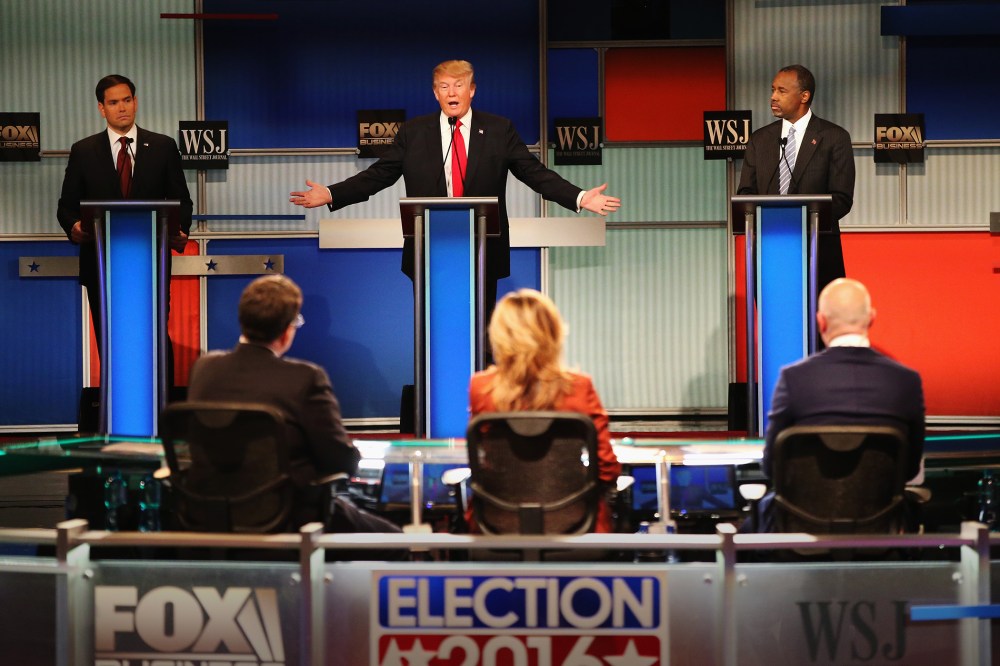
On the heels of last week’s Republican rebellion against the debate process, the moderators of Tuesday’s GOP debate hosted by Fox Business Network largely let candidates drive the conversation — allowing them to sidestep direct questions and stick with talking points.
“I would be remiss if I did not acknowledge the elephant in the room, and I’m not talking about your party’s fine symbol. I’m talking about the purpose of tonight’s debate: the economy and what each of you would do to improve it. No more, no less,” moderator Neil Cavuto said early in the debate — addressing the controversy surrounding the CNBC-hosted third GOP primary debate two weeks ago. In that debate, the moderators presented candidates with fact-checks, critical readings of their records, and pitted candidates against each other. Most of the Republican candidates chafed at the handling of the debate, with many sending aides to a joint meeting designed to lay out a series of criteria they’d demand of future networks. The Republican National Committee suspended an upcoming debate with CNBC’s sister networks, NBC News and Telemundo.
RELATED: Three major takeaways from the GOP debate
Tuesday’s debate was much more deferential, giving candidates considerable leeway. Participants were allowed longer answers — 90 seconds for each question and a minute to respond if their name was mentioned — and follow-ups from the moderators were limited and less forceful. Candidates weren’t pressed when they went off-topic or didn’t answer the questions they didn’t want to, allowing them at times to openly change the subject.
When Carly Fiorina was presented with data showing more jobs had been created under Democratic presidents than Republicans, and was asked how she’d “respond to the claim that Democratic presidents are better at creating jobs,” she didn’t answer. Instead, she argued that the upcoming election wasn’t about Democrats or Republicans, but rather about “challenging the status quo of big government,” before launching into a few of her talking points on the economy. She even asserted “problems have gotten much worse” under Democrats — completely ignoring the data the moderator had presented.
When Ohio Gov. John Kasich was asked whether he’d stop Chinese corporations from bidding on a major American hotel chain, he offered the audience “a little trip around the world,” listing a series of foreign policy problems without addressing the specific question.
And when Cavuto, the moderator, noted that Florida Sen. Marco Rubio had “called the recent Democratic debate in Las Vegas a night of giveaways, including free health care, free college and a host of other government-paid benefits” and asked which he’d take back, Rubio instead spoke about his own immigrant upbringing and the need to better foster business, without addressing the question at all.
RELATED: Six debate moments that could come back to haunt candidates
There were a handful of other factual flubs debate moderators did not respond to. During a lengthy and at times confusing answer on Syria, Dr. Ben Carson said that the Chinese were present in the war-torn country, though they have no known forces in the region. At another point, Carson said the unemployment rate rises when minimum wages are hiked, though there is no evidence of this.
In the undercard debate, all four candidates refused to name a Democrat they “most admired.”
“I need one name from each of you,” the Wall Street Journal‘s Gerald Seib asked.
Gov. Bobby Jindal refused to answer and said he wanted to enact term limits, while Gov. Mike Huckabee opted to talk about veterans – earning one of the few interjections of the night – but still finished his point. %E2%80%9CI%20thought%20the%20three%20moderators%20did%20a%20fantastic%20job.%20Not%20only%20really%20a%20good%20job%2C%20it%20was%20elegant.%20It%20was%20an%20elegant%20debate.%E2%80%9D’ “Since it seems to be an open question,” Gov. Chris Christie began to laughs, while Sen. Rick Santorum answered a previous question he hadn’t answered earlier in the debate. “Ronald Reagan did work with Tip O’Neill,” moderator Trish Regan reminded the candidates before the commercial break. The party and its leaders gave the moderation high marks, though. “I thought the moderators were fantastic,” Donald Trump said Wednesday on “Morning Joe.” “I thought the three moderators did a fantastic job. Not only really a good job, it was elegant. It was an elegant debate.” “I can say the candidates were very happy with you guys,” Carson told Cavuto after the debate. RNC chairman Reince Priebus said it was the “model going forward” for the debates.
Jane Timm Recommended


