








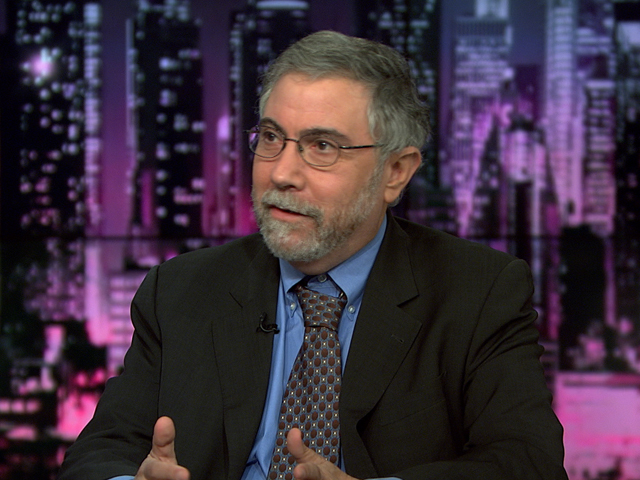
Kicking the can down the road is a much-maligned strategy in today’s politics. It suggests laziness and an unwillingness to do the tough, necessary work. But when it comes to the looming sequester–$1.2 trillion in automatic budget cuts set to occur in three weeks–economist Paul Krugman says it’s the best plan we have.
“The reality is, we should do nothing,” Krugman said on The Last Word Thursday. “The best thing to do right now is to kick the can down the road. We should not be having any spending cuts right now…The sequester is not serving any useful purpose that could be served better by something else.”
John Boehner doesn’t agree. He scolded Congress for its inactivity at a press conference Wednesday: “At some point, Washington has to deal with its spending problem,” he said. “I’ve watched them kick this can down the road for 22 years since I’ve been here. I’ve had enough of it. It’s time to act.”
In a New York Times opinion piece Thursday, Krugman reminds Boehner that when Bill Clinton left office he had lowered the federal-debt-to-GDP ratio by a third. Krugman calls the 1990s the “un-decade,” as many conservatives seem to forget that it ever happened. When Lawrence O’Donnell asked why this was, Krugman suggested it was to avoid responsibility for the 2000s.
“By making it that…everybody is to blame, they make it that nobody is to blame, which means that they themselves are not to blame,” said Krugman.
Krugman’s argument starts with the idea that cutting spending kills jobs. “This really isn’t a debatable proposition at this point,” he writes, pointing to failed austerity policies in Ireland and England. And if austerity is bad, sequestration is the worst kind of austerity, as it’s blunt and indiscriminate, slashing programs across the board.
Getting our debt under control may be the right thing to do eventually, Krugman says, but not now. When the Defense Department shrunk after the Cold War, businesses that depended on defense contracts were cushioned against serious fiscal damage by lowered interest rates. Today, the Fed has interest rates basically at zero. Rates can’t go any lower, which means we can’t create that same kind of buffer for those who will be affected by cuts.
“This is exactly the wrong time to be having fiscal austerity of any kind,” Krugman said on the Last Word. “And defense spending cuts are job destroyers just like anything else…If it all goes through, it’s enough push us certainly into rising unemployment, possibly even back into recession.” When asked why austerity is so popular among conservatives, despite the facts, Krugman points to a small group of influential people who talk only to each other. “They don’t believe stuff that’s coming from bearded college professors. Something like budget deficits, cutting entitlement programs–those are things that really fit their sense of what it means to make hard choices,” he said on the Very Last Word Thursday. “In Washington, hard choices is defined as making people who make less money than you suffer.” Visit NBCNews.com for breaking news, world news, and news about the economy
Evan Puschak Recommended


