Is growing political polarization between Democrats and Republicans creating more inequality?
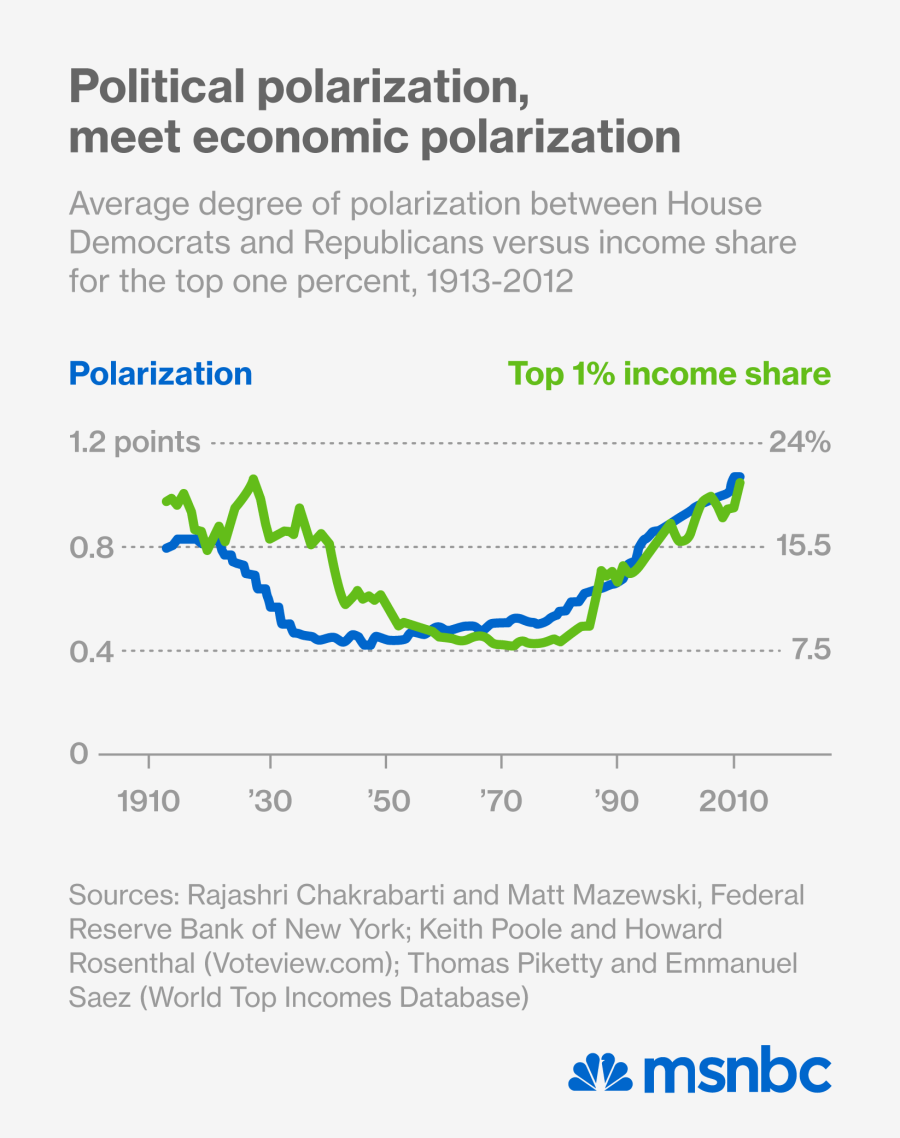
“The proximity of these trends is uncanny,” noted Princeton’s Nolan McCarty and Howard Rosenthal and the University of California San Diego’s Keith Poole back in 2003. Now, two researchers at the Federal Reserve Bank of New York, using an algorithm based on roll call votes developed by McCarty, Rosenthal and Poole, suggest that a growing ideological divide between House Democrats and House Republicans may be driving growth in income inequality. What’s more, this ideological cleavage is not equally the result of Democrats drifting leftward and Republicans drifting rightward: It’s mostly because Republicans have been drifting rightward.
%22The%20polarization%20gap%20between%20House%20Democrats%20and%20House%20Republicans%20is%20now%20wider%20than%20it%20was%20during%20Reconstruction.%22′
The data set that the Fed researchers used goes back to the end of the Civil War. It is hard to imagine any era when the roll call votes of House Republicans and House Democrats would have diverged more than during Reconstruction and its aftermath. From 1865 to about 1900 these two parties drifted further apart. Then, from 1900 until the end of World War II they grew closer together. After the war, House Republicans (who were usually in the minority) drifted leftward almost as rapidly as the House Democrats did. As a result, the gap between the two widened only slightly. Postwar Republican accommodation to FDR’s New Deal (which President Dwight Eisenhower termed “Modern Republicanism”) was a principal reason William F. Buckley sought to revive political conservatism with the 1955 founding of his magazine, National Review.
After President Lyndon Johnson signed the Civil Rights Act of 1964, he famously observed that Democrats had lost the South for a generation. It’s turned out to be more like two generations (so far); the retrenchment that followed passage of the civil rights laws continues today. Meanwhile, the patrician liberal wing of the GOP gave way to a less patrician “moderate” wing of the GOP (which itself is giving way to hard-right conservatism). These trends translated into growing polarization between House Democrats and Republicans beginning with the presidency of Gerald Ford. From 1975 on, the House Democrats’ leftward drift leveled off a bit; meanwhile, the House Republicans abruptly reversed their own leftward drift and turned sharply to the right. The degree of House GOP conservatism — its diversion from the mean — has been climbing steeply ever since. A graph in the Fed study pictures it as an almost completely straight line rising at a 45-degree angle.
%22Bitter%20partisanship.%20The%20rich%20pulling%20further%20away%20from%20the%20middle%20class.%20If%20the%20Fed%20study%20is%20right%2C%20these%20aren%E2%80%99t%20separate%20problems.%20They%E2%80%99re%20the%20same%20problem%2C%20and%20they%20originate%20in%20Congress.%22′
And here’s the shocker: The polarization gap between House Democrats and House Republicans is now wider — by a lot — than it was during Reconstruction. Even when the House was populated with representatives whose constituents, in living memory, had quite literally been killing one another, polarization along party lines was less extreme than it is today.
House Democrats and House Republicans don’t stand further apart today than during Reconstruction because House Democrats are drifting leftward, but because House Republicans are drifting rightward.
The Fed study references a 2012 blog item by McCarty, Rosenthal, Poole, and Christopher Hare, a doctoral candidate at the University of Georgia, about this “asymmetrical polarization.” Since 1975, House Democrats “have moved slightly to the left,” McCarty et al. write, “but most of this is a product of the disappearance of conservative Southern ‘Blue Dog’ Democrats.” Northern Democrats, meanwhile, are “ideologically indistinguishable” from their 1975 counterparts. (The same pattern can be observed over time in the Senate, the Fed study states, but it isn’t nearly as pronounced as in the House.) Now, superimpose a line showing the House’s GOP-driven polarization over a line showing income share for the top 1% going back to 1913 (which marks the advent of the modern income tax). They are practically the same line! The authors of the Fed study tried to identify a correlation between House polarization and GDP growth, hypothesizing that when the economy performed badly that would drive the two parties further apart. Interesting theory, but the patterns didn’t match. Political polarization and income inequality, on the other hand, fit together like Cinderella and her slipper. Would the same be true, the Fed authors ask, if political polarization were the Democrats’ fault? Actually, no: “Top income shares are more highly correlated with mean Republican … [rightward] scores in both chambers than with the difference in mean scores” between Democrats and Republicans. Mean Democratic leftward scores correlate with rising income inequality … not at all. Bitter partisanship. Rising gridlock. The rich pulling further away from the middle class. If the Fed study is right, these aren’t three separate problems. They’re the same problem, and they all originate in the rightward drift of Congress.
Timothy Noah Recommended