








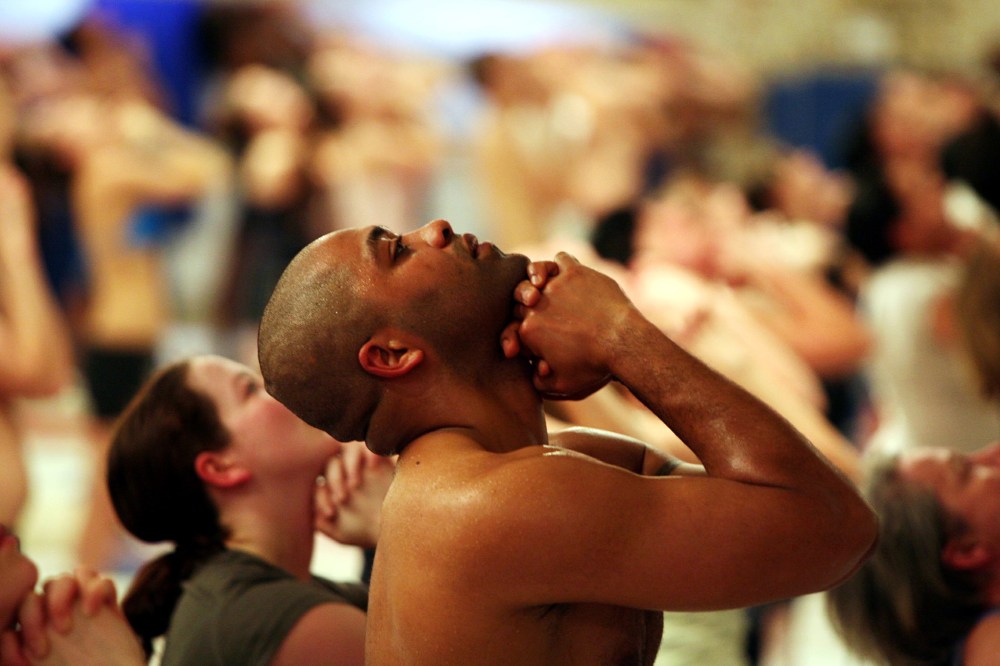
A federal court on Thursday ruled that yoga sequences are uncopyrightable.
In the 1970s, Bikram Choudhury, the “yogi to the stars,” developed a series of 26 different yoga poses that he advertised as being able to “avoid, correct, cure, heal, or at least alleviate the symptoms of almost any illness or injury.” Choudhury made a lot of money teaching this particular sequence, training other instructors in it, and licensing it to yoga studios around the world. When two of Choudhury’s former students opened their own studio using the same sequence of poses first created by Choudhury, he sued them for copyright infringement.
But is a yoga sequence even copyrightable?

To understand the issue, it is important to understand what wasn’t in dispute. Here, there wasn’t a question of whether Choudhury’s combination of different poses was sufficiently original and creative to merit copyright protection. Copyright law imposes an incredibly low bar to would-be authors, and no one claimed Choudhury failed to clear that bar.
Instead, the question was whether a yoga sequence constitutes copyrightable expression, or, if it is a process for producing a functional result, thereby placing it in the domain of patent law.
Choudhury’s sequence of yoga poses certainly has attributes of a “process.” A yoga practitioner engages in a particular series of poses in order to produce certain results. And unfortunately for Choudhury, he had spent a lot of time describing exactly what those results are. His advertisements consistently touted the healing benefits of his version of yoga.
Certainly we wouldn’t want to give someone a copyright in a pharmaceutical that cured erectile dysfunction or a surgical technique for ligament replacement. Doing so could unduly stifle competition in innovative industries.
RELATED: Appropriation art meets Instagram: Is copyright law ready?
And this is exactly what the 9th Circuit Court of Appeals held in rejecting Choudhury’s claim. If his method improves circulation or strengthens muscles, it is a functional process and only protectable under patent law.
But yoga isn’t entirely like pharmaceuticals or surgical techniques. It is also meant to affect people mentally. Practitioners might better commune with the divine or learn to feel satisfied with their lives. They might experience a wealth of different emotions or ideas. And the feelings they experience in their bodies and limbs may have significance beyond mere physical well-being.
Should these effects be treated like other physical results? Apparently not, according to the court. Choudhury argued that yoga is like dance—a well-recognized form of copyrightable expression. Both dance and yoga seem to combine the artistic with the functional. Just as some people practice dance for the health benefits, some people practice yoga for the beauty, artistry, and expressiveness associated with moving their bodies in certain ways. But the court was not persuaded. It seems to have treated all of the bodily effects of yoga as “functional” regardless of how they made people feel. For the court, the sequence of yoga poses was “functional” in the same way that a dish by Thomas Keller is functional. Choudhury made a lot of money touting the health benefits of his yoga sequence, so maybe it is fair that he is now prevented from ignoring those claims, and claiming instead that yoga is an art. Still, whether form dominates function, and which aspects of a work count as functions are two questions that remain deeply perplexing. Christopher Buccafusco is a professor at Benjamin N. Cardozo School of Law in New York City. His new article on copyright authorship is forthcoming in the Virginia Law Review and available to download here. Follow him on Twitter @cjbuccafusco.
Christopher Buccafusco Recommended


