








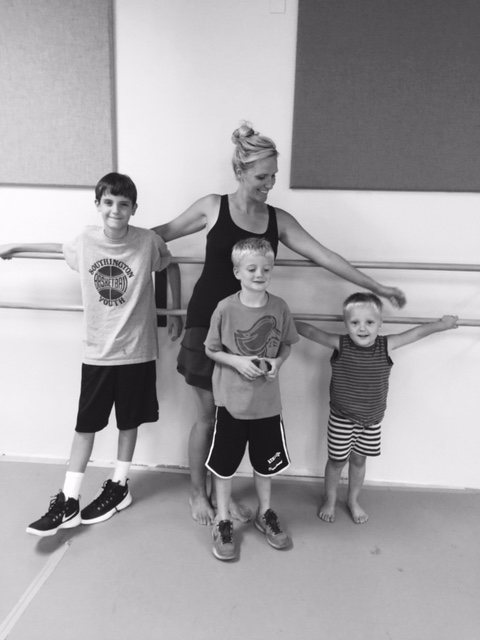
Grow Your Value finalist Diana Evjen has three sons and over 200 dancers. As the director and owner of a dance academy in Connecticut, Diana’s days begin at the crack of dawn and it’s full speed ahead: packing lunches, taking her sons to school, managing payroll, ordering costumes and scheduling for her dancers and then heading to the studio where she shares her lifelong passion with students at the Evjen Academy of Performing Arts, the business she started ten years ago with only six dancers.
In her submission video to the Grow Your Value bonus competition, Diana touched on a struggle that we as women know intimately: finding balance. As a mom, dance instructor, business-owner, wife and friend, Diana juggles the demands of many roles throughout the week and strives daily to master it all. While we often find this journey enjoyable and fulfilling, it can certainly spread us thin.
“I try to give a hundred percent to my kids. I try to give a hundred percent to my dancers. I work all the time,” Diana told me in her submission video. “I’m just trying to better myself as a business owner. And I’m constantly trying to balance that with being a good mom, a good wife, a good friend.”
Diana relies on dance to keep her grounded during life’s most trying days – a strategy she hopes to pass on to her dancers, who sometimes walk through the studio doors carrying the palpable stress of adolescence. More important to her than teaching the perfect pirouette is using dance as a medium to empower girls and help them remain present when things get tough. “When I’m dancing, I forget the problems of my day,” she told msnbc. “I know how hard it is to grow up as a woman, as a teenage girl. I feel very fortunate to be a dancer and to be able to reach girls in this way. I think they’re stronger when they leave.”
About seven months ago, Diana struggled to find her own strength after her youngest son EJ was diagnosed with Autism. She sat down at the kitchen table and cried, wondering how this would impact her family and three-year-old EJ’s future. A week after the diagnosis, therapists began working with EJ at home – adding an emotionally exhausting layer to the day.
Diana says she’s taking it in stride and continuing to use dance and teaching as her outlet – one that “saved” her as she searched for perspective and value. “It changed me, and it will forever change me,” Diana said of EJ’s diagnosis. “That’s my focus: on how I can still be the best me and be what he needs to survive and thrive in this world. I’m not going to take it as a bad obstacle. It’s been life-changing and that’s okay.” We selected Diana as a Grow Your Value finalist because her story represents so many women (including me) who are also trying, day in and day out, to give their all at work and at home. Diana took a necessary step by entering the Grow Your Value competition because what makes the struggle worth it is knowing that you are personally fulfilled with the choices you make. Don’t forget to take time for yourself—it will ultimately enable you to be the best version of yourself at home, at work and in life. You can catch Diana and the other Grow Your Value finalists compete for a $10,000 bonus at Chicago’s Know Your Value event on September 25 at msnbc.com/knowyourvalue where we’ll be livestreaming the event. And if you want to attend in person, you can still snag tickets. See you in Chicago!
Mika Brzezinski is the co-host of MS NOW's Morning Joe, founder of “Know Your Value” and author of four best-selling books, including “EARN IT!: Know Your Value and Grow Your Career, in Your 20s and Beyond” (Hachette Books; May 7, 2019) with co-author Daniela Pierre-Bravo. Prior to joining MSNBC in 2007, Mika was an anchor of CBS Evening News Weekend Edition and a CBS News correspondent who frequently contributed to CBS Sunday Morning and 60 Minutes. Recommended


