









Arkansas Senate candidate Tom Cotton is the kind of star recruit Republican strategists love. The first-term congressman, now 37, left Harvard Law School to join the Army after the 9/11 terror attacks. He served tours in Afghanistan and Iraq and then returned to Arkansas to run for office. President Obama’s approval ratings are abominable in the state, which has been trending conservative for years, and Cotton’s opponent, Democratic Sen. Mark Pryor, is considered one of the most vulnerable incumbents in the country.
Yet despite Cotton’s sterling biography and 2014’s supposed Republican lean, poll after poll shows the same problem: Arkansas voters just don’t like him. An NBC/Marist survey last month put Pryor up 51-40 over Cotton. Not only that, 39% of registered voters polled said they had a personally unfavorable opinion of Cotton, versus only 38% who liked him. With few exceptions, Pryor has led independent polls of the race.
“It’s something of a parlor trick: How can a Republican not win in Arkansas right now?” an editorial in the Arkansas Democrat-Gazette asked last month, citing Cotton’s struggles.
The answer to the question is simple: Democratic attacks – and lots of them.
Pryor got on TV early with campaign ads tying Cotton to House Budget Chairman Paul Ryan’s proposals to partially privatize Medicare. Meanwhile, the Senate Majority PAC has been running ads transforming Cotton’s biography from war hero into a consultant who “got paid handsomely working for insurance companies” — just one piece of $3 million in outside spending opposing Cotton so far. And Democrats across the state are bashing Cotton for voting against the Farm Bill in the House — the lone Republican from agriculture-heavy Arkansas to do so. Republicans are pouring millions of dollars into new pro-Cotton ads trying to build his image back up.

“He’s a strong candidate on paper,” Janine Parry, a professor political science at the University of Arkansas, told msnbc. “But what we’re seeing is that the few weaknesses he has are weaknesses the Pryor folks and their allies have exploited effectively and early.”
What’s happened to Cotton is hardly unique. In Senate races across the country, vulnerable Democrats are staking their candidacies on a preemptive offensive war that hey hope will knock their opponents out of the race before it ever begins. While Washington debates the nuances of coal and health care, control of the Senate might come down to which party’s candidates can throw the harder punch.
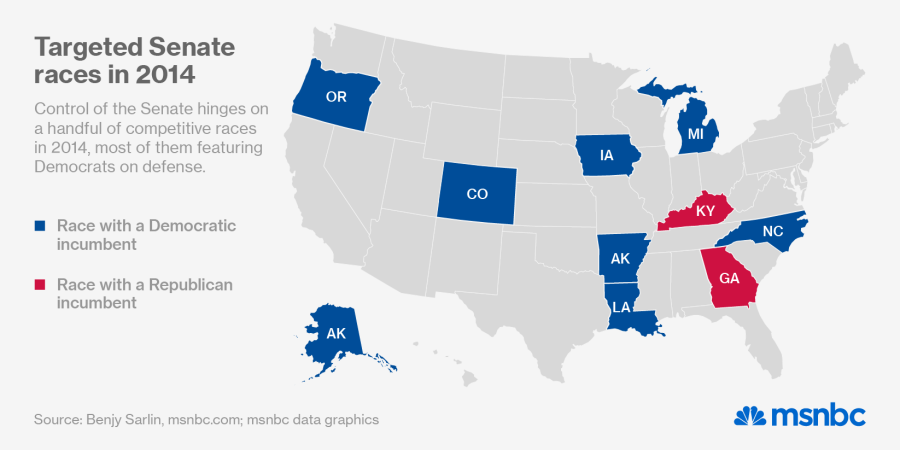
Defining opponents down
The strategy in Arkansas recalls the early months of the 2012 presidential contest, when President Obama’s re-election campaign spent big money defining Republican Mitt Romney as a plutocrat and corporate raider well before Romney accepted his party’s nomination.
Democrats prefer to stress that their candidates have done a great job “localizing” elections by focusing on the interests of their individual states instead of the one-size-fits-all GOP message built around opposing Obama’s agenda at every turn.
“We’ve been saying for some time we’d make this about the candidates on the ballots,” Justin Barasky, national press secretary for the Democratic Senatorial Campaign Committee, told msnbc. “That’s not to say there won’t be a ton of close races, but we think when you put the records of Republicans next to their names it balances out favorably.”
Republicans are crying foul, however, saying Democrats are tearing into their opponents with whatever weapon they can find to distract from the GOP’s otherwise strong message.
“We’ve been saying for the last year that in 2012 Democrats built and ran the nastiest campaigns our nation has ever seen,” Brook Hougeson, press secretary for the National Republican Senatorial Committee, said in an e-mail. “We know that they will ignore their records and focus on the politics of personal destruction. That process has already started.”
%22%5BI%5Dn%202012%20Democrats%20built%20and%20ran%20the%20nastiest%20campaigns%20our%20nation%20has%20ever%20seen.%22′
To the extent there’s been a unifying theme to the Democratic offense, it’s been the ongoing effort to portray Republican hopefuls as irreconcilably captured by their party’s right flank — a strategy that’s played out extensively in Arkansas. The rise of the tea party has pushed Republican candidates into near-uniform positions on most partisan issues, giving them less flexibility to assert their independence in a general election.
National Democrats are already trying to brand Joni Ernst, who won the GOP nomination in Iowa on Tuesday, as “the Sarah Palin of Iowa,” jumping off her rowdy image as a farmer who likens castrating hogs to slashing spending and fires shots (figuratively and literally) at Obamacare. Once again, the goal is to portray her as an extremist largely produced by out-of-state conservative movement forces. Democratic nominee Bruce Braley is already up with his first attack ad, a relatively gentler spot that accuses Ernst of failing to secure significant spending cuts in the state legislature. While Ernst is fast becoming a celebrated GOP star, Braley has led every poll so far that matches them up against each other.
Democrats are focusing in particular on convincing moderate women who have buttressed the party in recent years not to give the GOP a second look regardless of the individual candidate.
These tactics have been most pronounced in blue states where Republicans have been trying to expand the map in 2014.
Republican leaders have pointed to Michigan’s open seat as a prime pickup opportunity for months, thanks to a promising candidate, Terri Lynn Land, a former secretary of state whom the GOP hoped would be able to undermine Democrats’ “War on Women” messaging.
Land led Democrat Gary Peters in a series of early surveys, but has fallen behind in the latest round amid an all-out air assault from Peters and outside groups supporting his campaign. The attacks included a special effort to neutralize Land’s appeal to women, highlighting her anti-abortion position and skepticism of Democratic “equal pay” proposals.
They’ve also leveled more personal critiques aimed at undermining Land’s blue collar biographic appeal. After Land ran ads describing her humble upbringing in a trailer park, Peters ran a brutal response ad describing how Land later purchased the same trailer park and evicted 170 families for a planned development that never happened.
Like most Democratic candidates, Peters has faced millions of dollars in attack ads himself, mainly anti-Obamacare spots by the Koch-backed Americans For Prosperity. The difference is their effectiveness: pollsters have found Peters moving into a lead as Land’s image crumbles.
“The ads by Peters (and his allies) attacking Land on women’s issues have had more of an impact in terms of the race than the Obamacare attacks on Peters have benefitted Land,” EPIC-MRA pollster Bernie Porn told the Detroit Free Press last month after finding Peters up six over Land thanks to a 14-point advantage with women.
A separate Detroit News poll the same week found Peters up four amid a similar boost from female voters. Both polls found slightly more respondents had an unfavorable view of Land than had a favorable one.
The Democratic strategy is similar in Colorado, where Republicans are touting Rep. Cory Gardner – whose friendly personal style is one of his top strengths – as the ideal candidate to unseat Democratic Sen. Mark Udall.
Looking to throw Gardner off balance before he could establish himself statewide, Udall ripped into his opponent with ads highlighting Gardner’s support for an anti-abortion “personhood” measure that could ban some forms of contraception – a position Gardner has since abandoned. Once again, the goal is to make Gardner unacceptable to swing voters, especially women, before he has a chance to make his argument.
“If you’re thinking this is really early for campaign ads, it is,” local KUSA reporter Brandon Rittiman said in a segment on Udall’s ad buy. He noted that candidates in Colorado usually wait until later in the cycle when they can get discounted rates from TV stations.
%22If%20you%E2%80%99re%20thinking%20this%20is%20really%20early%20for%20campaign%20ads%2C%20it%20is.%22′ Quality independent polling in the Colorado race is scant, so it’s unclear whether the Democratic strategy is working so far. The most recent survey, a PPP poll sponsored by the League of Conservation Voters, offered a hint of concern for Republicans: Voters had an unfavorable opinion of Gardner by a 42-37 margin, worse than Udall’s weak 42-45 approval rating. Udall led by four in the poll. “I’m not sure how effective running ads earlier is going to be for (Democrats) but they’re trying to define Gardner as an extremist,” Katy Atkinson, a GOP strategist in Colorado, told msnbc. In Oregon, yet another race where Republicans pinned high hopes on a compelling female candidate, the GOP looks like it might be falling out of contention. In this case the issue isn’t TV ad spending, which has yet to take off, but a personal scandal that dropped right before the state’s primary last month that may or may not have been fueled by Democratic research. Dr. Monica Wehby rose to national attention with a feelgood ad illustrating her work as a pediatric surgeon. But after two police reports emerged in which Wehby had been accused of harassing an ex-boyfriend and her ex-husband, the first round of general election polls show Wehby trailing Senator Jeff Merkley by double-digit margins and personally unpopular with voters. Republicans complain the stories are a political low blow and Merkley has denied any involvement in the reports’ emergence in the press. Whether his campaign or other Democratic operatives leaked the story, it certainly was a weapon sitting in their arsenal. The Oregonian reported that a researcher with the state Democratic Party first obtained one of the police reports in April. Democrats are fanning the flames around the story indirectly by pointing out that Wehby has refused to address reporters for weeks since the police reports surfaced. But the Merkley campaign plans on employing a broader strategy similar to other states: tie Wehby, who holds relatively moderate positions on abortion and immigration, to the national GOP and never let her go. Peaking early? Republicans are skeptical whether the early barrage will prove effective come November. While it may provide a summer boost in the polls in certain races, the buzz could wear off by the post-Labor Day period when voters traditionally are more focused on races. “You can define either candidate now, I’m just not sure doing it this early sticks,” Atkinson, the Colorado GOP strategist, said. “I don’t think they’re really going to penetrate with what will end up being the swing voters.” Republican strategists note that some of the candidates most committed to early attacks are burning through campaign funds to do so. Peters in Michigan, for example, had already spent $1.85 million by March 31, the most recent filing deadline, versus just $859,000 from Land, who also has a larger campaign account thanks to a $1.7 million loan she gave to her campaign. In Arkansas as of April 30, Pryor has spent $5.8 million to Cotton’s $3.1 million. The Democrats haven’t always clearly moved the needle either. In North Carolina, mostly Democratic outside groups spent $4.2 million dragging down GOP nominee Thom Tillis, whom Democrats hoped would lose to fringe GOP primary rival Greg Brannon. Tillis won and the limited polling available in the race has shown him essentially tied with incumbent Democratic Sen. Kay Hagan, who is a major target of attack ads from outside groups as well. Across the country, both sides can count on plenty of outside money backing them up in key races thanks to an explosion of spending kicked off by the Supreme Court’s 2010 Citizens United decision. That may mean there’s less reason to conserve dollars now. Jim Manley, a Democratic strategist and former aide to Senate Majority Leader Harry Reid, told msnbc that today’s campaign environment demands candidates strike early and often %22You%20can%20say%20people%20won%E2%80%99t%20pay%20attention%20until%20after%20Labor%20Day%2C%20but%20I%20think%20it%E2%80%99s%20an%20old%2C%20antiquated%20way%20of%20thinking.%22′ “You can say people won’t pay attention until after Labor Day, but I think it’s an old, antiquated way of thinking,” he said. “You need to get ahead of the process much earlier than you needed to in years past.” Manley suggested that in identifying individual candidates as too conservative at the start of the race, Democrats were “building a larger narrative about how extreme the GOP has become” that would pay off down the line. This was the thinking behind the early assault on Romney in 2012, which campaign staffers on both sides credited with setting the stage for Obama’s victory. Political scientists are less sure: Lynn Vavreck and John Sides, author of “The Gamble,” reported they found little polling evidence Obama’s initial attack ads did much to knock down Romney. At the very least, Democrats seem to have more confidence in their offense at the moment. Republican candidates have been subtly (and sometimes not-so-subtly) shifting their focus away from Obamacare, which dominated their own first volley of attack ads.
Benjy Sarlin Recommended


