









Shell Oil sent a drill bit spinning through the icy waters of the Arctic and into the bed of the Chukchi sea late Thursday, officially starting its first exploration in the area since a disastrous effort in 2012.
At about the same time, an ice breaker controlled by Shell pierced the blockaded mouth of Portland’s Willamette River, avoiding dozens of activists dangling from a bridge and swarming the waters.
The ship set a new course for a location about 70 miles off the Alaskan coast, where the oil giant hopes to net a multi-billion barrel discovery after spending 10 years and more than $7 billion without pumping a single drop.
“Indeed, it is a major milestone,” spokesperson Curtis Smith told msnbc Friday. Shell is permitted to drill the tops of two wells in the Chukchi. But with its stricken ice breaker on the mend and en route, Shell plans to ask the Obama administration for permission to go deeper, down to the actual oil.
RELATED: Shell’s profits fall as protests mount over Arctic drilling
Earlier Thursday, protesters with Greenpeace, Rising Tide and Indigenous People’s Power succeeded in forcing the MSV Fennica back against a wall of people. Some hung in hammock-like pouches, dangling from the 408-foot St. John’s Bridge. Others slipped into kayaks, dubbing themselves “kayaktivists.”
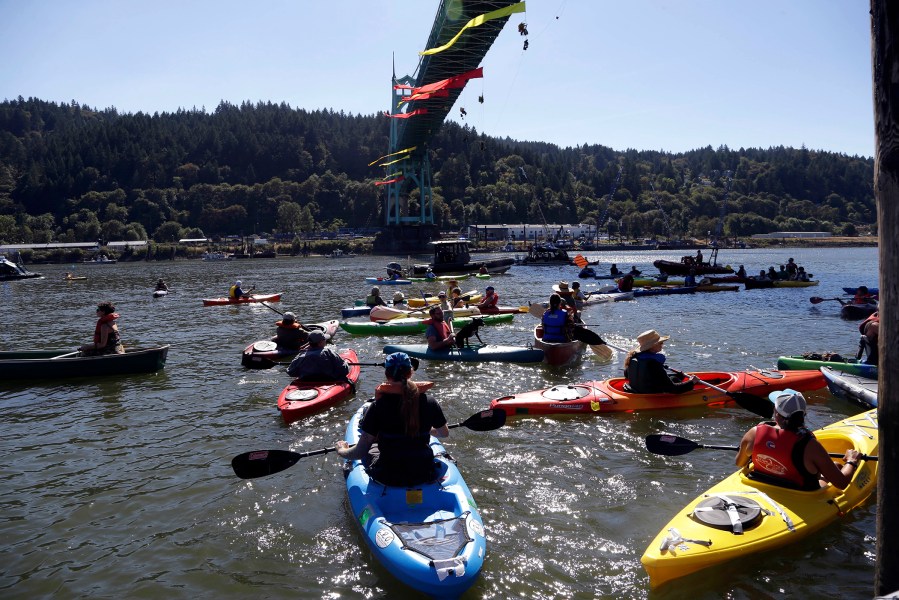
They hoped to put a brighter bulb in the spotlight on Shell’s Arctic ambitions — and the Obama administration’s decision to approve them. They brought supplies to last several days, according to activists on the ground. But in the afternoon, after hours of blue-sky quiet, the scene turned darker.
Police boats and other authorities circled kayakers and forced the danglers down into the water. Between 21 and 25 people were arrested, according to Meredith Cocks, one of the organizers. More than 10 were detained at a nearby Coast Guard station, leaving with citations.
“There were serious issues around the way safety was handled in the process to clear the river,” Cocks told msnbc, describing a scene where authorities rammed kayaks, forcing their occupants into the water. “Law enforcement boats including Coast Guard vessels were clearly prioritizing moving the Fennica through.”
By about 6 p.m. Thursday on the West Coast the authorities had cleared a path for the football-field sized vessel. The forceful response came after a federal judge in Alaska ordered Greenpeace to pay escalating hourly fines — from $2,500 Friday to $10,000 on Sunday — for delaying Shell’s work.
The order was based on an earlier ruling in May, spurred by similarly intense confrontations with Shell’s rigs in Seattle. Federal District Court Judge Sharon Gleason ordered protesters to stay at least 100 yards away from Shell’s vessels when underway. Within hours of this week’s ruling — which put protesters in contempt of court — the authorities moved in.
The ship’s next confrontation could come in Astoria, Oregon, where it was expected to arrive after 11 p.m. local time, according to NBC News. The Coast Guard said it was prepared to enforce a 500-yard safety zone around the Fennica as it navigated toward the open ocean.
Under the terms of Shell’s drilling plan, approved in May by the Obama administration, the company has to have the ship on site because it carries a special Arctic-ready spill containment system.
Without the ship, there’s no drilling – which is why activists decided to take this stand now. And why Shell was so aggressive in court.
The protests coincided with Shell’s second quarter earnings report, which showed a dismal $2.3 billion drop in profits. Thousands of layoffs are planned, among other adjustments, adding urgency to the oil giant’s Arctic push.
The exploration is already among the costliest, most complicated and controversial in the history of hydrocarbon fuel. Three years ago, Shell’s flotilla of rigs and support vessels chugged confidently toward the Chukchi Sea, about 70 miles off the untamed coast of northern Alaska. Even before they arrived, however, problems developed. The company’s special spill containment system failed a test run. One of its rigs lost anchor and drifted. Another rig, the Kulluk, later ran aground and was totaled. The contractor in charge ultimately plead guilty to eight felony charges related to the wreck. But worst of all, Shell drilled just two of its five planned exploratory holes, and those only to a partial depth. The company has until Sept. 28 to complete its work, ahead of heavy weather and plummeting temperatures. Before then it hopes to prepare a wellhead for production as soon as next summer. The company’s leases start expiring in 2017. Despite Shell’s progress, activists claimed success on Thursday. “Portlanders–and @greenpeaceusa @350_PDX @pdxrisingtide and all the rest–have done themselves proud these last days. Historic scenes!” said Bill Mckibben, the founder of 350.org and the organizer of last summer’s massive climate march in New York City. The Sierra Club, 350.org, and Rising Tide, among others, plan to hold a celebration Friday in Cathedral Park on the banks of the Willamette. “The mood is festive,” Rising Tide’s Mia Reback told msnbc. “People are celebrating the tremendous demonstration of people power and beginning to talk about what’s next.” Portlanders–and @greenpeaceusa @350_PDX @pdxrisingtide and all the rest–have done themselves proud these last days. Historic scenes!
Tony Dokoupil Recommended


