








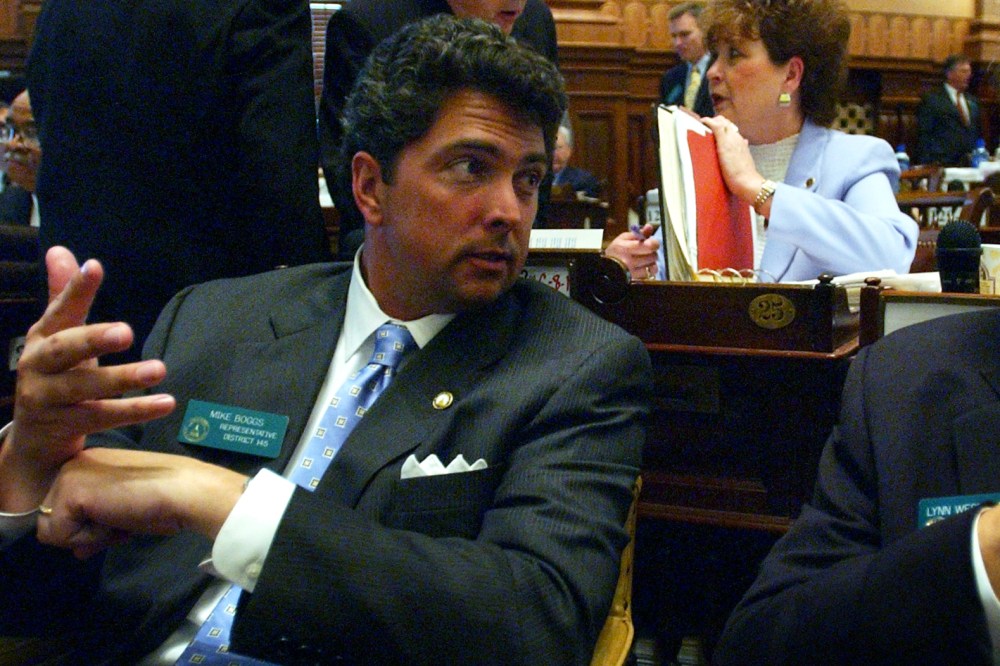
Democratic senators on the Judiciary Committee grilled a district court nominee Tuesday on his views on abortion rights, the Confederate flag, and gay marriage.
The nominee, Georgia state court judge Michael Boggs, has been fiercely opposed by progressive groups, largely because votes he took and remarks he made on those issues while serving in the state legislature.

“There is a question among many of my colleagues whether an activist conservative can become a judge that is not an activist judge,” said Senator Dianne Feinstein.
Boggs repeatedly said he would respect precedent and the rule of law, including on abortion rights, and that it would be “inappropriate” for him to state a position on such issues.
He did repudiate a vote to put detailed information about abortion providers online, one that was of particular interest to several senators, who said it would have exacerbated violence and harassment. “There could clearly be public safety implications for these doctors if you put this detailed information about them online,” said Senator Amy Klobuchar.
Boggs said the vote was “ill-conceived, I believe, in hindsight.”
%22Do%20we%20work%20with%20Republican%20senators%20to%20find%20a%20compromise%2C%20or%20should%20we%20leave%20the%20seats%20vacant%3F…%20We%20believe%20it%20would%20be%20grossly%20irresponsible%20for%20the%20president%20to%20leave%20these%20seats%20vacant.%22′
On his vote to keep the Confederate flag imagery in the Georgia state flag, Boggs said the decision was “terribly agonizing” but that he had voted in accordance with the “overwhelming majority of my constituents.”
“If someone is accusing someone of being a racist, how do you disprove that? I think the best evidence I would have is that the people who know me best don’t believe that of me.” He pointed out that African-American Democratic officials had later supported him in a primary: “They know me. They know that that vote was not indicative of any bias I held towards anyone.”
LGBT groups are also opposing Boggs’ nomination, citing his support for a state amendment banning gay marriage. Boggs gave a floor speech urging his colleagues to “stand up for things that are common-sensical, things that are premised on good conservative Christian values, and in this instance in particular, to support the sanctity of marriage.”
In the hearing, Boggs was ambiguous about gay marriage, saying at one point that his views “may or may not have changed.”
President Barack Obama nominated Boggs as part of a slate of nominees put forward by Georgia’s Republican Senators, Johnny Isakson and Saxby Chambliss, in an attempt to chip away at longtime judicial vacancies. White House counsel Kathryn Ruemmler defended the pick to the Huffington post in February: “Do we work with Republican senators to find a compromise, or should we leave the seats vacant?… We believe it would be grossly irresponsible for the president to leave these seats vacant.” There’s a reason the process has stalled even after filibuster reform: The Judiciary Committee’s chairman, Sen. Patrick Leahy, has maintained the informal “blue slip” tradition, which essentially gives Senators veto power over their states’ judges. Leahy told msnbc in November that he won’t budge on the tradition unless he thinks it’s being abused. But opponents of Boggs’ nomination think it is proof of just that, with Republican senators getting too much sway over the nominees of a Democratic president. Georgia’s five Democratic congressmen have also raised concerns about the deal that led to the nomination, saying their input was ignored. Lower court judges have a crucial role in deciding whether the cascade of anti-abortion legislation in the states violates Supreme Court precedent in Roe v. Wade and Planned Parenthood vs. Casey. This month alone, two district court judges in Alabama and Wisconsin will consider the constitutionality of laws passed in those states that threaten to shut down several of the states’ abortion clinics. It is rare for progressive groups that generally agree with President Obama on the issues to oppose one of his judicial nominations. (They have spent far more time lamenting that he was slow in his first term to nominate judges at all, after the Bush administration made it a priority.) It remains to be seen how seriously the senators will take those concerns, particularly after Boggs’ generally smooth deflection of their questions. But in addition to Klobuchar and Feinstein, Senators Al Franken, Richard Blumenthal, and Mazie Hirono all raised concerns. “For me I have to make a judgment, whether you mean what you say,” said Feinstein, “or whether it will be just like Supreme Court justices who pledged to us diligent pursuance of stare decisis” — or judicial precedent — “and it just didn’t happen.”
Irin Carmon Recommended


