








When it comes to Republican Party rhetoric, much of it is so reflexive and reactionary, debates no longer require any thought at all. Those who mention the gap between the rich and poor are guilty of “class warfare.” Those who believe the Pentagon budget is too big are “weak on defense.” And those who support court rulings the right doesn’t like are “judicial activists.”
The whole idea of “judicial activism” has been stripped of all meaning in recent years — it’s now simply a synonym for “rulings I don’t like.” But as E.J. Dionne Jr. explained today, anyone looking for legitimate examples of the phenomenon need look no further than this week’s hearings.
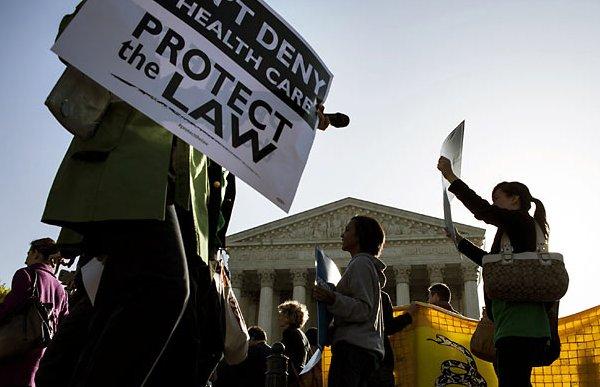
Three days of Supreme Court arguments over the health-care law demonstrated for all to see that conservative justices are prepared to act as an alternative legislature, diving deeply into policy details as if they were members of the Senate Health, Education, Labor and Pensions Committee.
Senator, excuse me, Justice Samuel Alito quoted Congressional Budget Office figures on Tuesday to talk about the insurance costs of the young. On Wednesday, Chief Justice John Roberts sounded like the House whip in discussing whether parts of the law could stand if other parts fell. He noted that without various provisions, Congress “wouldn’t have been able to put together, cobble together, the votes to get it through.” Tell me again, was this a courtroom or a lobbyist’s office?
It fell to the court’s liberals — the so-called “judicial activists,” remember? — to remind their conservative brethren that legislative power is supposed to rest in our government’s elected branches.
Justice Stephen Breyer noted that some of the issues raised by opponents of the law were about “the merits of the bill,” a proper concern of Congress, not the courts. And in arguing for restraint, Justice Sonia Sotomayor asked what was wrong with leaving as much discretion as possible “in the hands of the people who should be fixing this, not us.” It was nice to be reminded that we’re a democracy, not a judicial dictatorship.
Well, at least not yet.
I’m sensitive to the “rubber/glue” style of discourse. No one benefits when one side says, “Your judges are judicial activists,” only to hear rivals say in response, “Nuh uh, your judges are.”
But the facts are hard to avoid: among the key lessons learned this week is that the Supreme Court’s conservative bloc perceives themselves as some kind of unelected Super Legislators.
Jon Chait’s piece last night helped provide some additional context to the trend.
Five years ago, Jeffrey Rosen wrote a startling essay in the New York Times Magazine, describing a radical turn of events that is being borne out before our eyes. In the piece, Rosen described the rise of a new strand of conservative and libertarian judicial activists who believed the Constitution required small-government policies. Advocates of this theory believed judicial intervention was legally justified, of course, but also that it was necessary to win policy victories that conservatives could not obtain through Congress. “To Greve’s dismay,” wrote Rosen, citing one such scholar, “much of the regulatory state is politically quite popular; even a Republican Congress, he acknowledged, seems unlikely to roll back most post-New Deal programs and regulations. ‘Judicial activism will have to be deployed,’ he said. ‘It’s plain that the idea of judicial deference was a dead end for conservatives from the get-go.” What made Rosen’s piece so shocking was that, for decades, judicial activism had been primarily associated with the left — liberal judges handed down broad readings of laws to expand rights, enraging conservatives who believed they were taking upon themselves decisions better left to democratic channels…. The whole conservative legal and political movement had come to orient itself around opposition to judicial activism, which actually remains the term Republican politicians use to disparage liberal judges. The only thing Rosen truly failed to anticipate in his piece was how quickly Republican judges would pivot from impassioned defenses of judicial restraint to judicial activism when the opportunity arose to deploy it in their party’s behalf Right. Conservative jurists loathed the very idea of judicial activism, right up until they were given an opportunity to engage in some of their own. Before, Antonin Scalia thought such conduct from the bench represented a “threat to constitutional democracy.” Now, he’s comfortable repeating bogus Fox News policy arguments, which are unrelated to the legal dispute, during oral arguments. Put it this way: the only real differences between this week’s Supreme Court deliberations and one of the congressional hearings on health care reform were (a) in 2009, Democrats outnumbered Republicans; and (b) in congressional hearings, policymakers tend to speak one at a time. I don’t imagine this will stop Republicans from whining incessantly about “judicial activism” between now and the end of time, but there’s no reason for fair people to take their complaints seriously.
The place for in-depth analysis, commentary and informed perspectives. Recommended


