








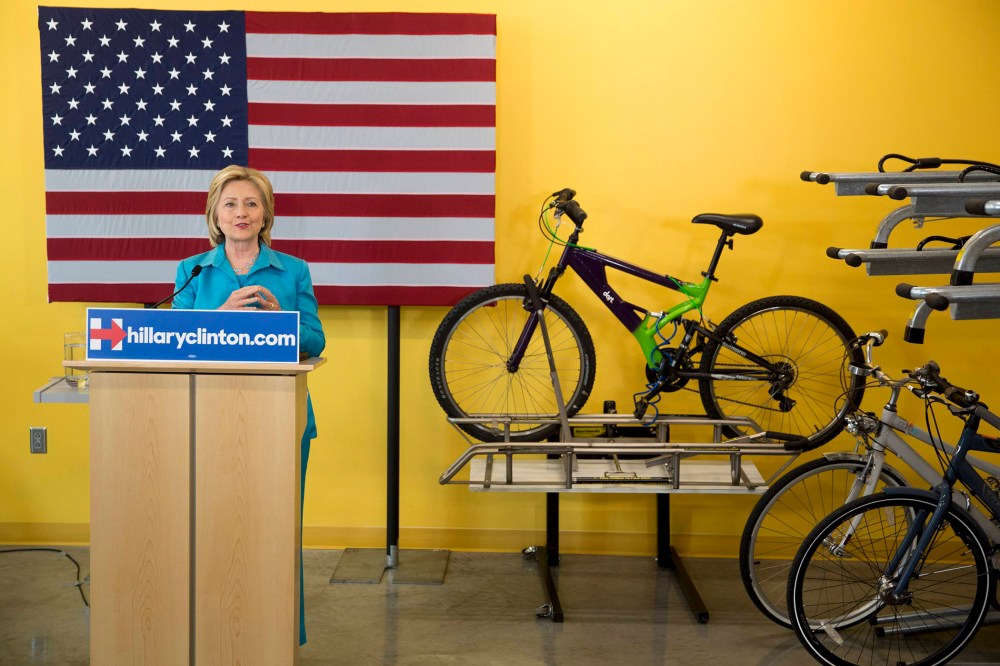
Democratic presidential candidate Hillary Clinton pledged to “heed the warnings” of climate change on Monday, offering the first peg of a promised six-point policy meant to make America “the clean energy superpower the world needs.” But she remained mum on the Keystone pipeline, Arctic drilling, and the details of her broader climate policy.
Clinton’s proposed goal — unveiled at a podium flanked by commuter bikes at a Des Moines, Iowa, train station — is to create enough clean energy to power every home in the United States by 2027. That’s an aggressive target by any measure. To put it in perspective, Clinton just vowed to oversee a near-tripling of the portion of the U.S. electricity market supplied by renewable energy. Currently, the country gets about 13% of its electricity from wind, solar and other green sources. Clinton’s pledge would require her to boost that figure to at least 33%.
RELATED: Is Clinton all talk, no substance on climate policy?
The proposal, which calls for a 700% increase in solar capacity, sped along by the installation of a half billion new solar panels by the end of Clinton’s first term, was generally cheered by environmental groups and analysts. The Sierra Club’s executive director Michael Brune called it a “strong plan,” while environmentalist mega-donor Tom Steyer blessed it as “an ambitious framework” in line with his own high standards.
Clinton says she'll lay out a plan for "safe and responsible" fossil fuel production. In an age of climate catastrophe, that's an oxymoron.
— Jamie Henn (@Agent350) July 27, 2015Others, however, were considerably less impressed. After all, Clinton has yet to take a position on many of the acid-test issues that matter most to the green movement. She hasn’t come out against offshore drilling, notably in the Arctic. She’s silent on a wished-for national ban on hydraulic fracturing. As secretary of state she said she was “inclined” to approve the Keystone XL oil pipeline from Canada to the Gulf coast, and she’s yet to comment further as a presidential candidate.
“Hillary Clinton is half the way there,” said 350.org co-founder Bill McKibben in a statement. “Because at the end of the day, growth in renewables doesn’t mean enough if we’re simultaneously kicking the decarbonization can down the road with more pipelines and more extraction on public lands.”
350 Action, the political arm of 350.org, went further, mocking Clinton’s explicit support for the continued production of fossil fuels. “Clinton says she’ll lay out a plan for ‘safe and responsible’ fossil fuel production,” co-founder Jamie Henn said in a tweet. “In an age of climate catastrophe, that’s an oxymoron.”
But perhaps the biggest gap in Clinton’s plan thus far is the magic formula for how it would actually be implemented.
Here’s what she promised: She’d veto any attempts by Republicans to weaken or repeal President Obama’s nearly-final Clean Power Plan. That’s important, because the plan would put strict limits on coal emissions. If successful, the plan would get Clinton close to her renewable energy targets. She also said she’d push the market further by extending federal tax credits for wind and solar — credits set to expire under the watch of the next president.
RELATED: Clinton’s climate hecklers may have a point
But Clinton doesn’t have much power over either lever. President Obama’s proposed regulations have already been attacked in court, and many expect its ultimate fate to be determined by the legal system. The tax credits, meanwhile, depend on Congress, which is hardly a guaranteed ally on progressive energy policy.
Clinton’s plan also faces epic technical hurdles. If wind and solar are ever to supply 30% or more of U.S. electric consumption, we’ll need to radically overhaul the grid system. The issues with America’s aging electric grid get technical very fast, but perhaps it helps to picture the system as a giant orchestra. The grid manager is a bit like a baton-waving conductor. For the lights to snap on when we like, the conductor has to call power into being and send it around grid. Right now, however, the system can’t easily handle any new notes — and it will be hard to upgrade quickly. “Technologically, the tools are available. Economically, the total system costs would be lower than a business-as-usual scenario,” Vox’s David Roberts wrote recently in a three-part series on the challenges of actually making wind and solar work. “But politically, the plan is wildly ambitious, to the point of fantasy.” It would require policy and investment decisions that are approached holistically, coordinated across multiple sectors, and made on the basis of long term cost-benefit calculations, he argued. In others words, it would require the exact opposite of what the American political system has been able to muster of late. Clinton herself seemed to recognize these challenges more fully in the past. During her last presidential campaign, for example, her climate change policy called for a National Energy Council, modeled on the National Security Council, to help coordinate a renewable energy transition across multiple offices, agencies, states and jurisdictions. Now, however, she seems to be leaving the transition up the market. For instance, she would create a “Solar X-prize” and a “Climate Action Competition.” Each would offer cash to communities and states with the best “market-based” ideas for accelerating green power. In a further affront to environmentalists, Clinton’s plan doesn’t mention a cap on carbon admissions either. Back in 2007, she proposed a cap-and-trade system that would reduce emissions 80% by 2050. This time, she appears to be counting on her vision being adopted voluntarily — an approach that hasn’t worked so far. But stay tuned: there are still five more planks of Clinton’s policy to come, and her rhetoric alone is promising. “The reality of climate change is unforgiving,” she said in Des Moines on Monday. “We have no choice but to rise and meet it.”
Tony Dokoupil Recommended


