








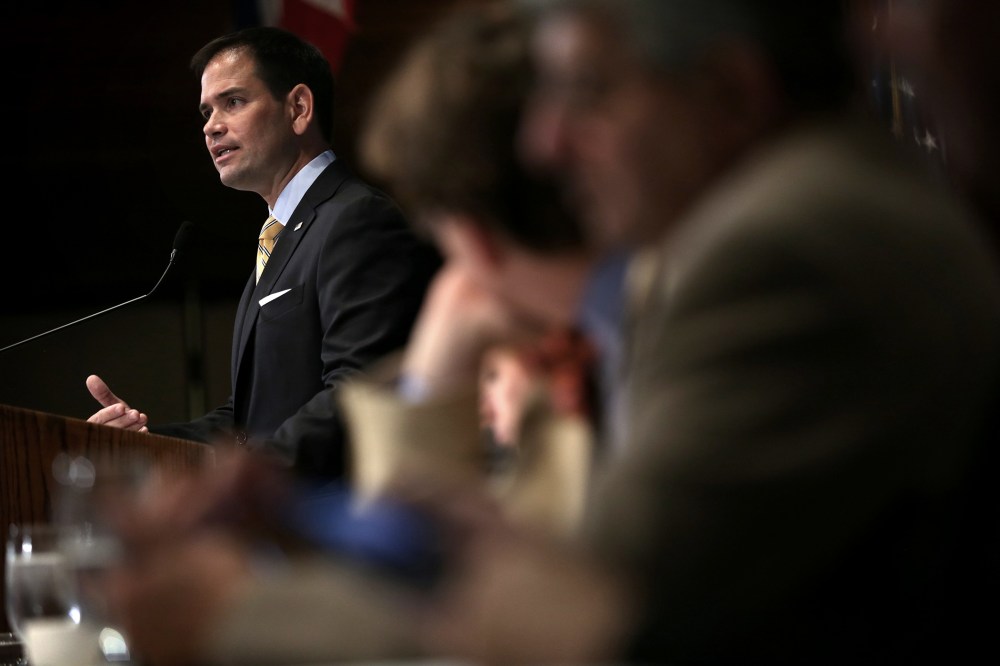
Florida Republican Sen. Marco Rubio recently fired back at criticism of his stance on climate change – he said last weekend that he did not believe climate change is caused by human activity — by changing the subject to abortion.
“Let me give you a bit of settled science that they’ll never admit to,” the likely 2016 presidential contendertold Sean Hannity Wednesday. “The science is settled, it’s not even a consensus, it is a unanimity, that human life begins at conception. I hope the next time someone wags their finger about science, they’ll ask one of these leaders on the left: ‘Do you agree with the consensus of science that human life begins at conception?’
In fact, “life” and “conception” aren’t scientific terms, and the rights of a blastocyst, embryo or fetus compared to the pregnant woman aren’t up to scientists; they’re subjective, based on personal, religious, or political commitments. But it’s ironic that Rubio should mention science and abortion. He and his fellow Republicans have passed numerous laws restricting women’s health with stated rationales that directly contravene scientific or medical consensus.

Or, as the American College of Obstetricians and Gynecologists, the American Academy of Pediatrics, the American Academy of Family Physicians, the American College of Surgeons, and the American College of Physicians recently wrote in the New England Journal of Medicine, “Legislators, regrettably, often propose new laws or regulations for political or other reasons unrelated to the scientific evidence and counter to the health care needs of patients.”
Here are just a few of those laws.
“Fetal pain.” Rubio is a co-sponsor of the “Pain-Capable Unborn Child Protection Act,” introduced in the Senate late last year. It bans abortions after 20 weeks on the premise that fetuses can feel pain at that point. (That’s against current Supreme Court precedent, which says abortion can’t be banned until viability, but supporters hope it will be a vehicle to change that.) According to an exhaustive literature review in the Journal of the American Medical Association, there is no scientific evidence for that claim. In fact, pain receptors typically only show up in fetal development at around 29 or 30 weeks.
The claim that birth control is abortion. Rubio signed onto an amicus brief in the Hobby Lobby case before the Supreme Court, arguing that the company and others with religious objections should be able to opt out of contraceptive coverage under the Affordable Care Act. Just as Hobby Lobby’s owners have, the brief repeatedly equates contraception and abortion, pointing to emergency contraception and the IUD in particular, which they say can block implantation of a fertilized egg. According to Princeton’s Office of Population Research, “There is no evidence to suggest that either of the FDA-approved emergency contraceptive options…works after an egg is fertilized.” There are two kinds of IUDs, one that is hormonal and prevents ovulation in the first place, and one that, according to the Princeton site, may prevent implementation of a fertilized egg. But that’s not abortion either, according to the scientific definition, because pregnancy begins with implantation. Claims that abortion leads to suicide, depression, or breast cancer. Scientifically disproven counseling before abortion is a favored tool of state-level Republicans. According to the Guttmacher Institute, five states “inaccurately assert a link between abortion and an increased risk of breast cancer” in their required counseling before abortion. A law currently in force in South Dakota requires telling women who are about to have an abortion that it carries an “increased risk of suicide ideation and suicide.” For decades, scientists have been looking for such a link. It has been repeatedly debunked. The most rigorous assessment, by the Academy of Medical Royal Colleges, found that “rates of mental health problems for women with an unwanted pregnancy were the same whether they had an abortion or gave birth.”
Irin Carmon Recommended


