








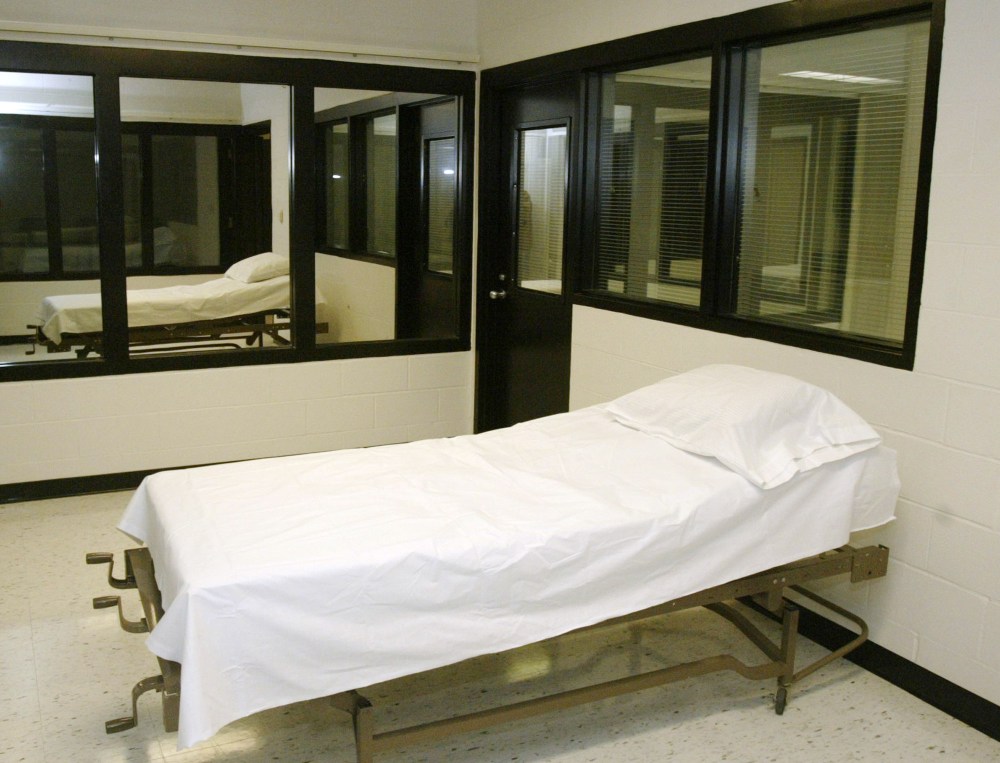
Missouri death row inmate Russell Bucklew — whose rare birth defect, his lawyers claimed, would cause him to suffer a “prolonged, tortuous death” — will not be executed as scheduled Wednesday morning, due to a last-minute stay of execution by the United States Supreme Court. The order, issued by Justice Samuel Alito — who handles emergency matters for states covered by the U.S. Court of Appeals for the 8th Circuit — came with little more than an hour to spare, and included no immediate explanation as to why the court decided to suspend Bucklew’s death by lethal injection.
Bucklew was scheduled for execution at 12:01 a.m. Wednesday.

“At approximately 10:30 p.m. the United States Supreme Court issued a stay pending further order of the Court,” Missouri Attorney General Chris Koster said in a statement issued late Tuesday, adding, “We understand the full Court will consider Mr. Bucklew’s pending requests tomorrow, May 21, 2014.”
If he exhausts all appeals, Bucklew could be executed at any time before 12:01 a.m Thursday.
Bucklew, 46, was sentenced to death for killing Michael Sanders, a man who offered protection to Bucklew’s ex-girlfriend, whom Bucklew raped and kidnapped.
Shortly prior to the Supreme Court’s decision, the U.S. Court of Appeals for the 8th Circuit vacated an earlier stay by a three-judge panel and also granted a petition for a rehearing before all the court’s judges.
The three-judge panel halted Bucklew’s execution because he suffers from a rare birth defect, which Bucklew claimed would cause him to suffer a “prolonged, tortuous death.” The panel found Bucklew could experience unnecessary pain and suffering “beyond the constitutionally permissible amount” seen in other executions, violating the Eighth Amendment to the Constitution.
Bucklew’s rare birth defect causes tumors in his face, neck and throat. His attorneys argued that the lethal drugs injected through his veins would cause him to choke to death, and his face to bleed.
The court also found that Bucklew would not be required to supply an alternative and “more humane” method of execution in order to argue that lethal injection would constitute cruel and unusual punishment.
Bucklew’s fate has galvanized activists who feared the condemned inmate’s rare birth defect would lead to harrowing effects once the lethal drug was injected into his system and pose a chilling repeat of a gruesome execution that went awry in Oklahoma last month.
The ACLU filed a petition Monday, arguing that Bucklew’s execution would violate international law, and the Inter-American Commission on Human Rights agreed to press the U.S. government to “take the measures necessary to preserve the life and physical integrity” of Bucklew and one other death row inmate.
“It was clear that as a result of this man’s rare health condition that he could have had some severe complications while he was in the death chamber in Missouri,” Amnesty International’s Thenjiwe McHarris told msnbc. “It just exemplifies how cruel it is to put people to death in this country and call it justice.”
As states maintain concerted efforts to shield where their lethal drugs come from and how they’re made, it’s becoming more than just the inmates fighting for their lives who are pushing back. State officials continue to dig in their heels on hiding execution practices, but the botched execution in Oklahoma – where death row inmate Clayton Lockett writhed in pain and ended up dying of a heart attack 43 minutes after the execution began – is bolstering the case for increased transparency. The Georgia Supreme Court on Monday upheld a state law granting anonymity to pharmacists who supply the lethal drugs. In a 5-2 ruling, the justices rejected a lower court’s decision finding the secrecy behind the law unconstitutional. The justices ruled that allowing a “more timely and orderly” execution process in Georgia trumped the need for heightened transparency. However, two justices offered loud dissents warning Georgia’s law has the “effect of creating the very secret star chamber-like proceedings.” Justice Robert Benham raised concerns that the state was trampling on the death row inmates’ rights to due process and “at the very worst, leads to the macabre results that occurred in Oklahoma.” Manufacturer boycotts on lethal drugs threaten already dwindling supplies, leaving state officials scrambling in haste to find alternate sources. More and more states rely on compound pharmacies to produce the death penalty drugs, an unregulated process that often hides both the source and composition. States say they have good reason to keep their execution dealings in secret. Officials argue that the lightning rod over capital punishment makes the compound pharmacies prime targets for retaliation. Opponents, however, warn that little oversight and untested drugs make an already controversial issue even worse, especially when shrouded in secrecy. The lack of transparency doesn’t just affect death row inmates. Two major news organizations – The Guardian U.S. and The Associated Press – teamed up with three local papers to sue Missouri after it changed its transparency policies and refused to disclose the source of its execution drugs. “Without this information, the public cannot provide meaningful oversight of the executions that the state of Missouri conducts in its name,” the suit said. Richard Dieter, executive director of the Death Penalty Information Center, said the outpouring of shock – both nationally and internationally – over the flubbed incident in Oklahoma raised consciousness over the secrecy laws. “You get at issues here that are fundamental to a democracy,” he said, “and in the long run, things like democracy prevail.”
Amanda Sakuma
Rachel Kleinman
Benjamin Landy Recommended


