








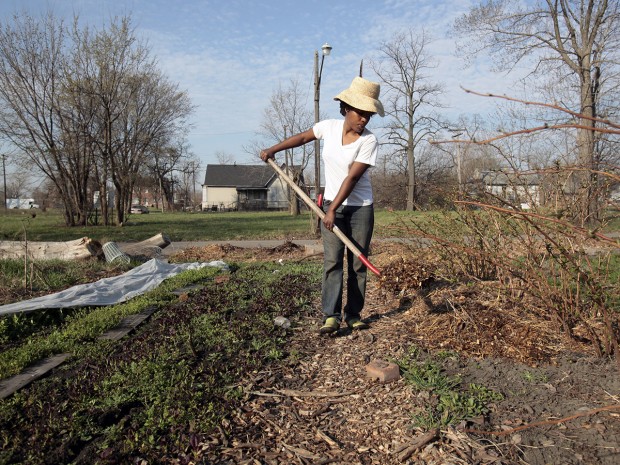
The Motor City is going green.
In a city with too much abandoned, derelict, and ruined space, Detroiters are fighting back with one of the country’s largest urban agriculture movements. Residents, nonprofits, and corporations are rehabilitating their city in a sustainable–and often edible–way.
“Detroit has really become the center of the urban agriculture movement,” said Rebecca Salimen Witt.
Witt runs a nonprofit, the Greening of Detroit, dedicated to beautifying the city through tree plantings, urban gardens, and other projects.
“We estimate that there are between 1500 and 2000 gardens in the city of Detroit,” she said. “Some of them are little postage stamp gardens in someone’s backyard, and some of them are full scale urban farms that are growing produce for sale, serving as someone’s primary living.”
Even the automakers are helping: last summer, General Motors began re-purposing 250 massive shipping crates into raised-bed planters, creating the Cadillac Urban Gardens. Last week, the corporation announced they’d expand the program with another 100 steel crates. Several hefty Ford grants have also made their way into green initiatives, too.
One farmer, who would identify himself only as Magnetic Sun, said he is a 33-year-old, lifelong Detroit resident.
Tired of seeing his friends struggle to feed their families, he started gardening on a lot near his home. Now he grows corn, tomatoes, zucchini, yellow squash, kale, sunflowers, and more. Walking around his garden, he pulls an ear of corn off a plant, shucks it and takes a bite.
“I feed the elderly people on the block, the youth they come down, they help, they take food home, we sell a little bit at the market, and you know, I feed myself and my family,” he said. “My aunty is 84 years old and has never seen a zucchini till last year. She’s 84 years old and she’s never seen the squash grow on the plant!”
This summer, Magnetic Sun took a job working with the Greening of Detroit in their gardens. (“They’ve taught me how to grow the biggest tomatoes I’ve ever seen—bigger than my fist!”) Soon, he hopes to completely support himself and his family with his garden.
Putting Down Roots
It’s no surprise that urban gardening has become so popular in Detroit: it’s a welcome contrast.
Residential neighborhoods are still riddled with ruin. The city used to be home to 1.9 million, but is down to just 700,000 residents, leaving an estimated 30,000 acres of distressed land. So well-kept, carefully tended grounds are a welcome surprise.
It’s a contrast that’s at the core of Detroit’s problems: with so much abandoned space, Detroit’s land has lost its value, eroding the city’s tax base and making it even harder for the city to maintain neighborhoods or keep empty lots from decaying further.
“Urban agriculture isn’t a silver bullet for Detroit’s vacant land opportunities,” Witt said. “But it’s certainly part…of a tapestry of vacant land uses that create for Detroiters a Detroit that is healthier, greener, the kind of place frankly that we all want to live in.”
City planner Rob Anderson sees opportunity in Detroit’s blight.
When Anderson became a Detroit city planner two and a half years ago, the city was trying to develop its way out of crisis. Now, they’re trying to restore, renovate, and green their way out of it.
“The desirability of living in that neighborhood on that block goes way up when you transform a vacant lot or a burned out building into a space like this. I mean, this is beautiful, this is a place people want to be,” he said. “People become more rooted in their place and that’s what we need in this town.”
In March, the city rewrote an old ordinance, legalizing urban agriculture in hopes of encouraging the green movement. Now, growing and selling produce in your backyard is allowed.
“The biggest thing we can do is try not to get in the way–within reason, of course,” said Brad Dick, the head of the city’s maintenance and parks department. They try to support local gardeners by dropping off mulch gathered from their tree removal duties. A Tree Grows in Detroit Farther east in Detroit, businessman John Hantz came up with a solution to restoring his neighborhood: trees. Hantz proposed a $30 million plan to the city to buy up 300 acres—for $300 each—over five years, use the land to farm trees—oaks, maples, and poplars, mostly—while maintaining it. Once sold, the trees would help the company recoup the money they’d spent maintaining the land. If the community allows it, Hantz can even envision growing fruit trees, which would create jobs picking and selling the fruit. “Making money is not the driver here, this is an investment in helping Detroit move into the future,” Hantz Farms president Mike Score said. Outside at Hantz Farm headquarters, a few acres have been planted with trees around blighted homes as a model to show neighbors what Hantz Farm might look like. The city has approved the plan, but Hantz still needs Emergency Manager Kevyn Orr’s approval, which they hope will come by the end of the summer. (Not everyone was keen on Hantz’s plan—many protested, asking why they hadn’t been allowed to buy the land. Now members of the community can purchase adjacent lots for just $200.) Green Lessons A decade ago, the Greening of Detroit realized they needed help taking care of all their farms, gardens, and parks and found a local resource. They began the Green Corps, employing high school students over the summer at minimum wage. They now employ 200 students each summer into their Green Corps, chosen from a competitive pool of 2000 applicants. “They learn they not only have the opportunity, but also the responsibility to make a difference in Detroit,” she said. “They learn that it’s important to get up in the morning every day and put on a uniform…. That kind of skill is what having a summer job is really critical for–and frankly in Detroit there aren’t that many opportunities for kids to have that experience.” Urban agriculture has become so popular with students that they’ve brought the farms to the schools—this fall, 45 Detroit public schools will begin integrating raised-bed gardens near the schools into their math, science, and economics curriculum and putting the food right back into the cafeterias. “We’re teaching them how eating the stuff that they’re growing is different than going to the gas station and buying Cheetos,” Witt said. “People always talk about the difficulties of getting kids to eat vegetables. When they grow those vegetables, it’s not hard at all.”
Jane Timm Recommended


