








Over the last few years, conservative groups have viewed toppling a Republican Senate incumbent as a crowning achievement. Think Utah in 2010, when Republican Sen. Bob Bennett was ousted at the state party convention. Or Indiana in 2012, when Richard Mourdock beat incumbent Dick Lugar — an event that helped Democrats win the seat in the general election.
But Democrats also have targeted their own: Party-switching Arlen Specter of Pennsylvania lost his Democratic primary in 2010.
With nearly a year to go before the 2014 primaries, here’s our very early look at the incumbents who are looking over their shoulders, as well as the current outlook in these races as we head into the Labor Day weekend:
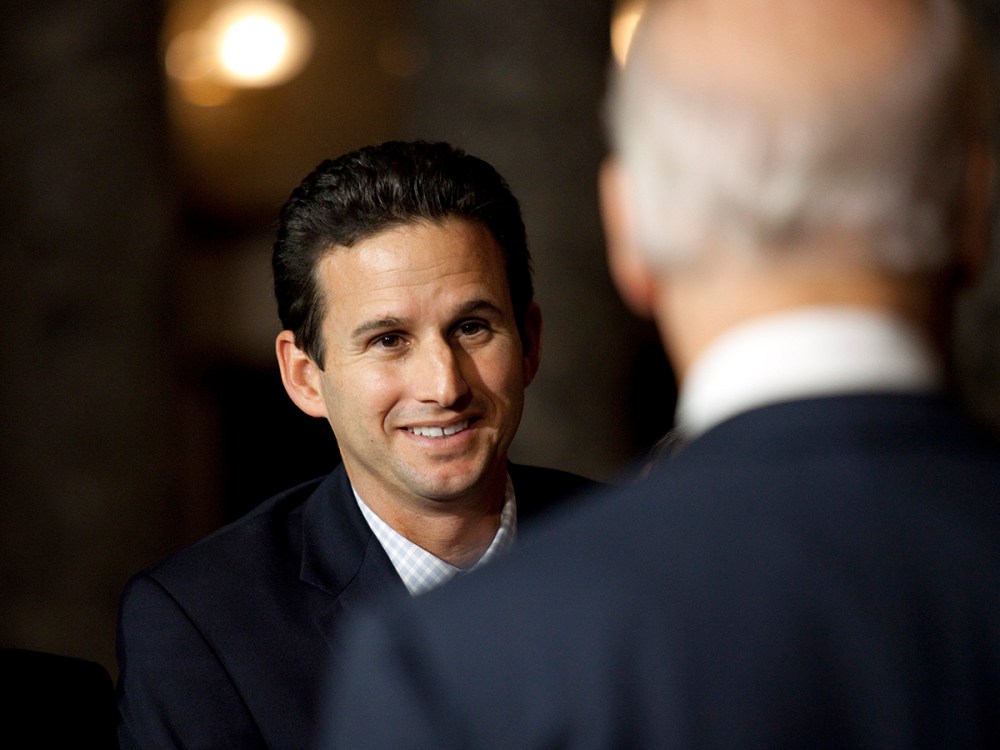
1. Sen. Brian Schatz (D-Hawaii): Call it a tale of political revenge from beyond the grave.When longtime Sen. Daniel Inouye passed away last December, he made it known in a deathbed letter that he wanted Gov. Neil Abercrombie to appoint Rep. Colleen Hanabusa as his successor. But Abercrombie passed over those wishes and instead appointed Schatz, his lieutenant governor. Now Hanabusa is challenging Schatz for a full term in 2014, and she has the backing of Inouye’s widow and his family, as well as EMILY’s List. Meanwhile, the Democratic Senatorial Campaign Committee (which supports its incumbents), the League of Conservation Voters and former Vice President Al Gore are backing Schatz. Polling has shown a close race — a July Civil Beat Poll showed Schatz with a three point lead, 36%-33%.But an EMILY’s List poll showed Hanabusa up nine points, while an internal poll for Schatz’s campaign showed him with a narrow one-point advantage.
The winner of the primary will be the heavy favorite, though Republicans appear to be trying to make a race here, sending a staffer to the islands to help the state party. But Hawaii is a tough state for the GOP: Ex-Republican Gov. Linda Lingle lost her Senate race in 2012 by nearly 25 percentage points.
2. Sen. Lindsey Graham (R-S.C.): A key author of the Senate’s bipartisan “Gang of Eight”immigration legislation, Graham certainly hasn’t changed his tone or positions in the face of primary challengers and has remained an outspoken proponent of immigration reform. Of course, that has drawn him ire from the state’s conservative wing for some time. Come next year, there’s anger to oust him, but the pathway to do so still remains difficult.
A trio of challengers so far has challenged Graham, with most of the buzz focused on Nancy Mace, a public relations consultant, the first female graduate of The Citadel, and former co-owner of the controversial conservative state blog FITSnews. Businessman Richard Cash is also running. And so is conservative state Sen. Lee Bright, who may be the most controversial the bunch, after calling Graham a “community organizer of the Muslim Brotherhood” when the senator traveled to Egypt on behalf of the White House.
None of Graham’s opponents has yet to mount a serious threat. But it’s still early, and if outside groups get behind one challenger, that could endager Graham. Still, his biggest threat is the potential for a run-off if he’s held under 50 percent in a multi-candidate field.
Many veteran Palmetto State political observers doubt Graham is that vulnerable, saying the minority is more vocal than the incumbent’s longtime support in the state. Remember, in Graham’s first race for the Senate in 2002, he accomplished an extraordinary feat — he was unopposed in the primary, but his ability to clear the field in a Republican state was all the more jaw-dropping when it was the state’s first open Senate seat since 1966. And Graham won’t just have his $6.3 million warchest on his side– he’s already getting help from a super PAC being formed by former state party chairman Katon Dawson. 3. Sen. Mitch McConnell (R-Ky.): McConnell finds himself facing fire from both liberals and conservatives in his re-election bid, and this is the only race on our list where the outcome of the primary could have implications on a competitive general election race with Secretary of State Alison Lundergan Grimes Businessman Matt Bevin made a good impression out of the gate, especially with his Fancy Farm debut, but other missteps lately question whether he’s ready for primetime. He’s come under fire for exaggerating the ties of a business program he attended to MIT, and he’s had mistakes with FEC filings. None may be huge issues, but together they suggest his campaign may not be ready for prime time. Bevin has a long way to go in proving he can tackle such a formidable politician, and he’ll need help from outside groups. But McConnell will spare no expense in extinguishing his candidacy. That said, McConnell’s campaign has had its stumbles, too. While the campaign tried to laughit off, McConnell campaign manager Jesse Benton’s caught-on-tape remark about “holding his nose” in working for McConnell only furthered the narrative that the Rand Paul-McConnell alliance is a marriage of convenience. And as much as the McConnell campaign will say Bevin’s challenge is a nuisance, it’s certainly taking him seriously. 4. Sen. Mike Enzi (R-Wyo.): Republican Liz Cheney’s primary challenge to Enzi doesn’t fit into a neat box — she isn’t saying he’s too liberal or has done something specifically wrong. Most of her pitch (either explicit or implicit) boils down to arguing that the 69 year-old’s time has passed and it’s time for new blood. That tough approach has only bolstered Republicans to line up behind Enzi. And while she has foreign policy experience, that may not play in a state where natural resources and conservation issues are key to voters. Cheney has had missteps lately on those issues, after having to pay a fine after getting a fishing license after living in the state for less than a year, that will only play into the carpetbagger narrative that Enzi’s certain to hit on. But Enzi hasn’t had a real race in sometime and has never been a prolific fundraiser, with less than $500,000 in the bank. He’ll have to mount a real race, but this is a state where the small primary electorate will be engaged with their candidates. It’s an uphill fight for Cheney, but will be a fascinating race. 5. Sen. Lamar Alexander (R-Tenn.): The Volunteer State’s senior senator doesn’t have reason to panic yet, but he’s been looking over his shoulder for the better part of a year. Like Graham, Alexander’s willingness to compromise and reach across the aisle have made him an easy target for conservative groups in the solidly red state. But the longtime state politician– who literally walked the entire length of the Volunteer State during his first gubernatorial race — remains a revered politician. A poll this week from his campaign shows him sitting pretty against any of his possible opponents. Perhaps the biggest boon for Alexander?There’s no run-off, so the more challengers the better for Alexander (because they divide up the vote). If Tea Party groups want to oust him, they’re going to have to solidify behind one challenger. And even then, it won’t be easy.
Jessica Taylor Recommended


