








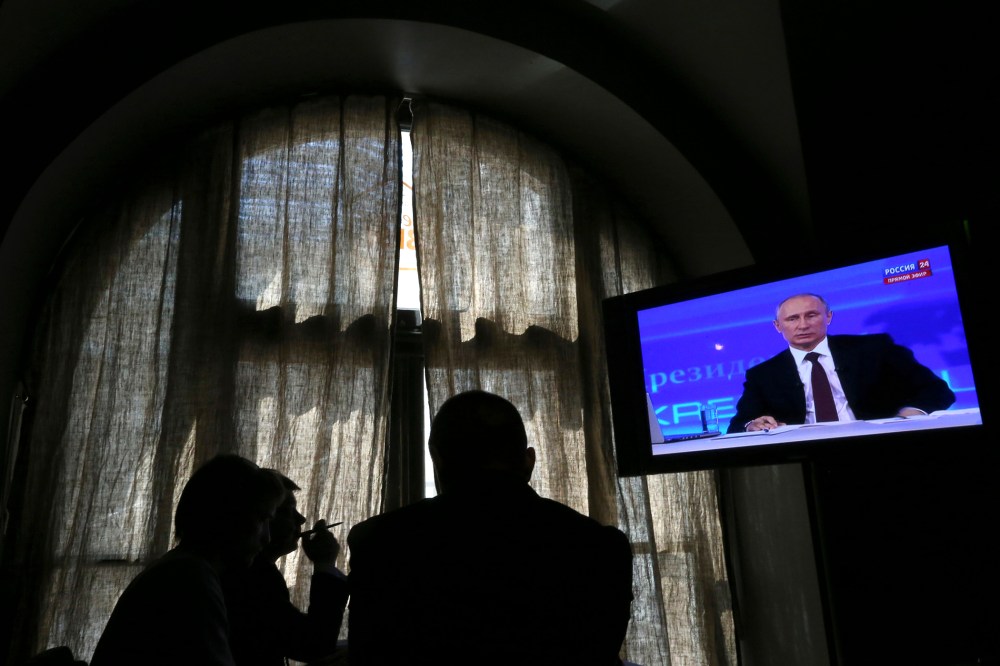
Russian President Vladimir Putin stressed his perceived right to use his military in eastern Ukraine on Thursday, according to the New York Times, just as President Barack Obama indicated that the U.S. may use further sanctions if Russia continues its actions.
“I remind you that the Federation Council has given the president the right to use armed forces in Ukraine,” he said during his annual marathon question-and-answer session, according to the Times. “I really hope that I do not have to exercise this right and that by political and diplomatic means we will be able to solve all of the sharp problems.”
On Wednesday evening, Obama told CBS on future sanctions that “each time Russia takes these kinds of steps that are designed to destabilize Ukraine and violate their sovereignty, there will be consequences.”
But on Thursday, Putin emphasized Russia’s historical right to the region, calling it “new Russia” several times, the Times reported, while continuing to press the narrative that his interest was in protecting ethnic Russians.
“Can a compromise be found on the Ukrainian question between Russia and America?” Mr. Putin asked. “Compromise should only be found in Ukraine.”
“The question is to ensure the rights and interests of the Russian southeast. It’s new Russia. Kharkiv, Lugansk, Donetsk, Odessa were not part of Ukraine in Czarist times, they were transferred in 1920. Why? God knows. Then for various reasons these areas were gone, and the people stayed there — we need to encourage them to find a solution.”
Putin maintained that the violence in eastern Ukraine is being carried out by Ukrainian citizens, not Russian forces as Western nations agree it is.
On Wednesday, the State Department called on Russia to stand down in the region, blaming them for the violence. “Any destabilization that’s going on inside Ukraine right now is a direct result of Russian action there,” State Department spokesperson Marie Harf told NBC. On Thursday, Secretary of State John Kerry continued talks with the Ukrainian and Russian former ministers on Thursday in Geneva.
Putin did admit that Russian forces had been deployed to Crimea, the peninsular region Russia annexed following the region’s referendum to secede from Ukraine. To Putin’s surprise, Edward Snowden posed a question via video chat, asking whether Russian citizens were monitored in the same ways that documents leaked by Snowden from the National Security Agency revealed that Americans are. “I’ve seen little public discussion of Russia’s own involvement in the policies of mass surveillance. So I’d like to ask you, does Russia intercept, store or analyze in any way the communications of millions of individuals and do you believe that simply increasing the effectiveness of intelligence of intelligence or law enforcement investigations can justify a place in society, rather than subjects under surveillance?” Snowden asked in part. Putin said there was strict legal regulation for listening in on phone calls and monitoring internet usage and the police had to obtain a court order in order to target specific individuals, but said they were still familiar with the tools and used them when needed. “But there is no mass scale and we do not allow ourselves to do that, and I hope will never do,” he said, according to an NBC translation. “We do not have as much money and as many devices as the U.S. to do that. Fortunately, our secret services are under strict control of government and society and their activity is regulated by law.”
Jane Timm Recommended


