








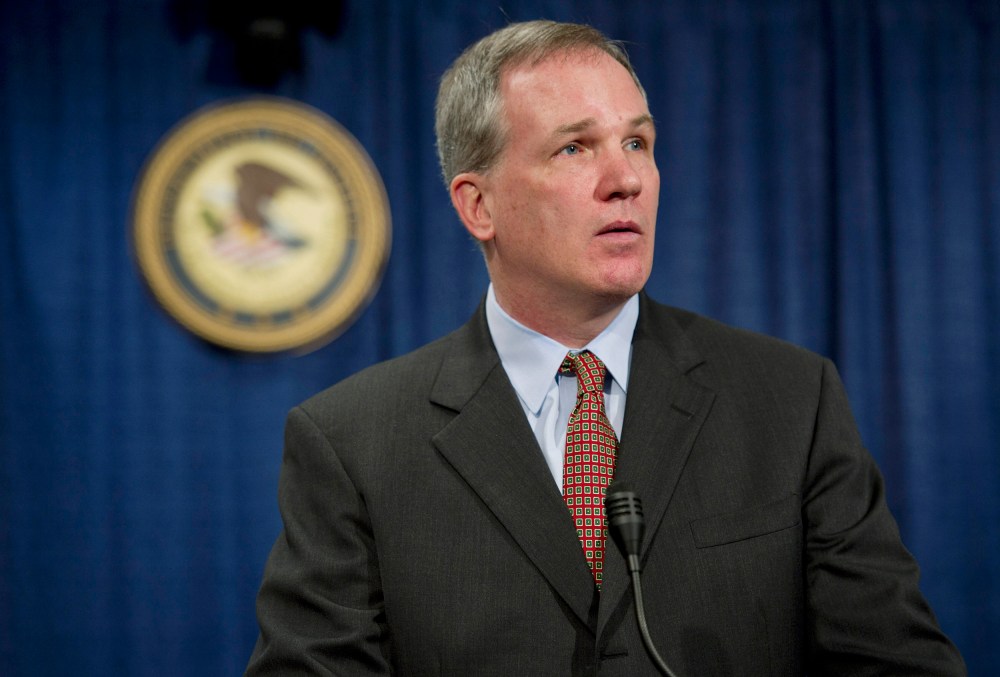
The Oath with Chuck Rosenberg
Pat Fitzgerald: The Right Thing
Chuck Rosenberg: Pat Fitzgerald, welcome to the Oath.
Patrick Fitzgerald: Thank you. Glad to be here.
Rosenberg: I’m glad you’re here. I know you grew up in Brooklyn, family of four children, Mom and Dad. Tell me a little bit about them if you don’t mind.
Fitzgerald: It was your classic immigrant family. So, my father immigrated from Ireland at 31. He went to school up to the sixth grade, and then worked on a farm in County Clare, Ireland until he was 31 and immigrated over to the US and became a citizen eventually.
Rosenberg: What made him come over at 31?
Fitzgerald: Looking for work, a future that he wouldn’t have back in Ireland. And then my mother sighed. I’m actually both first and second generation, oddly. My grandfather came over and immigrated to Cleveland, married my grandmother in Cleveland. She came from Ireland as well. He fought in World War One for the Fighting Irish, left for dead in the battlefield, but survived. And then remarkably, after the war, decided to return to Ireland. He and my grandmother were probably the only two passengers going the other way in 1920, or so. So, he went back to Ireland where my mother was born. So, she was actually a dual citizen. Growing up on a farm in Ireland, similarly, she left at 17, she only got to go to sixth grade as well and she came over here. And the one thing I think she was determined to do when she got here, was to make sure her kids got an opportunity for an education.
Rosenberg: So what kind of work did your parents do?
Fitzgerald: So, my dad worked in construction when he first came over and then later on after I was born the jobs and–my dad to have included being a warehouse man out in Queens. He was a security guard at the 1963 World’s Fair, in Flushing. He worked as a doorman and elevator operator, and so, most of the time during my life, before my dad retired, he was a doorman in the Upper East Side of Manhattan.
Rosenberg: Did your siblings go to college?
Fitzgerald: Yeah. Every one of the kids went to at least one level of school beyond college.
Rosenberg: Your parents must have been extraordinarily proud. My dad never went to college. My mom went many, many years later and became a nurse after her kids. My sisters and I all had gone to college
Fitzgerald: The way I would describe my father, was he was as straightforward a person as you can imagine. He just went to work and made sure he got to work on time. If his shift started at 8, he would leave there to be at least an hour early, sometimes an hour and a half early. So, he taught me if your doorman shift starts at 8:00, you will be dressed and ready to go by 7:00 in case the subway breaks down or something else. And always told me you know you go to a job never late, show up an hour early so they know you’re ready to work. And he viewed his role as making sure that he could do what he could to put food on the table and take care of the family. And my mother, who had worked sometimes, but mostly took care of the kids, which was a pretty big job, and a challenge at times, was a firm believer in education, and she was to make sure that we went to school did our best. Went to the best high school we could and went to college, and so she was a driving force and my father would do whatever he understood was necessary to be done to make that all happen. That’s why we all went to school. I would describe one thing my mother did that I’m forever grateful, but was entirely mortified by, when I was in eighth grade, I was looking to go to high school. And there’s a great school I eventually went to: Regis High School, which I think is the best high school in the country. It was endowed by an anonymous millionaire in around 1914, or so who wrote a check to a priest who said: send young Catholic boys of limited means to this high school for free, and that school has never charged a penny of tuition in more than a century for anyone and it is now being supported largely by alumni donations. When I took the test for that school, I did not make the cut. The first three hundred who would get in to be interviewed and one hundred and fifty would be let in roughly. They had done well at other schools, and so my mother first thought I’d take the test because I want to go to another school, so that was probably my first opportunity as an advocate to defend myself. And then she said you had to pick up the phone and ask them why you didn’t get in. And I was a short skinny eighth grader whose voice hadn’t changed, incredibly shy, and so I picked up that phone off the wall and dialed that rotary phone with my mother standing there to make sure I did this, mortified that I’m going to ask the admissions director of a high school why I didn’t get in. And so, I found the deftest way to ask, was to say I was just sad that I didn’t make the cut, and I wonder if you could give me some guidance as to whether I messed up the English part of test, or the math part of the test. I could frame it as a question, rather than as a protest. The priest, who was on the other end of the phone, said: let me have your name. And then he quickly said: oh, there’s been a terrible mistake. We sent you the wrong letter, and so come on in for an interview. My mother reminded me of that for many, many years afterward. And despite that being a mortifying experience, it was the best thing ever happened to me because I went to a wonderful school with wonderful people and opportunities I don’t think I would have otherwise had.
Rosenberg: From there, Amherst College and then Harvard Law School.
Fitzgerald: Yes. And my experience at Amherst was also very formative. I love the place, and I went–it was a very different atmosphere than being from Regis.
Rosenberg: And did you go directly from amorous to Harvard Law School?
Fitzgerald: Yes, I worked a summer as a janitor in York City public schools in between, but graduated in May from Amherst to Harvard in September.
Rosenberg: At what point did you know you wanted to be a lawyer?
Fitzgerald: I went to law school, and I started having my doubts mid law school, whether or not I wanted to be a lawyer. And I do remember interning at the U.S. attorney’s office in Boston as part of my internship in, I think, my third year. And I remember walking around with Assistant U.S. Attorneys and watching the cases they worked on. I remember one involved the Hells Angels motorcycle gang. One involved people shipping guns to the IRA and a trawler from Boston. And I remember literally running into a mobster in the hallway. He was coming out of a courtroom and AUSA asked me for some legal research, and I basically was running in to get him some cases that he needed. And this little man bumped into me and I said: Excuse me? I went in the courtroom, and the AUSA chuckled, and said: do you realize who you just nearly knocked over? And I think it was a ranking mobster in the New England crime family. And I thought to myself: wow what a great job. I will say this: when you grew up in Brooklyn, your parents are immigrants, and you get to go to school, you think: well, I will go out and get the best paying job that I could. That’s success. And there, I thought you know I’d love to do that job someday if I could, that just seems like really interesting and rewarding. That’s when I decided I wanted to be a prosecutor after working at a firm for a couple of years
Rosenberg: We were both blessed, I had wonderful parents. My dad, somehow with no college education, worked in credibly hard so that my two sisters and I could go to college and come out without debt, which is what enabled me to become a prosecutor. And when I think of all the gifts that my parents gave us, that’s right at the top.
Fitzgerald: I luckily graduated with very little debt. Amherst had a very generous financial aid system as an even more generous system now, and the ability to have people graduate from great schools with no debt is a wonderful gift to them, but it also enables people to dedicate themselves to some form of public service or public interest, which I think is a larger good than something that we need to pay attention to.
Rosenberg: Which U.S. attorney hired you?
Fitzgerald: I was hired by Rudy Giuliani to the end of his term.
Rosenberg: When was that?
Fitzgerald: Late 1988, I started Labor Day 1988.
Rosenberg: How do you like that job, Pat?
Fitzgerald: I loved it. It was both very exciting. It was stressful. Hard working fun and you felt like you were doing the right thing and you get to work on cases and felt like your job was to do the right thing which doesn’t mean you’re perfect at figuring out what the right thing is. But it’s a very laudable goal.
Rosenberg: I heard that you tried your first case with a guy named Jim Comey.
Fitzgerald: I did.
Rosenberg: Jim was a year senior too. So, he’s first chair your second chair.
Fitzgerald: Yes.
Rosenberg: He’s mentor, your mentee.
Fitzgerald: Exactly. And Jim and I knew each other because my Regis High School classmate and Amherst college roommate: John Goggins, was Jim’s law school roommate and friend. So, that’s how I came to know him before we were both in the office together. And it was a funny trial in the sense that made some really boneheaded mistakes. One of the things, was to cross-examine the defendant, who took the stand about her tone of voice on tape because it didn’t at all sound like she’s being pressured into anything. And the real issue was whether or not she had been entrapped by an informant, and sort of talked into engaging in a drug transaction because she showed up to engage in a drug transaction. So, I was getting up here to cross-examine her, playing the tape was key. There was some strategy here, and don’t sell me short here. So, what I first had to do was have her oversell and say, you know basically, like, someone put a gun to my head, otherwise I would have done the transaction. So, I get up there and I say so you weren’t really willing to do this transaction were you until so-and-so came along and talked you into it. And I think she, she basically said: well I wouldn’t say you exactly put a gun to my head. I should have just sat down. But this is my first trial and again this is cross-examination, that must go for half an hour. Then she breaks down and cries. So instead of taking a gift that I just told you everything you needed to know, I ploughed on to try to make sure I could get her to say she was forced into doing it even though she didn’t. And I had my “aha” moment to say: well, why don’t we listen to your voice on tape and see how much you were pressured into it. I then hit the button on the tape recorder. And nothing happened. I then thought well maybe it’s something wrong here I checked all the plugs. Now I’m sweating bullets or out of courtrooms. My first trial I can’t get a darn tape recorder to make a noise. I later figured out that somehow in the process, someone brushed against it, and one of the switches on the back out of the way from AC to DC or something like that had brushed against it. So, we had tested it played it out it all should work. And just sat there completely baffled. I think we came up with some really weak excuse like, I think there’s been a power failure and we’re in a room that’s as brightly lit as a 7-Eleven, so saying I think there’s been a power failure as people could put sunglasses on, didn’t make a whole lot of sense. And then as it turned out, I then decided well okay I’ll feature this in my summation. I’ll get up there and I’ll say just listen to this voice. So, I did. I said compelling closing argument building to a crescendo of saying: now just listen to this tape. Unfortunately, my crescendo was hitting about one minute before lunch, and the judge was insistent on going to lunch, and he said: we’ll stop there, we’re breaking for lunch, they don’t need to hear the tape. If they wanted, they can ask for it. So, my second dramatic moment fizzled away. The jury went out to deliberate, and the first note said can we hear the tape. They listened to the tape and they convicted. So I now in retrospect describe that as a brilliant strategy: fail at playing the tape, mistime it before lunch, and build the dramatic interest into what happened.
Rosenberg: I like your cover story. I’m not sure I credit it.
Fitzgerald: Yeah, I wouldn’t neither. That was the first verdict I took. And it was February 14th of 1989, it’s Valentine’s Day. And that’s when it came home to me that this person is now going to prison. And while the purpose of the trial was to prove that she was guilty, and she was in fact guilty, and it was proven, and then it comes home to you that this is a sad event at the end of what would be viewed as, quote, a successful trial.
Rosenberg: You know, I talked about this with Preet. And he also writes about it in his book: Doing Justice, that real prosecutors don’t celebrate verdicts, they don’t celebrate sentences, these are dramatic moments, they’re tragic moments. Justice has been done, but there’s nothing to celebrate, certainly not in the courtroom, certainly not in front of the defendant, or the defendant’s family.
Fitzgerald: Lots of the defendants may be sympathetic, some less so when they’re Al-Qaeda defendants and they’re trying to blow your country apart. You lose a lot less sleep over them in particular, but the other hidden pieces for many defendants they may well have earned the punishment they’re getting, but they have families, they have mothers and fathers or they have children or spouses or partners. And this is incarceration is a necessary evil in both senses when it’s a properly imposed, something you need to do at times, but not a good thing.
Rosenberg: You went on to do work involving the mafia in New York City. How did that come to be, and did you enjoy that work?
Fitzgerald: I loved the work. It was fascinating. There was a trial that was being scheduled. The prior trial team was shifting off the case had been around a while, and they came to me and said: would you be interested in working on this case, that was U.S. vs. John Gambino.
Rosenberg: And who’s John Gambino? Tell us about him?
Fitzgerald: The captain in the Gambino crime family. And he played a particular role because he was a bridge between the Italian mafia and Brooklyn, or La Cosa Nostra and the Sicilian Mafia in Sicily. And he was a bridge between the two, and a channel for sending, you know, heroin from Sicily to the United States, an important figure. His rank was captain in the Gambino crime family. Another codefendant was Joe Gambino, his brother, who was a soldier, and then other folks in the Gambino crime family. So, I was delighted to take on a case like that. It was fascinating. I called Jim Comey, who was leaving the office at that time to move to Virginia to say: who do you recommend to get as a trial partner. And to the credit of Patrice Comey, overheard the conversation. She basically told Jim you sounded real excited about that. Won’t you stay and do it. So, the two of us did it together. We went around the country visiting people in the witness protection program to sort of interview them, find out what they knew, and then figure out who these would make appropriate witnesses, then got ready for trial, and then had a long trial.
Rosenberg: How long did it last?
Fitzgerald: It was a six-month trial, depending on who you ask. I would say it was a six-month hung jury. Jim Comey would say it was the longest successful bail jumping conviction in history. We’d both be right. The jury hung on most counts.
Rosenberg: And what does that mean for a jury to hang?
Fitzgerald: They can’t decide unanimously whether to convict, or quit.
Rosenberg: And so, people understand, for someone to be convicted, it must be a unanimous jury but also for someone to be acquitted, it must be a unanimous jury. A hung jury just means no resolution.
Fitzgerald: Yes, they can be 11-to-1 to convict. That’s not enough. They can be11-to-1 to acquit, and that’s not enough. And so, we had the hung jury, and the bulk of the counts. They had jumped bail at one point in the process, John and Joe Gambino, so the jury convicted on that charge and then we had to retry it.
Rosenberg: But when you say we, Jim Comey had left.
Fitzgerald: Yes, we are reminded of that often. So, Jim, to his credit, and Patrice’s credit, put family plans on hold for a year to try this case, it then hung. We had to retry it. Jim left for Virginia, and poor Richard Abel volunteered to be my psychologist as we went through this second trial again.
Rosenberg: Not just your psychologist, but also your co-counsel. Rich is a very talented lawyer.
Fitzgerald: He’s a very talented lawyer and he had to endure my brooding over doing a retrial. And retry a case that didn’t work out the first time. Very frustrating.
Rosenberg: By the way, do you know why it didn’t resolve the first time. You know why it hung?
Fitzgerald: There were some issues around a particular juror. I will leave it at that. That, that led to some concern about whether this was a up and up hung jury. And you respect when jurors disagree. We’ve had our concerns, but nothing officially ever came of that, but we did do a second trial and it was scaled down. Rich was terrific. He brought new ideas. Rich would say: so why did we do it this way? And I would sort of say: well because that’s the way we did it. And I–you know, I try to remember why, and Rich would have a great idea, and say fine,
Rosenberg: You’re the senior prosecutor, you’re the mentor. Rich is junior to you.
Fitzgerald: Yes.
Rosenberg: But, he’s doing a lot of the trial as I understand it.
Fitzgerald: He was great. He was a great trial partner. So, in the US attorney’s office, it pretty quickly becomes a team of equals in many cases, and he was at least an equal if not driving the train in the case that we took to trial.
Rosenberg: With respect to the Gambino brothers, Joe and John were they also convicted.
Fitzgerald: Yes, they entered a guilty plea between the first and second trial. So, there was a guilty plea I think it was the first time that a member of the. Gambino crime family admitted to drug trafficking as part of a guilty plea, and they were not at the second trial. There was one defended at the second trial.
Rosenberg: And what did you learn from prosecuting mob cases, what stuck out to you?
Fitzgerald: What stuck out to me, is how people can rationalize certain things that make no sense. But to them, make rigid sense. That was particularly true when I dealt with the Sicilian Mafia witnesses straight from Sicily, and I remember once that there was a story that one of them who were involved in many killings told. And they viewed themselves as men of honor, and they took that very seriously.
Rosenberg: That was a phrase they used.
Fitzgerald: Uomini d’onore: men of honor. And when you were in the organization, there are all sorts of rules you followed, one of which was you know, this was secret. You didn’t talk about the existence of the organization much less who was in it. And so, there was a story one time where there were people they referred to as: common delinquents: thieves, burglars, that sort of thing, which in fact, this witness had been before he joined La Cosa Nostra. So, there were reports that someone was burglary one of the villages around Palermo in Sicily. So, they gathered two young men who were probably teenagers. And they interrogated them, and separated them, and they both confessed that they were doing these robberies and thefts.
Rosenberg: These common crimes.
Fitzgerald: Common crimes. And I don’t remember whether or not they had robbed someone who was a man of honor’s house, or broken some rules. By the end of it, they strangled both of these folks, saying they were common delinquents and they broke the rules. And so, there they are, they’ve just killed two young men. Then the story rolls around, you talk to the same witness, and they said there are some reports of some other robberies and burglaries in some area or other low-level crimes relatively low level. So, they bring two young men, and they separate them and interrogate them separately. And at the end of which, they become convinced that neither one of them was involved. Their stories made sense, and they realized they had the wrong guys. And they thereupon strangled him. And I said well, wait a minute. The first time you had to come in delinquents, they admitted to it and you strangled them. Now, you figure out these guys are not guilty. Why did you strangle them? Well, of course we had to strangle them because now we have revealed to them who we are. And they cannot know that we are in Cosa Nostra or know about Cosa Nostra. And then you say well, it’s a little odd, isn’t it, that if you’re going to interview these folks, if they’re guilty, you’ll kill them. If they are innocent, you’ll kill them, then why bother interviewing them if that’s what’s going to happen anyway. And watching the witness take great offense that there was no appreciation for knowing what the truth was, and feeling no sense of wrong
Rosenberg: No irony there.
Fitzgerald: No irony there. Putting aside the fact that you know imposing a self-imposed death penalty for low-level crimes is bad enough when people who did it. And then to overlay that with imposing the death penalty on those who didn’t. There was a sense of you do not understand. I will tell you I made the comment before when he joined La Cosa Nostra. I remember preparing the witness weeks before trial. And having debriefed him for a long time, and familiar with the facts and events that had to be told, I hadn’t been in the format of going to court. So, I said to him: OK, and when did you join La Cosa Nostra? And then he just looked back at me said: “I never join La Cosa Nostra.” And my heart sank. And I tried it again, and again, and again. And he kept saying he never joined La Cosa Nostra and my head is racing. I’m thinking this guy is going south on me. Someone’s got to him he’s panicked. But here he is the key witness going on in three weeks to talk about how he became a member of La Cosa Nostra and all the things that he did.
Rosenberg: And by going south, you mean that he was being untruthful.
Fitzgerald: Untruthful. And wondering what in the world is going on. And then finally, he just lectures me and says: have you learned nothing over the last year? You do not join La Cosa Nostra as if it is some sort of club or golf course and you just apply for a membership.
Rosenberg: He was offended.
Fitzgerald: He was offended. You become you were combined into La Cosa Nostra because you do not know La Cosa Nostra exists. They bring him somewhere and they tell you that you’re combined in and anyone who would use the word join doesn’t appreciate the Cosa Nostra is about. And so that I quickly made a note to myself. In front of the jury, I will ask when did you become a member of La Cosa Nostra, instead of when did you join. And that just shows me there was a rigour of mindset there that I, I realized is necessary for people to cling to in order to be able to do some of the horrific things that they did but they took it very seriously.
Rosenberg: Again, the word irony comes to mind. Folks who constantly break the law living by a rigid set of rules.
Fitzgerald: Yes. And that was very much the case particularly with the Sicilian La Cosa Nostra. The point that they could get pretty offended if you ask the wrong question, as they’re describing some horrible things they did.
Rosenberg: You liked that work, right?
Fitzgerald: I did. I found it fascinating. I thought it is important. And when you think that what many of the, sort of, ethnic organized crimes do groups do preying upon their own fellow immigrants, and taking advantage of the system, and killing people, or importing massive amount of drugs. It’s hard to feel that that’s not important work, and then to be part of a great team, work with great people: agents, investigators. I worked with Jim on that, I worked with Rich Abel, I got to work with the legendary Ken McCabe, and other folks, and FBI agents.
Rosenberg: We’ve mentioned Ken McCabe’s name before on this Podcast. Talk a little bit about him because every time I hear the name, and I never had the privilege of meeting him, I just hear wonderful things about the man.
Fitzgerald: He had a wonderful innate sense, he was a great guy.
Rosenberg: Former New York City police detective.
Fitzgerald: Yes. And then came to work at the U.S. attorney’s office on a case and kept him there had an encyclopedic knowledge of the mob. If you were driving around Little Italy with him, he’d, he’d look over and if he saw someone outside well those social clubs, he’d say: “there’s so and so…locked him up a couple of years back.” That was one of his favorite expressions because he had locked up most of them but he knew where people were. He knew like an encyclopedic knowledge of things. And great judge of character, and he said when you’d pick a jury. And he’d say, you know, I have concerns about that one juror. And he’d be right. But just a wonderfully hardworking, knowledgeable, low ego guy. And you’d see him sometimes meet some of the folks. Witnesses and there was a mutual respect there that they would look at him and say, he’s the real deal.
Rosenberg: The mobsters who he locked up respected him.
Fitzgerald: It was universal respect for the mobsters or at least, most of them that I ever heard of, and law enforcement and prosecutors and he’s just a wonderful, wonderful guy who passed away way too early in life. But left a real mark on those who worked with him.
Rosenberg: There was other work you did there, Pat, that we have to talk about. Some of the most interesting and important work that any federal prosecutor has ever done in this country and I don’t think I’m exaggerating. You and others, such as Ken Charisse, also a wonderful prosecutor now a federal judge in New York, were among the first to ever work on terrorism and on Al-Qaeda and Osama bin Laden in particular. How did that start?
Fitzgerald: So sadly, it started out with the World Trade Center bombing. February 26, 1993. The office then began to work on that prosecution. There were some close friends working on it, Henry DePippo, and Gil Childers, and Mike Garcia, and Lev Dassin. And while that was going on, I was actually in court doing the Gambino trial with, with Jim Comey. Well that was the middle of our six-month trial was January to June. So, it happened during our trial and then the retrial was I think the next January. When the retrial was over, I took a long vacation in Australia and New Zealand, went bungee jumping and all sorts of crazy stuff with my friend Dave Kelly, who was also in the office, and I had been promoted to be narcotics chief. And I came back from vacation and my boss Paul Shechtman said, we’d like you to join the trial team for the blind sheikh case. So, I think I had a three-month career as the chief of narcotics in the Southern District of New York, six weeks of which I was on vacation, and then I switched on to the trial team with Andy McCarthy and Rob Khuzami, and others were involved. Andy’s wife, Alexandra Rebay, was a key part of the team in terms of legal analysis, and brief writing. And so, we worked on the blind sheikh case which was a nine-month trial.
Rosenberg: Who’s the blind sheikh?
Fitzgerald: So, Sheik Omar Abdel-Rahman was a leader of what was called the Islamic group from Egypt, and he came to Brooklyn, and preached, and he was shown to be behind a group that was involved in a conspiracy that included the World Trade Center bombing, and our trial was from January of ‘95 until October 1st, 1995, and we overlap the OJ Simpson trial. And the OJ Simpson trial was packed everyone paid attention and there are many, many seats available in the courtroom for the blind sheik trial that got a lot less attention and I frankly think a lot of people thought the charges were a bit exaggerated. It talked about a global jihad effort around the world that was led by people who had extremist view of Islam and that was opposed to the west and was violent. And I think people didn’t take that all that seriously at the time. What is a fascinating trial and a great experience to work with Andy and Rob.
Rosenberg: 1993, a rented van was detonated in a subbasement of the World Trade Center and six people were killed. This was the first attempt by al-Qaeda to bring down the World Trade Center and, you’re right, not a lot of people were paying attention but it couldn’t just be because of the OJ trial.
Fitzgerald: I think there was a unwillingness to believe that this jihad conspiracy could be that real and that broad. It also is clear to me, looking back on it as part of that investigation, that the day that that extremist form of violence came to American shores, wasn’t February ‘93 it was back in ‘89 and ‘90. There have been prior attacks that were not paid attention to. There was a gay bar bombing in Greenwich Village in April 1990, and it was written off, I believe, by the police as anti-gay extremism which it was, but it wasn’t just your random person who had a bias against gay people.
Rosenberg: Who was responsible for it?
Fitgerald: It was El Sayyid A. Nosair, who was also behind the World Trade Center bombing plot and others. There were attempts to set off bombs against Dan Quayle and Jeane Kirkpatrick that were inept. But it happened in hotels while there were labor strikes. So, that was being dismissed. There were–we learned later, efforts to stalk Hosni Mubarak by El Sayyid A. Nosair
Rosenberg: The president of Egypt.
Fitzgerald: He president of Egypt. There are tantalizing hints of acts of violence beforehand and then there was a remarkable story of the assassination of Rabbi Meier Kahane in the middle of Manhattan. And that story is incredible. Meier Kahane is in the middle of a hotel room and Meier Kahane was would I say would be a right wing pro-Israeli person who wanted all the Palestinians removed from the state of Israel. So, a controversial figure, he’s giving a speech in midtown Manhattan
Rosenberg: When?
Fitzgerald: November 5th, 1990. And during the speech, a man walks up in the middle of the hotel. Walks up to the speaker, pulls out a 357 Magnum, and shoots him dead in front of the crowd. The shooter then runs to the back of the room, Irving Franklin at 76 doesn’t have a gun, but bravely goes to tackle the gunman. The gunman shoots him in the thigh. He runs out the back of the hotel, is running out into midtown traffic, and jumps into a cab. A whole bunch of people attending Kahane’s speech, unharmed surround the taxi. He jumps out of the taxi, and then there’s a postal police officer closing up the post office across the street with a gun and a bulletproof vest. And he turns around, and there’s a shootout between the shooter and the postal police officer who shot, but hit in the vest, and a man lies on the ground bleeding with 357 inches from his fingers and gets arrested. That El Sayyid A. Nosair, who would later play a role in the World Trade Center bombing. We’ve taken a trial in the state, he is acquitted of killing Rabbi Kahane, but convicted of possessing the gun that did so
Rosenberg: It wasn’t a federal prosecution it was a state prosecution.
Fitzgerald: I never quite figured out what happened at that trial. But, because the federal government can re-try cases under certain circumstances, it’s not a violation of the double jeopardy clause of the Constitution. We took that murder and brought it into the case that we brought against the blind sheikh and others as part of an overarching conspiracy, retried it, and convicted those share of that. So, to me, that’s clear proof that back in November 1990 extremist jihadis come to America.
Rosenberg: There’s an interesting story, Pat based on the forensic work of the FBI, in the aftermath of the ‘93 World Trade Center bombing, where they found a car part that led them to the bombers. Can you talk about that?
Fitzgerald: Sure. There’s some great forensic science that can figure out which car was the host of the bomb. It’s sort of like think about an egg in an egg carton. If own put a firecracker in one of the eggs. The one that had the firecrackers going to have little pieces distributed in all directions. So that sounds easy, when people do the hard work the forensic folks trace it back. They found the VIN number of the vehicle identification number of the truck that contained the bomb. And it was a van that was rented from some car rental service. And when they pulled the record up, they saw that had been rented by a guy named Mohammed Salameh. If I back up to tie this into an earlier story
Rosenberg: Please.
Fitzgerald: When El Sayyid A. Nosair killed Rabbi Mahone in the middle of a ballroom, it turns out that this fellow Mohammad Salameh was there with him, sitting in the audience later spotted in a video. So, there had been talk that in fact Nossair was going to bomb big buildings. There had been an effort to, to appraise it. And frankly, the person who was reporting it was viewed as being unreliable. And so, the FBI closed its investigation by trying to scare Nossair, Salameh, and others. 6 months later, they realized Salameh is the one who rented the van that blew up the World Trade Center. The guy who was in the back of the room with Nossair, and they realized they had to arrest him. They sent an undercover agent when he, when Salameh comes back to get the deposit on his van return. Imagine the brains behind that. You use a van to blow up the World Trade Center and you’re going back to collect a deposit. There was an almost comical exchange where the undercover agents negotiating whether he should pay him two hundred dollars and Salameh is outraged. And then the agent says OK seven hundred. What if I offer you seventy-five.
Rosenberg: So, the FBI agent negotiates down.
Fitzgerald: Down, and he takes it, and then he’s arrested. And then meanwhile, this tied into a fellow named Ibrahim el-Gabrowny, who is Nossair’s cousin. And they went to find him in Brooklyn. There was a great detective since passed away: Tom Corrigan, a dear friend, as much as they loved and admired Kenny McCabe, equally strong feelings about Tom Cargill who is a great American, and we miss him. And he went in with part of the arrest team for Ibrahim el-Gabrowny, who they thought might have had plastic explosives in his jacket when they felt something hard in his jacket. It turned out it was five fake passports for Nossair to go to Nicaragua to escape, and he ended up being prosecuted. But this whole Vin episode was a quick forensic unraveling that took him back into the conspiracy of folks that ended up being charged with the bombing and the plots around it. And then after the conviction of the blind sheik, one of the things that Mary Jo White will forever give credit for
Rosenberg: Then the U.S. attorney for the Southern District of New York. Your boss.
Fitzgerald: My boss. She understood that there might be more to this jihad stuff and people were giving credit for. So, with no resources coming from Washington, she stood up in organized crime terrorism unit to say let’s be more proactive. And ironically, people can forget how it all happened. It wasn’t focused on Osama bin Laden in particular. It was focused on Islamic extremism, or terrorism generally. And we started that unit, and it was a fascinating way to work. And eventually, we learned appropriately, that there were other people at the CIA, who were looking at Islamic extremists and they were focused on a guy named Osama bin Laden. And we had a lot of legal difficulties to work through, but we got to the point where we could partner with both the FBI to work on a criminal case against bin Laden, but also, to appropriately be read into intelligence that the CIA had about him. And my first reactions were to thinking that Osama bin Laden was a little bit like Where’s Waldo. Every time something bad happened around the world, people were like: it’s bin Laden. And how could this guy actually exist and be that involved all around the world. And maybe he’s a billionaire or a very wealthy man. Maybe he was loose with his finances. But what sort of role did he actually play? And so, we ended up working on the bin Laden case from ‘95 forward, what was an evolving sense of bin Laden not with a sense from day one that he’s the kingpin over a terrorist organization. One of the more interesting things I think people don’t appreciate about al-Qaeda, is how sophisticated and how corporate it was.
Rosenberg: What do you mean by corporate, Pat?
Fitzgerald: They had a H.R. folks, they had communications folks, they had salaries. They had policies. So, if you worked for al-Qaeda you were paid a fixed salary. You would get medical benefits of some sort. You would get like two weeks-vacation. At one point, they had a financial crisis within al-Qaeda, they had a downsizing, where they told people: you can retire from al-Qaeda, and we’ll give you X amount of money and two tickets to return to your home country, unless your home country has the death penalty imposed on you already, then you can go somewhere else. But there was like a buyout plan when they wanted to downsize, and you worked at their direction. You could be a bottle washer in a field camp one day, you could be the communications person a month later, and then they could be sending you to do a military action, as they would view it in Afghanistan, at the same time.
Rosenberg: So. when you call it corporate, you’re not kidding
Fitzgerald: Not kidding at all. And this fellow, we called him Junior was his nickname, Junior came to learn as sort of the paymaster in the Sudan, that there was racial discrimination going on in al-Qaeda that the Sudanese who were looked down upon, were paid less than the Egyptians or the Iraqis. So, he decided to engage in self-help, he was Sudanese. He started taking money from al-Qaeda to make up for what he thought was the unfair salary he was paid.
Rosenberg: Junior’s real name was Jamal Al-Fadl.
Fitzgerald: Jamal Al-Fadl. And then it became known that bin Laden that Junior has been embezzling from him. So, he called him in your room and said pay the money back. And then Junior decided he wouldn’t pay the money back and he absconded. I won’t tell you where he went, but he made contact with American officials overseas, and then we had the opportunity to meet him overseas, and debrief him. It was an interesting moment because his first reaction was I read President Clinton has a program to pay rewards to people who turn in terrorists. He thought he might get a bounty for coming forward and we had to explain that that program didn’t apply to terrorist themselves. And then as a member of al-Qaeda, we were interested in working out a plea deal with him, that he would come to America. He would plead guilty to a crime. He would get consideration for helping us. And eventually we convinced him to do so.
Rosenberg: Was it difficult to bring him on board?
Fitzgerald: It took work. It took time of listening to him with some great agents and a team. And you mentioned Ken Charisse before, and we worked through with him, and getting him to the point where he understood it was in his interest, personally, and his family’s interest in safety to get him to United States to get him in the witness protection program eventually to get his family out of the Sudan, which we did, and get them into the witness protection program. And frankly the strangest thing about it is I’ve always had a theory that very few people who become government witnesses have any sort of conversion. They might want to tell a jury: I used to rob banks for a living and suddenly I decided it was the wrong thing and I became a witness. Usually when they had that epiphany, it’s shortly after the handcuffs go on them outside a bank where they got caught in the middle of a bank robbery. And I’ve always been reluctant to believe anyone who had a conversion
Rosenberg: An epiphany of convenience. Fitzgerald: Epiphany of convenience. There was a point with him in the development of him as a witness, where we were going to put him in a very difficult situation having to testify against someone very close to him. And wanted to just bracing for that. And at one point he cut us off, and said look you guys are beating around the bush, you need to lock someone up. And we said we understand that, but understand that when we do, you’ll be a witness against that person, who’s very close to you. They said I know that that’s what you have me as a witness for and while it’ll break my heart to do so, I know that we need to stop bin Laden before he kills more American men, women, and children. This was before 9/11. Rosenberg: In 1998, there were bombings at two U.S. embassies in Africa, one in Kenya and one in Tanzania. Describe what happened, and why those events are so important in the evolution of our fight against al-Qaeda. Fitzgerald: I remember it vividly. We had indicted bin Laden under seal in June of 1998 under Attorney General Janet Reno. Rosenberg: We the Southern District… Fitzgerald: The Southern district of New York under Mary Jo White’s leadership and working as a team and working with people at Main Justice. Rosenberg: Was that based in part on Junior’s cooperation? Fitzgerald: Yes. And we worked closely with the FBI. I thought there was a good working relationship with the intelligence agencies and the CIA in particular. And we got access to lots of information, and pulled the trigger and indictment in June, 1998 which was under seal. It was a strange feeling because that was the goal for about two years to build to that indictment. And working like a dog. And then it’s sort of like, will we ever see him in handcuffs. We’ve achieved this. What does it mean? And then August 7th rolls around, and you wake up to a news report that minutes apart. There’s been a bombing in Kenya, a bombing in Tanzania. And right away, it said to me, that has to be al-Qaeda. And ironically, we had been investigating a cell in Nairobi, Kenya before the bombing. We’ve been investigating in New York. An odd fact that I can share because it became public later: we had put one of bin Laden’s lieutenants in the grand jury in New York in the summer of 1997. A person named el-haj. He had operated out of a house in Nairobi, Kenya. The U.S. government with the Kenyan government raided that house in 1997. One of our case agents, Dan Coleman attended that raid, and we had said we need an FBI agent on the ground just in case we find some key evidence we may want to use. Rosenberg: You want the FBI agent in the chain of custody for that evidence. Fitzgerald: Exactly. And so, he was. And then why did el-Hage, an American citizen living in Kenya then left to go to the US. We subpoenaed him off an airplane at Kennedy Airport to go to the grand jury in the Southern District of New York. And in the meantime, what we knew then, and can say now, was that we have recovered a computer in that search that had had documents from al-Qaeda on, it including the fact that a person named Haroun, whose name will be important later, had removed files from what his house, Wadih el-Hage was the guy who was in the grand jury. In essence, they had figured out that the Americans and other intelligence agencies knew that bin Laden’s cell was there in Nairobi, Kenya. So, we put Wadih el-Hage in the grand jury in Manhattan, and we’re asking him about this fellow named Haroun, and where are these files. And the grand jury, I think is looking at me like, what is this guy doing asking this man about files and they rugby Kenya because we’re having him draw a map to the house where the files are stored. I think Wadih el-Hage is looking me like, what is this crazy person doing drawing a map to Nairobi, Kenya. So, he draws the map. And as we leave the grand jury, I realize we’re in a pickle because we’re not so sure we can take this map, which is grand jury information and share it more broadly in the government than the FBI. Rosenberg: There are rules that restrict the dissemination of grand jury information. Those have been amended over time, but back then, there are fairly strict. Fitzgerald: Yes. And so, if we wanted to say why don’t we give it to non-law enforcement, it wasn’t clear we could. So, Dan Coleman is standing outside the grand jury. The average person wouldn’t know this, but FBI agents are not allowed in the grand jury other than when they’re testifying. So, we bring Wadih el-Hage who is an al-Qaeda member out. And say Mr. el-Hage, Agent Coleman wasn’t allowed in there, do you mind redrawing that map? So, he redraws the map which we can now use. Rosenberg: Was created in or for the grand jury, it’s created outside the grand jury for Dan Coleman. Fitzgerald: Exactly. It literally outside the grand jury. One of the things the Patriot Act did, was to clarify that situation because we had to rely on the professional courtesy of an al-Qaeda member to both waive the Fifth Amendment, and testify in the grand jury, and then do it again after. Rosenberg: What did Dan Coleman do with the map? Fitzgerald: You’re on to me. So, we go looking. The U.S. government goes to look and cannot find the files. So, it’s frustrating, but we knew this fellow Haroun was the one who had hid the files. Fast forward a year. It’s August, 1998, we fly over to Africa. We’re working with people on the ground. And one of the FBI agents working on the case, says that they found someone suspicious, a guy who was later convicted of the bombing. And so, this story’s not making sense. They bought new clothes after the bombing as if to hide he’d been involved in the bombing. And he’s telling me the story at night that says he was in a bank with a friend. And he was in the bank next door to the embassy when the bomb blew up, but it doesn’t make sense. And he says he was with his friend named Haroun. And my jaw dropped. I’m thinking that’s the same route we would later miss Haroun by a day getting to the location where he had fled. So, it was a big mess. But we knew this guy would be one of the bombers if he was Haroom. It later turns out that we went on a search of a particular charity that was involved in the bombing. And lo and behold, we found these files. The files that had been hit in the year before we found him after the bombing and we later brought Wadih el-Hage back to the grand jury and showed them all these documents and he lied about them and they ended up being charged with perjury then charged with conspiracy and part of this big trial. Rosenberg: Why did he help and then lie? Fitzgerald: The interesting thing that’s very different between al-Qaeda people, and the mob, the mob never answered the question. If you walk up to any mobster and say Excuse me sir do you have the time, they don’t answer it, or they take the Fifth just for the sport of it and no one can ever say anything nice to a person. If you’re in the mob that’s in law enforcement, so you’re always get the fifth. I found that with all kind of witnesses, an overwhelming majority will talk. Number one, they like to debate with you, two they try to convince you their position. I never made el-Hage into a cooperating witness. As I said, once we spent hours sitting on the floor eating Afghani food in the U.S. attorney’s office in the Southern District of New York. I tried to convert him into a witness and he tried to convert me to Islam and we had equal success Rosenberg: Meaning, none. Fitzgerald: None. But they do talk, and I also thought he thought he could just tell enough truth and fool us. And so, part of the issue is he made all sorts of lies about the documents. But he ended up being convinced Haroun ended up being a key player in the bombings. So, after that, we then put together a case against the various bombers involved. In very interesting ways and a lot of unorthodox flying by the seat of our pants, frankly, because we weren’t used to be in a situation overseas, and then we went to trial. There’s one fascinating story that shows how things can be counterintuitive. So, there was a bomb factory in Kenya that was a house, but it was rented, and it was used to assemble a bomb. So, when eventually the FBI could trace it back and figure out that’s where the bomb was built, it was leased by one of two brothers, they were Ashiv and Sikander, but the Juma brothers–they are the ones who leased the bomb factory. And so, they move up on the suspect list and we realize that those two were the brothers in law of a late military commander of al-Qaeda. So, before this time, around 1996, bin Laden was the head of al-Qaeda. The current head of al-Qaeda: Ayman al-Zawahiri was one of two military commanders. So, there were two number two ranks. And this third guy, whose name was Abu Zubaydah was the other military commander. These guys were brothers in law to the military commander or al-Qaeda. Third bad fact for them, is someone swabbed their clothes and their explosives. Rosenberg: Like the thing you occasionally see at the airport where they swab your hand. Fitzgerald: Exactly. So, you’re related to a military commander in al-Qaeda, you rent the house for the bomb factory, you’re seen around it new test positive for explosives, and so as we’ve seen, ripping up papers sirens hot to trot to lock these guys up. But as we talk to them, we realized they were dupes. An amazing story. They were living in Kenya. So, the reason why they rented a bomb factory is this guy Haroun knew them. And it’s easier for a Kenyan to rent a house than a foreigner, and you get a cheaper rate. So, they had him, one of the brothers, go rent the place. So that’s understandable. They had them clean the place at some point and they paid them by giving them blankets and sheets they wouldn’t need anymore. So, these guys are sleeping in their homes with blankets that were used by people to make a bomb. So, all the bomb traces that were on the bomb makers go to the blankets to them. Rosenberg: Therefore, the residue was on them. Fitzgerald: Exactly. And then the question becomes OK. But their brothers in law the military commander of al-Qaeda. How could they not know? Or are they dupes. And one of the things that was found in that computer I mentioned before, that was seized in Kenya in 1997, was a report. About how the military commander died. He was taking a ferry ride on a lake in Tanzania. Hugely overcrowded boat, if there’s possibly two people on the boat, there were 400. It capsized in the lake, hundreds of people died. One of the brothers was in a cabin with the military commander of al-Qaeda. The boat is upside down. As the water is flowing in, the brother climbs up, and opens the door, and is climbing into a hallway so he can swim out. And he reaches down to the military commander who just says “inshallah,” it’s God’s will, a heavy-set guy, he couldn’t make it out, he drowns. This guy swims down hallways and stairs and gets out from under the boat, and clings to a bunch of floating bananas until he saved. Al-Qaeda is trying to figure out why did their military commander die in a capsized boat and the guy in the cabin with him survived. Could this have been a hit. So, they sent Haroun, that same guy who keeps popping up. The guy who hid the files. The guy who it turns out led the bombing in Nairobi. He was in the lead truck and didn’t kill himself. But he led the bomb trucks there. Haroun went and interrogated him, and wrote a report to al-Qaeda that basically cleared him, and said we asked him all sorts of questions that he doesn’t really know what his brother in law is. Rosenberg: And unlike the mob story you told earlier, if you’re cleared by al-Qaeda, they don’t automatically kill you. Fitzgerald: So, they, they left him alone. And so here we had that report that vindicated that this guy was a dupe. And so, when put him on the stand to explain the story, we first showed him that report. Rosenberg: He must have been astonished. Fitzgerald: Astonished. And here he is, reading about interrogation by al-Qaeda of him, for how he escaped a sinking boat in Lake Tanganyika on a witness stand in Manhattan. Rosenberg: The junior testified at that trial. Fitzgerald: He did. He was the first witness, but one amazing thing that happened is no one really knew his identity until shortly before the trial. The defense had guessed, because of news reports, that a number of member of al-Qaeda had defected and he probably had to another country. That’s where the news stories were. So, they expected a different person as a witness. Rosenberg: Now, when you make someone your first witness, it’s usually somebody very important to the case who can set the scene. Fitzgerald: That was the point here. He was very important. Junior, as we call him, was born in the Sudan, moved to Brooklyn in the late 80s, and hung around the very areas where the blind sheikh and others were organizing to go fight in Afghanistan. He then went to Afghanistan. He then joined al-Qaeda. Al-Qaeda moved to the Sudan in the early 90s. He was pivotal in that move because he was Sudanese based and then al-Qaeda moved back later on obviously in 1996 to Afghanistan. And at some point, around that time, he had broken from al-Qaeda and was with us. So, he was a stage setter to walk through and explain to a jury in 1998 pre-9/11 what al-Qaeda was, how it worked. He had been eyeball to eyeball with bin Laden many, many times. And so, he’s a critical witness to set the backdrop. You have to understand, there was a very, very tragic episode that have two tragic episodes before the trial which made us on edge about security. So, at one point, early on in pre-trial proceedings, el-Hage, this person who was a U.S. citizen, whose computer we had seized in Kenya, and who testified in the grand jury a couple of times, wasn’t a large man, and he had a physical handicap. One of his arms was much, much smaller than the other I think from birth. And he was not what you would think of as a physical threat. But during a pre-trial proceeding, he leaked out of his chair, and tried to kill a judge in the courtroom. And obviously, that was very, very concerning. Then, it was a second episode where there was a high security wing in the jail that they were held in, called the MCC, specially purpose built for high security risk detainees. And during a tragic episode, a person by the name, officer Pepe, very kind corrections officer, treated these guys with lots of respect, was basically assaulted grievously. Rosenberg: Pepe almost died. Fitzgerald: Almost died, very close to. because they’re behind a high security wall, and they had fashioned a shank, a comb, a hard, plastic comb, and they jumped him. Rosenberg: A shank is a prison-made weapon, but they can be lethal. Fitzgerald: Yes, they stabbed him in the eye into his brain with the shank, and it was awful. And the rescue team had to get through the high security doors. And he survived, but he was grievously hurt. That was tragic. And so, you had those episodes of trying to kill a judge in the courtroom, trying to kill officer Pepe to take over the wing to demand the release of the blind sheik, and then another person when being treated in the hospital for the assault on officer Pepe, had secreted a weapon to try to attack their defense counsel. So, by the time the court trial rolls around, we have these guys shackled to the table at the feet with bunting over the tables so the jurors wouldn’t see the shackles. And then all the pens that were on the defense table were these safety pens that we tried to stab someone in the eye could do very little damage. They weren’t your standard big pens. And so, you’ve got this packed courtroom with the guy shackled to the table with bunting around it with safety pins. Rosenberg: And Junior is truthful. Fitzgerald: Truthful. He’s the first al-Qaeda member to break with al-Qaeda and now he’s on the witness stand Rosenberg: During the East Africa embassy bombing trial, I understand, Pat, that the State Department brought in victim families from Kenya and from Tanzania to watch and to listen. There’s an interesting story at the end of the trial involving those victim families. Would you share that with us? Fitzgerald: Sure. I will say this: when the Victim Witness Act first kicked in, as federal prosecutors you often didn’t have direct victims and some of your crimes. If people are drug trafficking, there is harm to the community, but you did murder cases less, so unlike a state prosecutor who would see a victim of a robbery or a murder. We had a lot less contact. We, then decided after scanning the code book, that we wanted to make sure that this was a prosecution of both sets of victims, the majority of which were Kenyan victims. We found a statute that made someone who kills someone else in the course of a bombing, a separate charge. So, we put out a separate charge for every victim in alphabetical order without regard to nationality. There were some later charges that were focused on killing just Americans Rosenberg: Because some Americans were killed in those bombings. Fitzgerald: They were, but we wanted the Kenyans to appreciate that they were victims too. And this was about vindicating their loss. And then the State Department would fly over group of Kenyan victims who were injured to be witnesses, as well as family members or those who lost their lives to observe the trial on a rotating basis throughout this trial, which went seven months. And we had Fridays off. And so, there’s a regular practice on Thursday afternoon, when we didn’t have anything immediately do, we would meet with those victims in a room just to talk to them explain what was going on. It was fascinating. The Kenyan people are wonderful people. And how they handle the circumstance was just amazing. And so, I think the American prosecutors got more out of those meetings than they did, but they were very often very emotional and very touching. And then the day the verdict came back, I’ll never forget: we walk into the room. And I can’t describe it. But there’s this tribal call. I can only describe it sounds like a banshee type noise. It’s like a “whoop.” I will not embarrass myself by trying to recreate the fail. But it was this celebration noise they just felt vindicated. And just to hear those people feel appreciated and to have them walk up and give you one plate—it was a plate that was made in their village. Propped it in my office when I moved to Chicago. That meant the world to them means it meant the world to us. Rosenberg: Your connection to Kenya did not end with the East Africa embassy bombing trial. Fitzgerald: I mentioned earlier. I went to Regis High School and one day, I picked up Regis magazine and read about the school in Nairobi called Saint Aloysius Gonzaga. And it was founded by a Jesuit priest and the Jesuits are the same priest who taught me at Regis. It’s in Nairobi. It’s in a slum called Kibera, which is incredibly poor, and there are students there that go to school from 8th to 12th grade at Saint Aloysius Gonzaga. Because the school was founded by a Jesuit priest who is being–running out of the Chicago province of the Jesuits. And so, when I read about it, I’m thinking to myself: well this is interesting. There’s a connection here to Kenya, which I have always been fascinated by, its connection to education, which I greatly appreciate all the gifts I’ve been given educationally-wise, but particularly by the Jesuits. It’s got this connection, ironically, to an office in Chicago that was a mile from my house. And so, I’ve gotten involved with that group. There’s a board in, in the US now, the school the Hope Foundation that helps support that school in Nairobi, and teaching students who were initially–it was restricted to people who were AIDS orphans whose parents had died of AIDS. And now because the AIDS crisis is still very real, but less lethal, and because there are other social ills, it still trying to serve a disadvantaged population. So, it’s a wonderful school and I’d become involved with the board having a chance to go back there. But my kids are a little older I want to go there and bring them there and both have them see what a different part of the world lives like and then also see the city again and just of reacquaint myself with it. So, I hope to do that soon. Rosenberg: Pat, you’re a son of Brooklyn. You went to high school at Regis. You left for seven years for college and law school. But, then you came back to New York and were a storied, legendary, iconic, federal prosecutor. Those aren’t just my words, but the words of your colleagues in describing you. How in the world do you end up in Chicago? Fitzgerald: That’s a great question. I got a phone call one night during the trial–the embassy bombing trial–was before 9/11. It was Senator Peter Fitzgerald, no relation— Rosenberg: — the United States senator from Illinois. Fitzgerald: Yes, and he was calling to see whether I’d be interested in applying to be the U.S. attorney in Chicago. I know that he reached out to Jim Comey. I know Jim Comey provided my name. I think he reached out to Louis Freeh who helpfully provided by name. But I didn’t know that either had done so at the time he called. Rosenberg: He also reached out to Mary Jo White, I’m told. Fitzgerald: I believe so too. Rosenberg: He didn’t just reach out. He asked them the same question. He asked who is the best federal prosecutor in the United States, and all three told Senator Fitzgerald, it was this guy named Patrick Fitzgerald, you– Fitzgerald: I don’t know if that’s true, or not, but I’ll tell my kids that. When he called me, and asked me to apply, I almost hung up on him. I assumed it was one of my college roommates pulling a prank. When I realized he might actually be a senator from Illinois that I really didn’t have time to focus on this right now, I was focused on the trial, and sort of politely declined, and just sort of hung up the phone thinking guy that was weird. Rosenberg: Well, there’s a reason to think it’s weird. I mean nobody gets a call from a sitting United States senator that you’ve never heard of from another state asking you to come and be the U.S. attorney there. Fitzgerald: He called, asked me to apply, and then I think he called back maybe a month or so later. And then at that point, I was talking to Ken Carriage, who was from Chicago, and I said: what the heck. And I went down to meet with him, and then I met with him further, and it was all kept very hush hush. And then, one day, he told me I was the choice. Rosenberg: How long were you the U.S. attorney in Chicago Fitzgerald: For 11 years. Rosenberg: Did you like the work? Fitzgerald: I loved it. I love the people I love the people I work with in southern New York. I love the work I did there, and I loved every bit as much the people of Chicago. They were different. I love the work I did there. I missed a little bit that when you’re U.S. attorney, you’re not an a AUSA with your hands on as much. I missed that but it was a wonderful experience and treasure those days. Rosenberg: Maybe a slight exaggeration, Pat, but I used to describe my time as an AUSA as doing everything and seeing nothing in my time as the U.S. attorney, as seeing everything and doing nothing. Fitzgerald: It reminded me of my days as a janitor. There was a sign over my boss’s desk: work, I could sit and watch it all day. And so, as san attorney it was great work. I sat and watched it all day. Rosenberg: How big was the office in Chicago? Fitzgerald: When I left, I think I was about 160 and about 300 people. Rosenberg: And so, the focus necessarily changed. You had to working mob cases and terrorism cases as an AUSA in Manhattan. What was the work of the Chicago office like? Fitzgerald: It was different. They were focused on gangs in particular: gangs, drugs, and guns, which is a focus in New York. But the gangs were different, and it became clear to me right away: the difference in New York was you went to a drug ring, and it may have dominated five different street corners in the Bronx, and you arrest those folks and they go away. And three years later people don’t really talk about them. In Chicago, gangs were entrenched, well-organized, and intergenerational. So, there was a gang before my time that got dismantled, that they once found an assignment sheet for drug workers. I think there were 9,600 of them on the list. They had a board of directors for their gang. One for inside prison, one for outside prison. The gangs often had people who were third generation, their grandfather and father before them were in the gang. So, I remember hearing from someone in DC who said: look, you guys have to stop focusing on these gangs and start focusing on organized criminal enterprises that are involved in drugs. I was like, that’s who our gangs are. Find me an organized criminal enterprise that has the firepower of some of the Chicago gangs. One example was, there was a time shortly after 9/11, and I transitioned to Chicago right around 9/11. I was in New York on 9/10 closing my bin lot of files and flew out the morning of 9/11 to Chicago, and I was in the air when the horrible things happened. Shortly thereafter, we heard that there was a housing project in Chicago where they had probable cause to search half the apartments for drug reasons. They had a fence around the apartment building. They had people on the roof with these gangs with. Night vision glasses and rifles with scopes. And an undercover officer had walked into the premises, they had felt his bulletproof vest and shot at him. And that this was a no-go zone where law enforcement couldn’t go and thought to myself: we’re going into Tora Bora to show the world that, you know, we’ll go wherever we have to go to keep Americans safe. But there were people, families living in these buildings in Chicago, where it’s not safe for law enforcement to go. What about these folks. And a team of 300 law enforcement agents raided the place and took down this gang which had also pirated a Christian radio station. So. The problem of gangs, drugs, and guns in Chicago is more acute. And it’s why, sadly, Chicago’s per capita murder rate has always been significantly higher than New York. So that was an interesting experience to learn a lot from people who are really, really working hard. And I think there is really good cooperation among state federal local law enforcement Chicago. Rosenberg: So you described that gangs were very different in Chicago. Why were they very different in Chicago? Fitzgerald: That’s a very good question we struggle with. I think part of it is Chicago strikes me as being geographically more segregated than New York. I’m not saying that New York was a melting pot always and still is, but it seems like there is more geographical boundaries in Chicago. And I think there is greater access to guns, ironically, at least when I was U.S. attorney. The big source states for guns for Chicago were Illinois, Indiana, and Mississippi. It was a pipeline of guns there. And I think the intergenerational nature of gangs made them a stronger force, and it made it more violent. Rosenberg: I know that the murder rate in New York has declined precipitously, though the murder rate in Chicago, and just as important, the number of shootings in Chicago, remains incredibly high. Is that something you focused on as U.S. attorney? Fitzgerald: There wasn’t just me, it was a whole large number of people in the office. Rosenberg: I use that as a shorthand because I was a U.S. attorney too. It’s the men and women in the office, it’s the folks in law enforcement at the local and state partners, it’s not you, Pat. Fitzgerald: Yeah. And that teamwork and beyond law enforcement, which I’ll talk about in a moment was very focused on that. I remember the year I came in, there had been 666 homicides the year before. I remember working with a colleague, Matt Crowl, who was great to work with, and said how are we to focus on this. Remember the numbers crept down from the lower 600s, and then I think we got to very low 600. And the next year, we were thinking can we break into the five. So, we broke into the force. And so, there was a point at which the homicide rate which had been I think as high as 900 in the 90s dropped to the 600s and it dropped into the 400s. And that’s great news when you would look out at the, the law enforcement officers who were making that happen and saying Isn’t it great that maybe there are 200 people less lost their lives than before. But how in the world we live in a city where we’re losing 400 people a year like that. And how is it that the per capita rate is north of New York. The numbers have ticked up, they’ve gone back down. And so, part of the problem we had is that there were so many people trying to fix the problem, that when you applied five different solutions to a particular neighborhood and the numbers dropped, you were happy the numbers dropped, but you couldn’t quite establish which particular intervention was the cause of that. I would say that one of the most important things that I think people don’t appreciate today, is the issue of reentering felons if people commit crimes and they go to prison and they come out. If our attitude is: that’s it for them, they should ever be hired again, we are just ensuring that that person and their family is condemned to a life that isn’t very good, and there’s a greater likelihood of recidivism. Rosenberg: I talked about this with Sally Yates on this Podcast. We all realize in law enforcement, that the overwhelming majority of people who go to prison, come back out and that we want them to work. We want them to get an education. We want them to pay taxes. We want them to raise families and we want them to contribute. We need to find a way to do that. Fitzgerald: And so, one of the great things that the office was doing in partnership, was working at law enforcement to take parolees as they left prison. Giving them a little bit of facts of life saying look, if you go out there and start doing what you’re doing before, we’re watching, but if you’re here to sort of turn your life around, here’s someone for the community who’s offering jobs, and literally some guy would stand up and say: I work in this industry it’s manufacturing, here’s the address if you’re interested, stop by tomorrow morning at 7:00. The law enforcement lectures don’t work as much people want–you may want to reinforce the message. We would have a felon who had been in prison and gotten out or who was shot and paralyzed in a wheelchair would talk. That would resonate with folks. And the real thing is to convince employers that this is not just a responsible thing to do society-wise, But, you’ll get good employees. If people think that everyone coming out of prison is gonna be violent, let me tell you something: if they want to go back and be a gang banger the door’s open. No one is gonna get up at 5:00 in the morning to take a bus one hour across town to go into a minimum wage job unless they want to work it. And there’s no value in it. The people who have self-selected and said this life is not for me. I want to turn it around. We’ll show up and they’ll work hard and there were organizations that helped organize them. So, I think one of our big issues as a society is to, to deal with this reentering felon population, and to treat them like citizens, and to realize that we need to get engaged in in making them a productive part of the workforce. And that’s really important. Rosenberg: Is it fair to say that there was a culture of public corruption in Chicago, and what did your office do to address it? Fitzgerald: Yes, there was a culture of public corruption. I felt uncomfortable when I first got to Chicago saying that like, who’s this kid who’s from New York who’s been here three weeks and now he’s going to talk about it. So, I thought I would hesitate to say it at first and then I finally said What the heck let’s just be straight about it. There is a culture of corruption. And part of the problem is that low expectations are set. There’s an issue that may be addressed quite soon by the new mayor: Lori Lightfoot, who worked in the office when I was there about aldermanic prerogative. It simply meant the alderman could block anything in their ward that they didn’t like. That leads to a license for abuse. And that was an issue that went on, but a big part of it was a culture of tolerating it. So, for example, a number of corruption cases were brought. After they’re brought, after the person is convicted, you run into someone at a party who says, thank god you convicted so-and-so, that person has been preying on people for so many years. I never want to talk to you about it before. I don’t want to be a witness, but we all knew. And by the way, what took you guys so long. I used to say. You want to throttle them like OK so you’re out there knowing this person is shaking people down, maybe you’re being shaken, down and maybe you’re making the payments and you’re wondering where’s the government when you don’t tell them. And then when it’s finally done, you’re sort of saying it should have been done sooner. And I used to use the example of Vermont, and maybe I’m glamorizing Vermont, but I think if you went in many towns in Vermont, and said I want a permit to put a barn up, said, fine pay me 20 bucks expedite your permit. People would go screaming down the street and that person in Vermont would be out of a job in a nanosecond. That’s not the culture in Vermont. And I think in Chicago, they haven’t seen enough pushback to corruption, that people roll their eyes too often and put up with it. And sort of say, if I have to pay two bucks to expedite the permit that’s what I got to do. If I had to hire the connected guy to get this done, that’s what I have to do. And we haven’t turned the corner yet in Chicago. We’ve made real progress. I know there are things going on there now that are you know cases are being brought. And I think we’ve just got to get the point where people in Chicago say: unacceptable. And that’s where the solution is going to be, it’s going to be with the population, not with law enforcement. Law enforcement has to do its part. It has to show people that will be acted upon but people need to speak up and fight back a lot more. Rosenberg: Any idea how many assistant U.S. attorneys you hired while you were the U.S. attorney? Fitzgerald: I think it was close to 150. Rosenberg: Because that was the thing I liked most about being U.S. Attorney, frankly. Fitzgerald: I heard someone before he became U.S. attorney say, you won’t remember the cases, you remember the people you hired. I thought that sounded very nice. I didn’t know if that would resonate. I totally feel that way. And you look around sometimes and you hear about one of the people you hired that’s still in the office, and some of the things they’re doing, or left the office had done something great. They’ve gone on the bench or they’ve done something else. And even though it was probably a no brainer to hire them and they were probably 12 people before you who put this person in front of it was yours not to screw up that decision you still take great pride and say Oh I hired that person and look how great they’re doing. Rosenberg: When I talked to friends and colleagues of yours, they told me you were the best they ever worked with. I wanted to let our listeners know that, and I wanted to thank you for sharing those stories and coming on the Oath today. Fitzgerald: Well, you’re way too kind. I’m glad you picked some people with bad judgment to talk to, so I appreciate it. Rosenberg: Well, they may have bad judgment, but they were uniform in their praise. Fitzgerald: Thank you. Rosenberg: Thank you, Pat.
The place for in-depth analysis, commentary and informed perspectives. Recommended


