








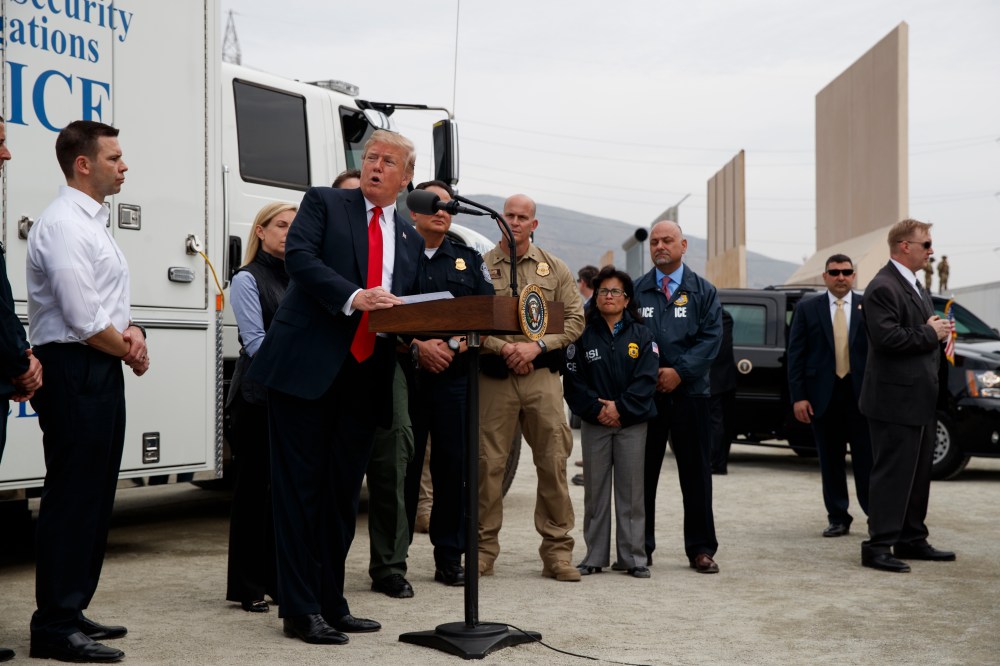
CNN published a striking piece on Friday, reporting that Donald Trump not only told Customs and Border Protection Commissioner Kevin McAleenan to block asylum-seekers, but also that the president offered to pardon him if McAleenan faced any legal consequences.
Soon after, the New York Times published a related report, alleging that the president urged the CBP chief to close the border between the United States and Mexico. As we discussed on Friday, the Times‘ article went on to note that Trump raised the prospect of — you guessed it — a presidential pardon in the event of McAleenan facing legal jeopardy as a result of Trump’s directive. Administration officials denied the accuracy of both of the reports.
In the president’s first two years in office, reports like these would raise questions that would receive no official follow-up. The political conditions are, however, quite a bit different now. Politico reported yesterday on new efforts from top Democrats on the House Judiciary Committee to get answers.
In a letter to McAleenan, Judiciary Chairman Jerry Nadler (D-N.Y.) and other Democrats asked the new acting secretary to turn over a list of all DHS employees present during a meeting with Trump in Calexico, Calif., where the pardon exchange reportedly took place. The lawmakers also said the list should include individuals McAleenan told about the encounter.
Nadler, along with Reps. Zoe Lofgren (D-Calif.) and Steve Cohen (D-Tenn.), wrote the reported pardon “follows a troubling pattern of conduct.” The lawmakers said the alleged conversation suggests Trump “views the pardon power as a political tool, or even worse, as an expedient mechanism for circumventing the law or avoiding the consequences of his own conduct.”
It’s possible, of course, that the president made the comments but was trying to be funny. In fact, there’s nothing to suggest McAleenan took Trump’s alleged directives seriously: the CBP chief neither closed the border nor started blocking asylum-seekers from entering the United States.
That said, given the number of instances in which we’ve seen reports about the president urging officials to break or ignore federal laws, coupled with Trump’s willingness to abuse his pardon powers, it’s hardly unreasonable for members of Congress to seek additional information. The Washington Post‘s Greg Sargent, whom I believe was first to report on the congressional letter, added yesterday: If the story about McAleenan is true, Trump didn’t merely demand that he (or his border agents) break the law; he also dangled a pardon as a way for his subordinate to avoid accountability for it later, compounding the corruption. “It would certainly be an abuse of presidential power,” Daniel Hemel, a professor at the University of Chicago Law School who co-wrote a good paper on whether the pardon power can be abused, told me. “The Constitution requires the president to take care that the laws be faithfully executed. If Trump said what he is reported to have said to McAleenan, then he tried to use his presidential power to see to it that the laws aren’t executed.” The Judiciary Committee’s Democrats requested that the Department of Homeland Security provide members with the requested information “no later than April 30.” Watch this space.
Steve Benen is a producer for "The Rachel Maddow Show," the editor of MaddowBlog and an MS NOW political contributor. He's also the bestselling author of "Ministry of Truth: Democracy, Reality, and the Republicans' War on the Recent Past." Recommended


