








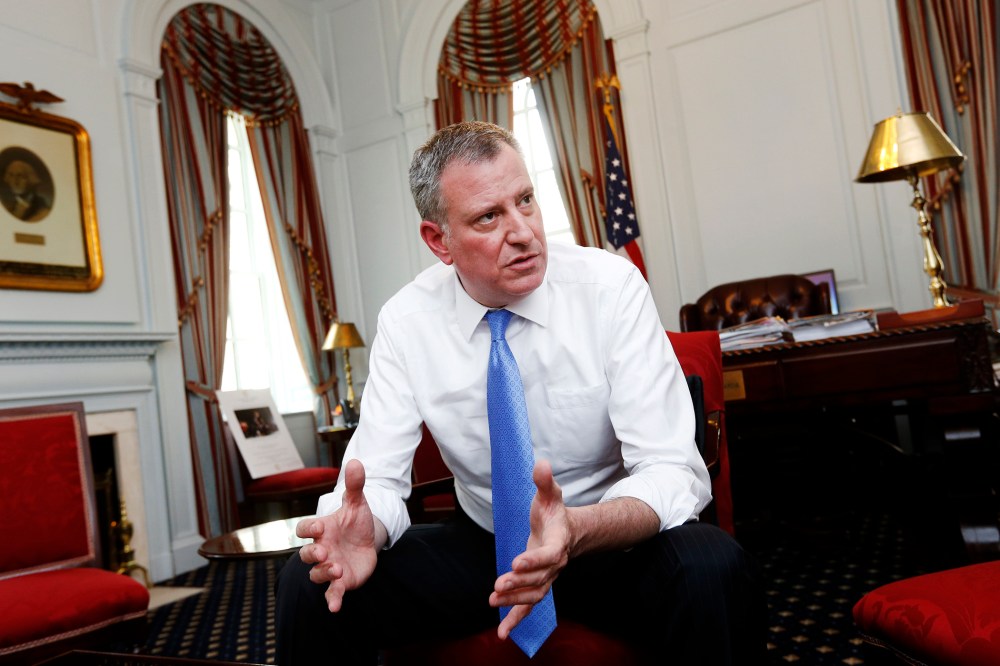
The nation’s highest-profile experiment in progressive governance has hit its hundred day mark. And the report card on New York City Mayor Bill de Blasio is decidedly mixed so far.
De Blasio, the city’s former public advocate and councilman, was sworn in in January as New York’s first Democratic mayor in 20 years and the most liberal hizonner since long before then. The towering, 6-foot-5-inch mayor, who rode a populist wave to a monster victory in November, promised to prioritize the city’s poor and middle class residents he claimed had been overlooked by his plutocrat predecessor, three-term Mayor Mike Bloomberg.
It sounded like a progressive revolution in the making and a staunch liberal’s dream come true: Tax the rich to help fund universal prekindergarten! Put an end to stop-and-frisk police practices! Create more affordable housing! Shrink income inequality between the city’s wealthiest residents and everyone else!
Even the song de Blasio’s campaign to play (the rich-skewering “Royals” by New Zealand pop star Lorde) as he and his family took the stage after his November victory captured his message: This was a mayor who would stick up for the little guy.
But now, just over three months into his first term, de Blasio’s idealistic campaign rhetoric has hit the reality of governing — drawing pushback from conservative media, big business, and New York Democratic Gov. Andrew Cuomo, a wily political operator and the new mayor’s former mentor.
De Blasio has certainly made good on several campaign promises after he was catapaulted into victory. At the same time, he’s facing criticism for either going too far or not going far enough — with some progressives questioning whether he has the gravitas and leadership skills to play political hardball in the country’s largest city. Can de Blasio really deliver change they can believe in?
According to a poll from last month, the majority of New Yorkers disapprove of de Blasio’s job performance. The majority—57%– rated his work so far as “fair” or “poor,” according to the survey by Marist College, NBC4 and The Wall Street Journal.
Meanwhile, just 39% said hizzoner has done a “good” or “excellent” job. His highest approval ratings came from the minority and lower-income voters who helped catapult him into victory in November.
By contrast, Bloomberg, at the same point in his first term in 2002, had a 50% approval rating.
“He overpromised,” said Jeanne Zaino, a professor of political science at Iona College and of political campaign management at New York University, said of de Blasio.
Zaino said that while that’s not unusual for candidates in the heat of a campaign, the newly minted mayor is now realizing the “institutional reality” he faces.
While de Blasio was able to help secure $300 million in state aid for his signature pre-Kindergarten initiative, it wasn’t through the means he wanted: hiking taxes on residents who make more than $500,000 annually. Not surprisingly, that plan was staunchly opposed by Cuomo, who is facing re-election this year. He and state legislators in Albany instead offered de Blasio surplus state funds to pay for the program.
De Blasio is hailing the round of funding as a big win. But the issue of taxing the wealthiest—whom the mayor insists were unfairly coddled by Bloomberg—is unlikely to go away.
“A lot of progressives believe from a moral standpoint that taxes should be raised on the wealthy. This issue could come back to haunt him,” said Jamie Chandler, a political science professor at Hunter College, noting there won’t necessarily be a state surplus every year to help fund the city’s Pre-K program in a sustainable way.
Team de Blasio did not respond to requests for comment for this story.
De Blasio has also been tripped up in the debate over charter schools which operate with taxpayer money but are independent of unions and regulations that govern the city’s traditional public schools.
De Blasio, an outspoken advocate of traditional schools, refused to “co-locate” three charter schools in buildings that already house public schools, arguing charter students there had an unfair advantage. These schools are among the city’s highest performing and are operated by former city councilwoman Eva Moskowitz– a fierce political foe of de Blasio. The move drew opposition from Cuomo, and wealthy proponents of charter schools poured millions of dollars into a TV ad campaign skewering the mayor.
De Blasio eventually softened his stance and pledged to work with the charter schools. And now the state budget imposes new restrictions on the mayor’s power over charter schools.
Zaino said the charter school fight left de Blasio with a leadership dilemma. “He had a point on charter schools that many people believed…But then he stepped back and bungled it. Whether you disagree or agree with him, he has to lead. He can’t waver back and forth and step back under criticism,” Zaino said. De Blasio has indeed made significant headway on several progressive issues. He has taken steps to curb the city’s controversial “stop-and-frisk” policing policy that overwhelmingly targets black and Hispanic men. He’s signed off on sweeping paid sick leave legislation, hired a new jails commissioner who has been credited with reducing the use of solitary confinement, and has hired a slew of former progressive activists and has launched a program to reduce traffic fatalities. “He certainly has made a strong attempt to fulfill the promises he made in the campaign,” said George Arzt, a Democratic consultant who served as press secretary to the late Mayor Edward Koch. Arzt acknowledged there have been “some minor bumps” but chalked it up to a learning curve. “Wait until next year,” after election season is over,” Arzt said. Indeed, de Blasio’s biggest test may be what’s yet to come. His universal pre-K program, not implemented yet, will be closely scrutininzed when it kicks off next fall. And he has yet to tackle the issue of affordable housing, a key plank of his vow to tackle the what he calls New York’s inequitable “tale of two cities.” De Blasio has said he wants to build or preserve 200,000 affordable housing units over the next decade for lower income New Yorkers – an ambitious goal that’s substantially higher than his predecessors. Affordable housing “the biggest challenge in front of his administration and the most important one,” said Jonathan Westin, the executive director of New York Communities for Change. Westin said de Blasio has largely stayed on the course he put forth on the campaign trail, despite the fractious political atmosphere he has encountererd. Like the charter school battle, Westin said he fully expects de Blasio to face powerful, big money interest groups as his term continues, including from the real estate industry and Wall Street. “If you’re running an agenda on economic inequality that is about taxing the rich, creating more affordable housing, creating better schools –a lot of these groups are not going to be interested,” Westin said. The ire of conservatives isn’t likely to go away anytime soon either. De Blasio has been a frequent target of the right-wing media, who have tried to paint him as a sort of soft-on-crime socialist who will return the city to its days of filth and squeegee men. Fox News’ Bill O’Reilly said last week at a fundraiser that he wants to “beat up” the mayor for wanting to tax the rich. During the campaign, the New York Post ran de Blasio’s face on a red cover next to a big hammer and sickle saying “Back in the USSR!” in a piece criticizing his 1980s-era visit to the Soviet Union. The tabloid also jumped all over the mayor when his motorcade was caught speeding after he’d announced a pedestrian safety initiative. Despite the hiccups, Kenneth Sherrill, a political science professor at Hunter College said de Blasio “is making reasonable progress. He added: “…Most of the things he spoke about in his campaign require legislation, you don’t just issue orders. The Democratic process takes time.”Recommended


