








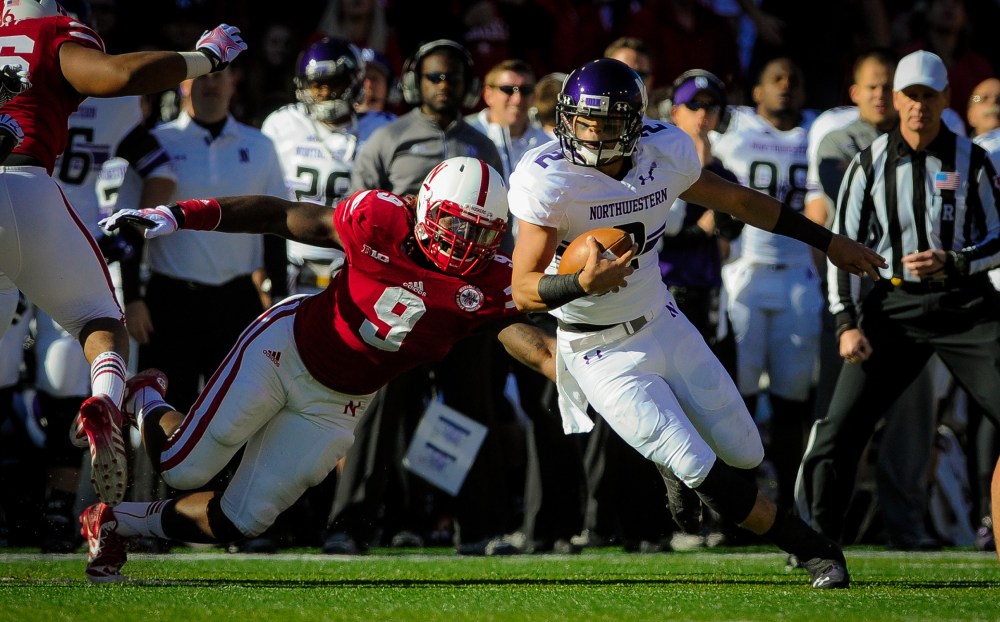
A group of college athletes demanding the right to form a union won their first legal contest on Wednesday afternoon, when the Chicago branch of the National Labor Relations Board (NLRB) approved their petition. NLRB Regional Director Peter Sung Ohr ruled that players on the Northwestern University football team were employees of the school, and therefore legally entitled to union representation.

The publication of Ohr’s ruling [PDF] marks a historic moment in the history of college athletics. For years, the NCAA has argued that college athletes are “student-athletes,” not workers, and that they are therefore not entitled to the workplace rights enumerated in the National Labor Relations Act. Wednesday’s NLRB ruling explicitly rejected that argument, declaring that Northwestern University players are employees of the school who receive scholarships as compensation for their labor.
Former Northwestern quarterback Kain Colter congratulated his teammates on Twitter and thanked Ramogi Huma, the founder of the non-union labor group NCPA (National College Players Association). Huma’s organization has supported the Northwestern players’ labor fight and spent years organizing student-athletes at other schools around the country.
“So proud of my teammates, Ramogi, lawyers, and supporters around the nation,” wrote Colter. “This is a HUGE win for ALL college athletes!”
Wednesday’s ruling was far from inevitable. Last month, shortly after Northwestern players first demanded union representation, Illinois Institute of Technology labor law professor Martin Malin told msnbc that they would “have a really tough row to hoe under current legal doctrine.” Even an NLRB hearing officer involved in the case described the players’ argument as “weak.” As a result, the favorable ruling came as a considerable surprise.
But just because Northwestern players have won a single battle doesn’t mean they’ll win the war. In a statement released shortly after the ruling came down, the Northwestern University administration announced it would appeal the ruling to the NLRB head office in Washington, D.C.
“The University will continue to explore all of its legal options in regard to this issue,” according to the statement. Even if the players win on appeal, they’ll still be a long way away from forming a union. They would then have to win a union election and begin negotiations on a contract. Even then, the university could refuse to recognize the union as a legitimate bargaining agent, kicking off another court battle. The Northwestern University labor struggle is at least months, if not years, away from a resolution. NCAA chief legal officer Donald Remy said in a statement that the organization was “disappointed” with the ruling. “Over the last three years, our member colleges and universities have worked to re-evaluate the current rules,” he said. “While improvements need to be made, we do not need to completely throw away a system that has helped literally millions of students over the past decade alone attend college. We want student athletes — 99% of whom will never make it to the professional leagues — focused on what matters most — finding success in the classroom, on the field and in life.”
Ned Resnikoff is an urban policy analyst, researcher, writer, and editor. His byline has appeared in a variety of publications, including the New York Times, San Francisco Chronicle, Dissent, and The Nation. He writes the newsletter Public Comment, which can be found at publiccomment.blog. Recommended


