








Nearly a year into his second term, President Donald Trump has effectively sidelined scores of diplomats and experts at the State Department and National Security Council and supplanted them with Steve Witkoff, a billionaire real estate developer who uses a private jet for diplomatic travel, has negotiated on a yacht and often works closely with the royal family of Qatar, a Persian Gulf nation smaller than Connecticut.
That reality has sent longtime U.S. allies scrambling to adjust to a new Trump 2.0 American diplomacy — a dramatic shift that extends far beyond upending the traditional alliances with Western European nations that guided the U.S. since World War II. Diplomats from around the world say it’s forcing an overhaul of their own diplomacy and foreign policies to accommodate an American president who appears to prefer working with monarchs and autocrats over leaders of democracies.
Trump administration officials say the narrow, streamlined approach is intentional, generating faster results with fewer people. Longtime diplomats say it’s a path fraught with risks — one that generates celebrated announcements but may inhibit longer-lasting outcomes.
“Compressed negotiations and centralized decisionmaking tend to sideline the broader coalition work required for a durable peace,” said David Cattler, a former senior NATO and Pentagon official. “When negotiations move faster than allied political alignment, particularly in Europe, the result is often a fragile agreement that struggles to hold over time.”
Trump administration officials dismissed the criticism and questioned the effectiveness of traditional approaches.
“It’s ironic that foreign diplomats complain more about President Trump’s efforts to end wars than Joe Biden’s inability to prevent them,” State Department deputy spokesperson Tommy Pigott said in a statement. “Wars broke out under the so-called ‘experts,’ and wars are ending now under President Trump.”
An emirate as a U.S. conduit
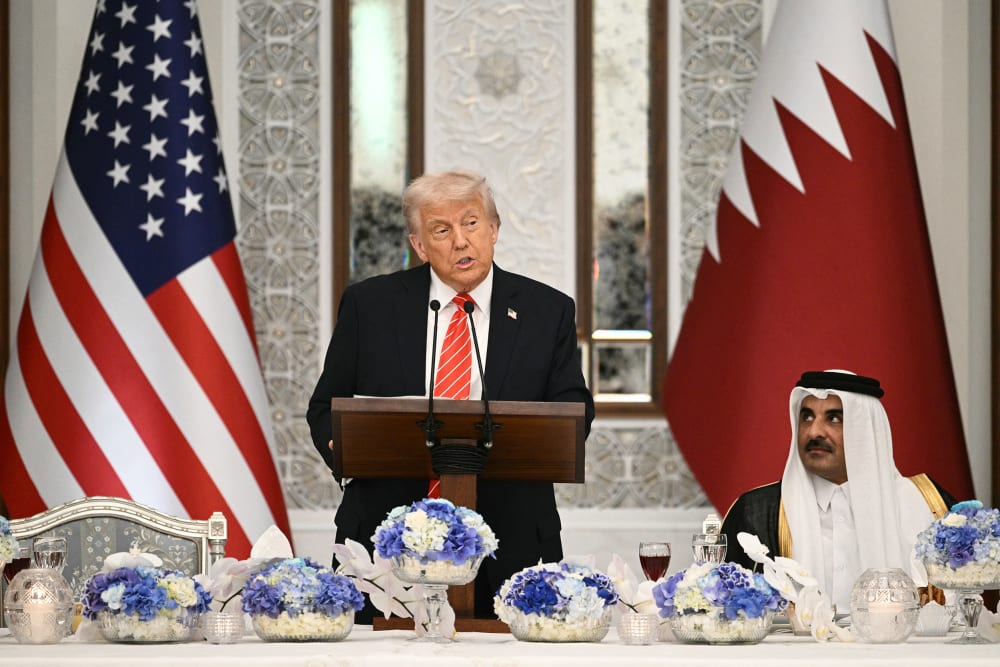
The Trump administration’s relationship with Qatar — a nation roughly the size of Connecticut by landmass, with an annual GDP similar to Kansas’s — perhaps best exemplifies the new American diplomatic order. The emirate has proudly taken a leading role in U.S. negotiations with Russia and Ukraine and the drafting of peace agreements between Israel and Hamas, the Democratic Republic of Congo and Rwanda, and Azerbaijan and Armenia, according to a Middle Eastern diplomat who spoke with MS NOW on the condition of anonymity to more freely provide insight into the growing depths of the White House’s reliance on Qatar.
“Qatar has proven to be the closest strategic ally to the U.S,” the diplomat said.
Qatari officials have essentially turned into Witkoff’s negotiating proxy. They helped prepare an initial 28-point framework proposal with the U.S. to end Russia’s war in Ukraine in early December. That’s a draft critics derided as a Russian “wish list” for requiring Ukraine, for example, to cede land not yet taken by Russian forces.
It’s a diplomatic role once helmed by State Department officials through carefully orchestrated interactions, but now reflects the president’s desire to rely on Middle East monarchies as more flexible, faster conduits.
“We can do stuff you guys cannot,” said the aforementioned Middle East diplomat. “We can speak to people who are designated as terrorists, but you can’t. We can allocate budget and resources for negotiation.”
“We can do stuff you guys cannot,” said the Middle East diplomat. “We can speak to people who are designated as terrorists, but you can’t.”
“You can’t, cause you have to seek budgetary approval and seek congressional approval,” the diplomat added.
Democratic members of Congress have criticized the approach as overly secretive and argue that the public deserves a clear sense of the Trump administration’s activities overseas. They have questioned business deals that the Trump and Witkoff families have struck with Qatar, the United Arab Emirates and Saudi Arabia while conducting diplomacy with them.
This fall, Qatari officials coordinated with the intelligence chiefs of both Egypt and Turkey to push forward direct talks with Hamas. They continue to do so. Over the summer, the Qataris hosted Witkoff on a yacht in the Riviera to engage with individuals party to the Israel-Hamas talks — an atypical venue for high-stakes talks but one which, the diplomat contended, “led to a historic deal that had never been done before.”
U.S. allies in the Middle East say the developments show the failure of traditional diplomatic approaches in recent years.
“President Trump’s methods have had concrete achievements,” a foreign official in the region told MS NOW. “Europe may not have the same risk tolerance or willingness to break the mold that U.S. allies in the Middle East have.”
The Trump administration brushed off concerns about Doha’s outsized influence on U.S. foreign policy, calling the Qataris “a great partner.”
“It’s a good thing that people who are responsible for sustained peace in the Middle East are engaging with critical partners in the region, and that’s how it should be done,” a White House official said.
Frustration over Ukraine
Multiple senior officials in Europe said in recent interviews in London and Brussels that peace talks for Ukraine have been complicated by the small size and top-down nature of Trump’s diplomatic team, which they said sidelines traditional U.S. government experts in diplomacy and national security.
European officials expressed bafflement at Witkoff’s continued prominent role in the Ukraine talks, citing his failure to sometimes bring his own translator to meetings or take detailed notes, and his lack of diplomatic experience. They expressed confidence in Jared Kushner, Trump’s son-in-law, and in Secretary of State Marco Rubio.
One European diplomat said officials on the continent are especially alarmed by Trump administration officials at times openly embracing Russia’s view of the war in Ukraine.
“You are in a situation where you are sitting with high American officials, and the speaking points you get are from Russia,” said the diplomat, who spoke on condition of anonymity with MS NOW in order to convey their frustrations candidly.
European diplomats said they believe only two members of Trump’s inner circle — Witkoff and Kushner — can accurately convey Trump’s thinking and, most importantly to them, potentially influence it.
A White House official praised that approach. “This is not a top-down foreign policy apparatus,” the official told MS NOW. “It’s a feature, not a bug, that all foreign policy actions come from the President of the United States, who was elected, among other reasons, on the basis of his America First foreign policy agenda.”
Trump is “leaning on people who understand his thinking, who share his untraditional background, and the results at this point have been successful,” the official added. A White House official said that after each meeting, Witkoff “briefs necessary national security officials” as well as the president, receives briefings from the Office of the Director of National Intelligence prior to diplomatic trips, and brings note-takers and translators into almost every meeting. Rubio and Vice President JD Vance also provided feedback to Witkoff on the revised 20-point Ukraine peace plan prior to sharing it with Trump, the official said. During a press conference on Friday, Rubio pushed back on the idea that Trump’s reliance on special envoys has sidelined State Department officials and diminished his own power as America’s top diplomat. He praised Witkoff, whom he described as “a phenomenal person, very smart, very talented.” “Steve doesn’t do anything independently; he relies on the interagency” process, Rubio said, adding Witkoff is staffed by State employees “especially as we get to the technical parts of these agreements.” “The synergy there is very tight across the board,” he said. Trump’s reliance on Witkoff carries risks, critics say. A Persian Gulf diplomat not from Iran accused Witkoff of presenting a “bogus misrepresentation of himself as a ‘man of peace’” in negotiations during summer 2025 before Israel and the U.S. carried out airstrikes on Iran. “Mr. Witkoff conducted himself in a manner not befitting the office he represented,” said the diplomat, who spoke on condition of anonymity. A second person who has knowledge of the talks and is not from Iran said Iranian officials now believe they were misled by the U.S. Iranians say the talks with Witkoff were a ruse designed to keep Iran from expecting and preparing for the strikes. “It’s seen by the Iranians as an insult,” said the person with direct knowledge of the talks. Iranian officials did not immediately respond to a request for comment. The White House defended Witkoff and denied the allegations. “The special envoy is a good-faith actor in everything he does,” a White House official told MS NOW, adding Witkoff was actively working towards a deal and was “transparent with everyone.” Witkoff’s continued role The Middle Eastern diplomat who spoke with MS NOW predicted Trump and Witkoff will continue to rely heavily on America’s partners in the Middle East, saying Witkoff “respects us” and “trusts us.” “We have proven we can deliver stuff to him,” the diplomat said. The diplomat acknowledged Witkoff’s lack of traditional foreign policy experience, but said his close relationship with Trump gave him something invaluable: power. “He doesn’t have the experience in diplomacy. He has zero. But he’s an excellent negotiator,” said the Middle Eastern diplomat. “Witkoff is powerful, and he can achieve these agreements.”
David Rohde
David Rohde is the senior national security reporter for MS NOW. Previously he was the senior executive editor for national security and law for NBC News.
Vaughn Hillyard is a senior White House reporter for MS NOW.
Julia Jester covers politics for MS NOW and is based in Washington, D.C.
Ian Sherwood is the director of international newsgathering for MS NOW, a former executive editor for NBC News and a former deputy Washington bureau chief for the BBC. Recommended


Talks with Iran


