








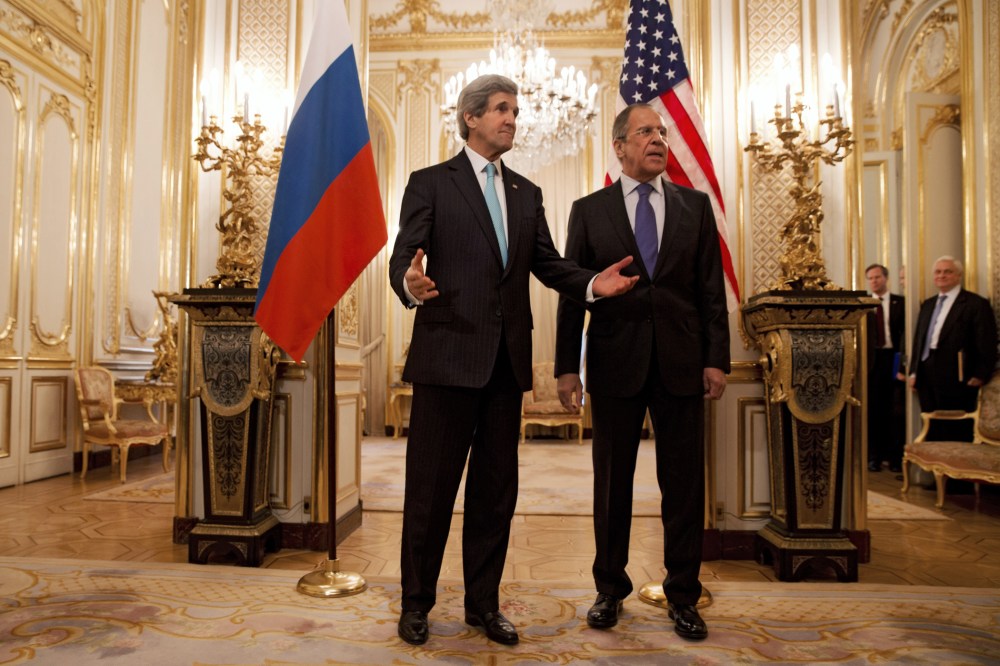
U.S. Secretary of State John Kerry said following a four-hour in-person meeting with Russian Foreign Minister Sergei Lavrov in Paris that the U.S. and Russia agree on the importance of a diplomatic solution to the Ukraine crisis, but that there’s a difference of opinion in exactly how it should get resolved.
“The U.S. is consulting with Ukraine at every step of this process,” Kerry said, stressing that Ukrainians have to be involved in the strategy toward deescalating the political situation.
Discussing the specifics of his conversation with Lavrov, Kerry said that the U.S. “still considers Russia’s actions to be illegal and illegitimate and at odds with international law and on the wrong side of history.”
“A way forward in Ukraine must include a pullback of Russia’s very large military presence on the Ukrainian border,” he said. “We believe it’s creating fear and intimidation. It doesn’t create the climate that we need and the dialogue and the messages to the Ukrainians themselves.”
Kerry explained that both sides made suggestions on how to move forward toward unified democracy. “We talked very seriously about the impact of the amassing of troops along the border and the draw-down of those troops during this process,” he said. Ultimately, Kerry said, “it is Ukrainians that ultimately have to agree to a road ahead.”
Kerry will return to the U.S. to converse with President Obama regarding next steps.
The Sunday meeting comes after a Friday phone call between President Barack Obama and Russian President Vladimir Putin, where Obama said that a diplomatic solution “remains possible only if Russia pulls back its troops and does not take any steps to further violate Ukraine’s territorial integrity and sovereignty,” according to the White House statement.
Though the triggering event for strained relations with Russia was the annexation of Crimea from Ukraine, the focus now is largely on the troops Russia has amassed on Ukraine’s eastern border. In an interview Friday, President Obama said Russia needs “to move back those troops and to begin negotiations directly with the Ukrainian government, as well as the international community.”

Russian Ambassador to the U.S., Sergey Kislyak, is dismissive of the idea that a Russian pullback would include withdrawal from Crimea. “Crimea is a part of the Russian federation,” he told ABC’s George Stephanopoulos on This Week. Kislyak reiterated the Russian assertion that the troops they have mustered are part of “normal exercise” and echoed Lavrov’s statement Saturday on Russian television that Russia “has absolutely no intention of — or interest in — crossing Ukraine’s borders.”
U.S. officials assign little credibility to that claim in light of the military posturing by Russian forces along Ukraine’s eastern border. Speaking Sunday on CNN’s State of the Union, Senator Dianne Feinstein confirmed that U.S. intelligence estimates upwards of 40,000 Russian troops and offered the further characterization that “to people who watch this it looks like an invasion force.”
Michael McFaul, former U.S. ambassador to Russia, pointed out on NBC’s Meet the Press that Putin has already moved on from Crimea and essentially moving the goal posts, acting as if negotiations are about asserting more influence on Ukranian governance, from their constitution to the autonomy of southern and eastern regions that may identify more closely with Russia.
“He’s a revisionist power now. Things that we thought were settled 20 years ago, or at least in ice, he’s now trying to open up the Pandora’s box.” While former CIA deputy director Michael Morell speculated on Sunday’s Face the Nation that Putin’s primary concern is that Ukraine not be admitted to NATO or the European Union, House Intelligence Committee chairman Mike Rogers on Fox News cited other, more specific, concerns about Russian interests in forging “land bridges.” Rogers speculated that more likely than an invasion of eastern Ukraine, Russia would consider connecting Crimea to the Transnistria region via Ukraine’s southern edge. Rogers also considered Russian ambition to connect itself to Iran. “And then I would ask why is he moving the equimpment that he is into South Ossetia up in Georgia, which makes really no sense other than that they’re contemplating maybe using those armored columns to drive through Georgia down to Armenia to create a land bridge from Iran.” In a broad sense, one thing both sides seem to agree on is seeing that the will of the Ukranian people is borne out. While the west sees intimidation and undue influence by Russia in Ukrainian affairs, Russia presents the new Ukrainian government as illigitimate and unrepresentative. “The biggest problem, and you need to remember this, is not between Ukraine and Russia, it’s between the Ukranian temporary government and the rest of the country,” Kislayak told ABC. Former CIA director, General Michael Hayden, agreed to the extent that the would discourage the U.S. from getting ahead of Ukraine in negotiating anything with Russia. “We cannot be negotiating over the heads of the Ukrainian people. What fundamentally matters here is what the Ukranians will for the nature of their state. So we need to be careful not even to project the appearances that we’re negotiating beyond them,” he said on Face the Nation Sunday. News broke Saturday that Vitali Klitschko has pulled out of the race for president of Ukraine. Klitschko, a global boxing celebrity who gained popularity as a politician through the protests that led to the ousting of former president Viktor Yanukovych, has endorsed tycoon Petro Poroshenko. Elections are set to be held on May 25.Recommended


