








Dr. Jonas Salk didn’t miss a beat when Edward R. Murrow asked him, in a 1955 television interview, who owned the patent on the polio vaccine. Salk had recently developed the breakthrough inoculation with his colleagues at the University of Pittsburgh. Millions of school kids were lining up to receive it, and the greatest scourge of the postwar era was receding.
“Well, the people [own it],” Salk replied. “There is no patent. Could you patent the sun?”
The answer made perfect intuitive sense. Salk and his colleagues hadn’t invented the polio virus. It was a product of nature. They had simply discovered that the right injection of killed virus could immunize people against the live one.
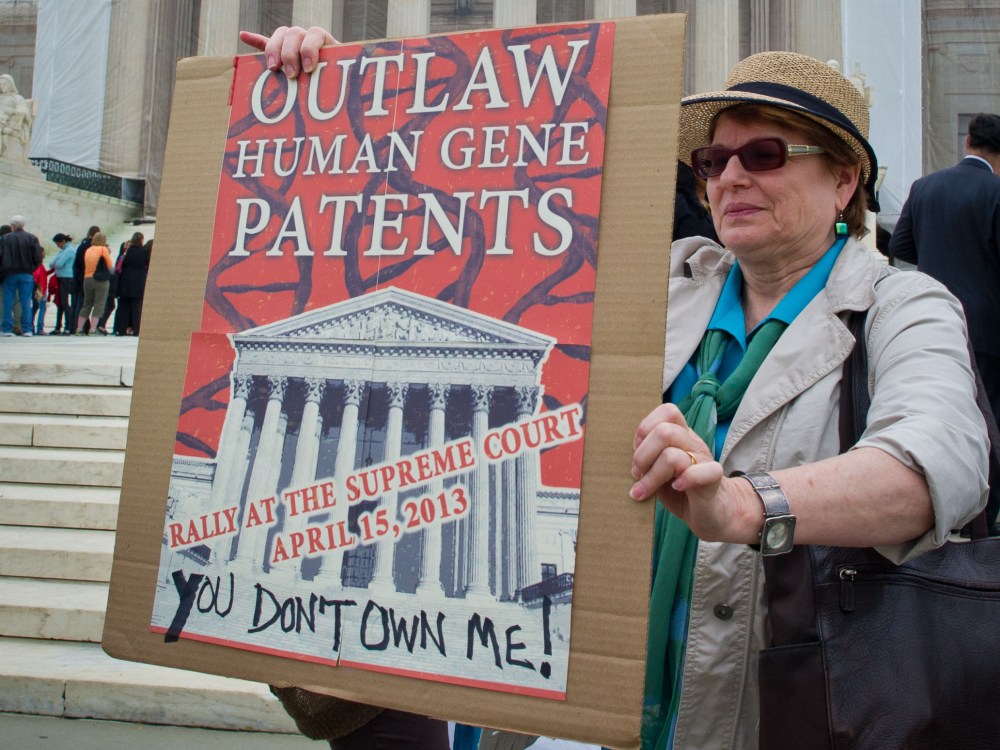
Six decades later, the U.S. Supreme Court is weighing Salk’s hypothetical question in earnest. The case at hand—Association for Molecular Pathology, et al. v. United States Patent and Trademark Office, et al.—has historic implications, not only for scientists and entrepreneurs but for all of us. It’s one of a half-dozen that could yield landmark rulings in the next few weeks. The others involve voting rights, same-sex marriage, affirmative action in school admissions, and the collection of DNA from people under arrest but not yet charged or convicted of crimes.
The question before the court is whether Myriad Genetics, a Utah-based biotech company, can enforce the patents it secured on two human genes during the 1990s. The genes—BRCA1 and BRCA2—foster breast and ovarian cancer when they carry certain mutations, and Myriad markets tests that women can use to determine their own risk.
No one disputes the company’s exclusive right to the tests it developed. But by staking a claim to the BRCA genes themselves, Myriad has impounded a piece of our biology. For nearly two decades, its patents have blocked the use of better, cheaper technologies, forcing patients and insurers to pay $3,000 to $4,000 for tests that would cost less than $100 in an open market. Is this the legitimate exercise of intellectual property rights, as Myriad and its industry believe? Or is it an unlawful effort to patent the sun?
Under the Patent Act of 1952, “human-made inventions” can become private property but “products of nature” cannot. The distinction was still clear in the 1980s, when bioengineers started synthesizing artificial DNA molecules for diagnostic and therapeutic use. These “probes” and “primers” were laboratory inventions, and the Patent Office treated them accordingly. But as genetic science expanded during the 90s, the Patent Office went further, allowing thousands of companies to patent useful segments of naturally occurring DNA (i.e., genes) that scientists had extracted from human chromosomes. The Patent Office reasoned that these naturally occurring genes qualified as “human-made inventions” because scientists had isolated them from their natural surroundings.
Under that controversial policy, Myriad secured patents on the BRCA genes that reside in every human cell. The company also claimed ownership of all possible mutations in those genes, and all possible methods for finding those mutations. For good measure, it also patented the correlations between BRCA mutations and the risk of breast or ovarian cancer. As the ACLU notes in a backgrounder on the case, “anyone who makes or uses a patented gene without permission of the patent holder—whether it be for commercial or noncommercial purposes—is committing patent infringement.”
After securing those rights, Myriad enforced them aggressively, alienating scientists and health advocates at every turn. A coalition representing both groups pushed back in 2009, challenging the patents’ legality, and a federal district court ruled in their favor. The district court found that as “products of nature,” the BRCA genes couldn’t legitimately become private property. But a three-judge appeals panel overturned the ruling, voting two-to-one that Myriad has made the genes more useful by isolating them from the surrounding DNA in human chromosomes. The Supreme Court must now decide who’s right.
Where will the justices come down? Biotech industry analysts are betting the court will side with Myriad. They point to a recent decision in which the justices sided unanimously with Monsanto in its dispute with a farmer who failed to pay royalties on soybeans derived from its own genetically modified variety. But the analogy is imperfect. Unlike the BRCA genes, Monsanto’s patented soybeans differ from anything found in nature. The company reconfigured the natural bean genes to create a plant that would stand up to pesticides. In short, the patent covered an invention, not a “product of nature.” A 2012 case involving the Mayo Clinic and Prometheus Laboratories may offer a better window into the court’s likely position. In that case, Prometheus sued Mayo for developing a test that doctors could use to predict different patients’ reactions to the same class of drugs. Prometheus, which had already patented such a test, claimed (like Myriad) that it owned not only the tool it invented but also the physiological relationships the tool measured. The court rejected that claim, ruling that “the relationships . . . are not themselves patentable” and that a patent on an invention can’t legitimately “monopolize” the natural correlations the invention illuminates. That insight may have been lost on the Patent Office and the biotech industry, but the rest of the world seems to get it. The plaintiffs in the original complaint against Myriad include organizations representing 150,000 scientists, medical groups, women’s groups and anti-cancer activists. And since reaching the Supreme Court, the case has drawn amicus briefs from the U.S. Solicitor General, a host of medical societies and even Nobel laureate James Watson, who co-discovered the structure of DNA in 1953. “A human genome cluttered with no trespassing signs…inhibits scientific progress,” Watson writes in his brief. “The resources devoted to cancer research, neurological diseases, and other areas will be diverted to concerns about whether one can use a particular human gene. For a new assay using hundreds of human genes, the sea of patents and patent applications would create hundreds, if not thousands, of individual obstacles to developing and commercializing the assay. The best way . . . to resolve this problem is to eliminate the unnecessary patenting of human genes.” A ruling to that effect could free the BRCA genes from Myriad’s control. It could invalidate 4,000 other gene patents. And it would broaden the quest for medical knowledge.
Geoffrey Cowley Recommended


