








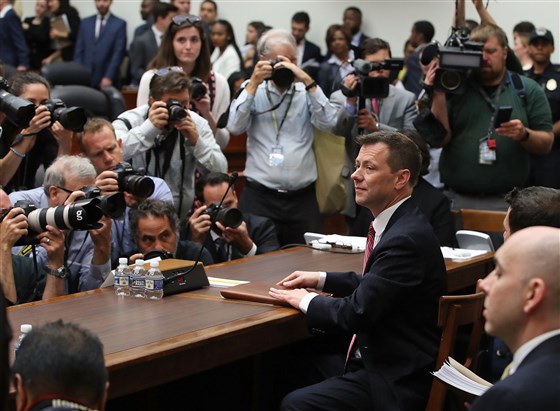
House Republicans made no effort to hide their intentions: they wanted to create a spectacle with a lengthy interrogation of Peter Strzok, who served as the head of the FBI’s counter-intelligence division, and who’s become a boogeyman in Republican circles.

To a degree, GOP lawmakers got their wish. On the heels of 11 hours of closed-door testimony from Strzok, Americans were treated to 10 hours of open-door testimony yesterday, which offered plenty of sound and fury.
But did it signify anything? Yesterday’s drama on Capitol Hill created a circus-like atmosphere, which at times descended into farce, but if we look past the spectacle and focus on the ostensible point of yesterday’s hearings, we’re left with a question Republicans failed to think through.
If Donald Trump and his allies are correct, Strzok was a biased attack dog who conspired to use his role at the FBI to undermine the president’s 2016 candidacy. But if the conspiracy theory were true, why didn’t Strzok do what his critics claim? As a Washington Post analysis explained:
If there was such a conspiracy, of course, it didn’t work. Trump is president and, before the election, there was barely a public whiff that any investigation even existed. If Strzok’s idea was to “stop” Trump from becoming president, it was a spectacular failure.
In a written statement offered before he testified before the House Oversight Committee on Thursday, Strzok pointedly noted that there was no effort on his part to keep Trump from winning the White House — and, further, that he was one of only a few people who could have potentially leaked details from the investigation in an effort to block Trump’s victory.
“In the summer of 2016,” Strzok told lawmakers, “I was one of a handful of people who knew the details of Russian election interference and its possible connections with members of the Trump campaign. This information had the potential to derail, and quite possibly, defeat Mr. Trump. But the thought of exposing that information never crossed my mind.”
This point has gone unrefuted. Strzok could’ve leaked word to the public about the pre-election investigation into Trump’s political operation, but he didn’t. If the high-ranking agent had been determined to use his position to undermine the president’s candidacy, why didn’t he use his position to undermine the president’s candidacy?
It’s a foundational question that effectively answers itself. The entire Trump-driven conspiracy theory is predicated on the idea that Strzok worked behind the scenes to undercut the GOP ticket, which might be more compelling if Strzok made any effort to do that — by, say, alerting voters to the fact that Trump World was the subject of a counter-intelligence investigation.
Strzok could’ve helped bring Trump down. He didn’t. I’m not even sure what more there is to talk about.
Asked yesterday about the “we will stop him” text, Strzok had an important, impromptu response for the committee, which is a little long, but which I think is worth your time:
“Sir, I think it’s important, when you look at those texts that you understand the context in which they were made and the things that were going on across America.
“In terms of the texts that — ‘we will stop it’ — you need to understand that that was written late at night, off the cuff, and it was in response to a series of events that included then candidate Trump insulting the immigrant family of a fallen war hero.
Recommended


“And my presumption based on that horrible, disgusting behavior, that the American population would not elect somebody demonstrating that behavior to be President of the United States.
“It was in no way, unequivocally, any suggestion that me, the FBI, would take any action, what so ever, to improperly impact the electoral process for any candidate. So, I take great offense and I take great disagreement to your assertion of what that was or wasn’t. As to the 100 million to one, that was clearly a statement made in jest and using hyperbole.
“I, of course, recognize that millions of Americans were likely to vote for candidate Trump. I acknowledge that is absolutely their right. That is what makes our democracy such a vibrant process that it is.
“But to suggest, somehow, that we can parse down the words of shorthand textual conversation like they’re some contract for a car is simply, not consistent with my or most people’s use of text messaging.
“I can assure you, Mr. Chairman, at no time in any of these texts did those personal beliefs ever enter into the realm of any action I took. Furthermore, this isn’t just me sitting here telling you. You don’t have to take my word for it.
“At every step, at every investigative decision, there were multiple layers of people above me; the Assistant Director, Executive Assistant Director, Deputy Director and Director of the FBI, and multiple layers of people below me. Section Chiefs, Supervisors, Unit Chiefs, Case Agents and analysts, all of whom were involved in all of these decisions.
“They would not tolerate any improper behavior in my any more than I would tolerate it in them. That is who we are as the FBI. And the suggestion that I, in some dark chamber somewhere in the FBI, would somehow cast aside all of these procedures, all of these safeguards, and somehow be able to do this is astounding to me.
“It, simply, couldn’t happen. And the proposition that that is going on, that it might occur anywhere in the FBI, deeply corrodes what the FBI is in American society, the effectiveness of their mission, and it is deeply destructive.”
For quite a while, Republicans have treated Peter Strzok as a pinata. Yesterday, the pinata hit back.
Steve Benen is a producer for "The Rachel Maddow Show," the editor of MaddowBlog and an MS NOW political contributor. He's also the bestselling author of "Ministry of Truth: Democracy, Reality, and the Republicans' War on the Recent Past."
